New Financial Year, New Compliance: Is Your D2C Brand Ready for April 2026 Waste Mandates?


If you run a D2C brand in India, April 2026 brings multiple compliance requirements into focus.
These are often discussed together, but they operate under different frameworks.
Extended Producer Responsibility (EPR) under the Plastic Waste Management Rules governs what brand owners must do about the packaging waste their products generate.
The Solid Waste Management Rules (2016, as amended, and recent updates notified in January 2026) govern how waste is handled at your facilities.
These frameworks operate separately, but most D2C brands are affected by both. Your obligations depend on where you fall across them.
Framework 1: EPR for Packaging - applies to almost every D2C brand
If you sell products in plastic packaging, EPR compliance is not optional.
Under the Plastic Waste Management Rules and EPR guidelines, you are classified as a Producer, Importer, or Brand Owner (PIBO), with legally binding obligations.
Register on the CPCB EPR Portal
Operating without registration can attract Environmental Compensation. Registration is the starting point for all other compliance.
Declare your packaging identification mechanism
CPCB guidelines require PIBOs to declare a tracking mechanism such as a barcode, QR code, or unique identification on plastic packaging. Implementation timelines and enforcement may vary by category, but this should be treated as an active compliance requirement.
Meet recycling targets
Targets are category-specific based on packaging type (rigid, flexible, multilayer, compostable) and the volume you introduce into the market.
File returns
Returns are typically filed quarterly and annually on the CPCB portal, with timelines notified by CPCB.
If you sell sanitary products
Under solid waste management regulations, sanitary waste must be properly wrapped or disposed of as prescribed. This is one area where both frameworks intersect.
Most lean D2C teams partner with a Producer Responsibility Organisation (PRO). These agencies handle collection and recycling on your behalf and provide documentation required for filings.
Framework 2: Solid Waste Management Rules - applies if you operate a large fulfillment center
Under the Solid Waste Management Rules (2016, as amended, and recent updates), your fulfillment center may be classified as a Bulk Waste Generator (BWG) depending on factors such as waste generation levels, facility size, and operational scale.
If you operate a large warehouse or fulfillment center, it is worth confirming how your local authority classifies your facility.
If you are classified as a Bulk Waste Generator:
Segregate waste at source
Typically into four streams: Wet (organic), Dry (recyclables), Sanitary, and Domestic Hazardous or Special Care waste.
Process wet waste
Through on-site composting or biomethanation, or through authorised service providers where on-site processing is not feasible.
Register and report as required
Registration and reporting requirements are defined by local authorities and may also be integrated into CPCB systems as they evolve.
Maintain compliance records
Track waste generation, handling, and disposal practices.
Non-compliance can attract Environmental Compensation levied by State Pollution Control Boards under the Polluter Pays principle.
Quick self-assessment
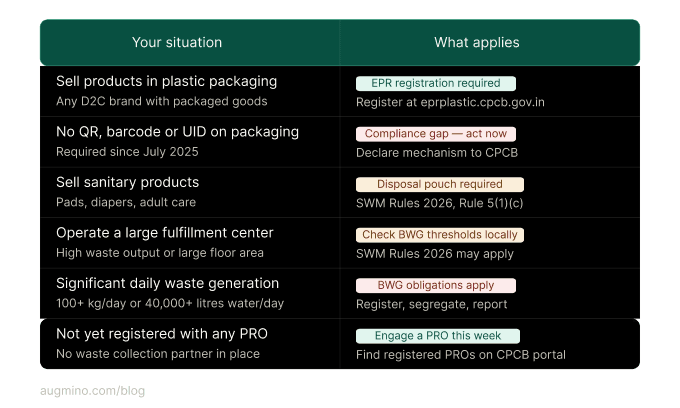
What to do this week
Check your EPR registration status
If you are not registered on the CPCB portal, this is the immediate priority.
Review your packaging compliance
Ensure you have declared and implemented a tracking mechanism aligned with CPCB guidance.
Assess your fulfillment operations
If you operate a warehouse, check how your local authority classifies your facility under waste management rules.
Engage early if needed
PROs or local waste management partners can help operationalise compliance faster.
Final thought
The compliance burden here is not new. What is changing is enforcement and visibility.
The cost of fixing this early is predictable.
The cost of being flagged later is not.
See Also
Frequently asked questions
Do EPR rules apply to small D2C brands or only large companies?
EPR applies to all brand owners regardless of size. If your brand name appears on packaging, you are classified as a PIBO and must register. There is no standard turnover-based exemption.
What is the difference between EPR and solid waste management rules?
EPR governs what brand owners must do about packaging waste including registration, recycling targets, and reporting. Solid waste management rules govern how waste is handled at facilities, particularly for larger generators. Both may apply to the same business.
Do I need to verify vendors for EPR compliance?
Yes. If you are working with recyclers, PROs, or packaging suppliers, ensure they are registered on the CPCB portal where applicable. Using unregistered entities can create compliance risks.
When are the filing deadlines?
EPR filings are typically half-yearly and annual, with timelines notified by CPCB. For bulk waste generators, reporting timelines are defined by local authorities and may align with annual reporting cycles.
Who needs to register for EPR compliance?
Any business that introduces plastic packaging into the market under its brand name is typically classified as a Producer, Importer, or Brand Owner (PIBO) and must register on the CPCB EPR portal. This applies across company sizes.
What should I prioritise first for EPR compliance?
Start by confirming your registration on the CPCB portal, reviewing your packaging declarations, and ensuring your recycling or PRO arrangements are in place. These are the foundation for all further compliance.
Are EPR deadlines fixed across all businesses?
Filing timelines are typically defined by CPCB and may vary slightly based on category and updates. Businesses should regularly check portal notifications to stay compliant.
Ready for fewer, better conversations?
Augmino connects verified Indian manufacturers with buyers who mean business.
Apply to Join