How to Verify a Supplier in India: The Complete Checklist Before Your First Order


You found a supplier. They responded to your RFQ. The quote looks competitive. The samples look good. Everything points to placing your first production order.
This is the moment most buyers make their most expensive mistake. They place the order on price and sample quality alone, without verifying whether the supplier can reliably deliver at scale.
A sample proves a supplier can make one part correctly, once, under conditions they controlled. It does not prove they can make five hundred parts next month, or five thousand the month after, at the same quality, on time, every time.
Verifying a supplier in India comes down to six stages before that first order ships: legal, export, and financial legitimacy, certifications, trade references, physical verification (which is also where you assess production capability and quality systems), commercial terms, and finally samples with pre-shipment inspection. No single stage is proof on its own. Together, they are the closest thing to certainty a buyer gets before committing real volume.
A few signs you are about to skip this process:
- You are moving to a production order on sample quality and price alone.
- Nobody on your side has visited the factory or paid for an independent inspection.
- Your only reference is whichever contact the supplier handed you.
- You are taking certificate numbers at face value instead of checking them with the issuing body.
- You have not confirmed the company is legally registered to do what it says it does.
If two or more of these are true, the rest of this guide is written for you.
The verification sequence
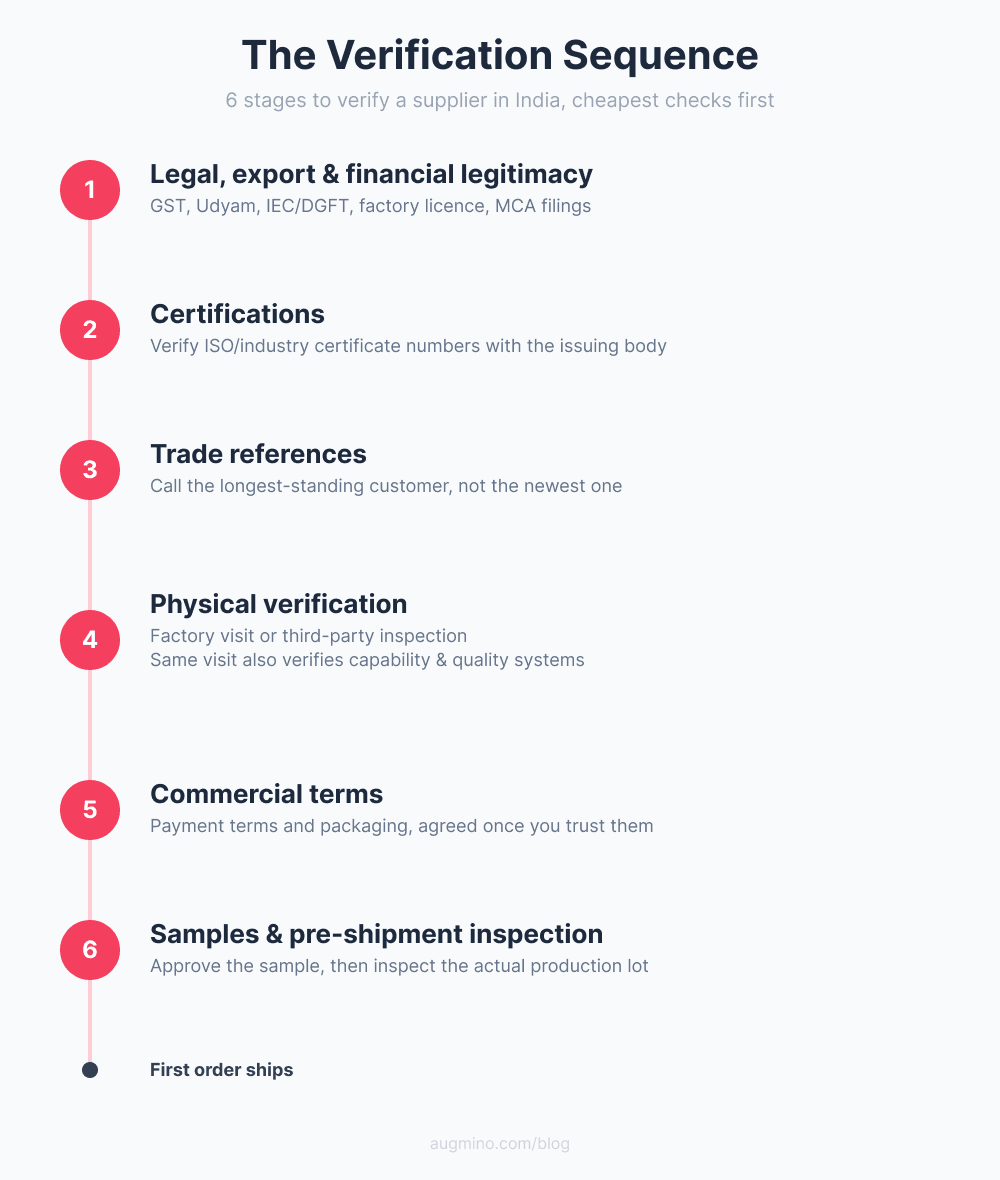
The order below is not arbitrary. It runs cheapest and most disqualifying first, most expensive and most relationship-dependent last, so you never spend money on a factory visit or an inspection before confirming the supplier is even legally real.
- Confirm legal, export, and financial legitimacy. Free, remote, and fast, and any one of these can be a hard stop.
- Verify certifications directly with the issuing body.
- Check trade references, specifically, not superficially.
- Complete physical verification, a factory visit or a third-party inspection. This is also how you assess production capability and quality systems. They are not separate trips.
- Agree commercial terms.
- Inspect samples, and require pre-shipment inspection before the container loads.
Each stage is covered in detail below, in the same order. Work through the full sequence before a first order, or jump straight to the stage you need.
Stage 1: Legal, export, and financial legitimacy
Everything in this stage can be checked from a desk, most of it for free, in a single sitting. Do it before you spend any more time on this supplier. If something here does not check out, stop. Nothing later in the sequence matters if the entity you are dealing with is not who or what it claims to be.
1. Valid GST registration
Confirm the supplier's GSTIN is active. You can verify this on the GST portal. An inactive or cancelled GSTIN means you cannot claim input tax credit on your purchases, which directly affects your cost structure.
2. Udyam registration (if MSME)
Confirm whether the supplier is Udyam-registered, and verify the registration number directly on the Udyam portal against the company name. It is free and quick to check, and it is a basic legitimacy signal: an entity that has registered under a government MSME scheme is easier to trace and cross-verify than one that has not bothered.
It also tells you which size bracket the supplier sits in. The classification thresholds were revised effective 1 April 2025: micro now goes up to Rs 2.5 crore investment / Rs 10 crore turnover, small up to Rs 25 crore / Rs 100 crore, medium up to Rs 125 crore / Rs 500 crore, roughly double to 2.5x the pre-2025 limits. A supplier's bracket, and the scale of operation you should expect from them, may have shifted even if nothing about their business changed.
Source: MSME classification revision, Union Budget 2025, effective 1 April 2025.
3. IEC and DGFT export credential check
Ask for the supplier's Import Export Code, a ten-digit number issued by the Directorate General of Foreign Trade. Any company legally exporting from India holds one. You can verify the code and the registered company name directly on the DGFT website, free of charge, in a couple of minutes. This is the one check on this list that is a genuine binary knockout for a foreign buyer specifically: without a valid IEC, the supplier cannot legally export to you at all, regardless of how good their capability or samples look.
There is a second check worth adding as of 2026. DGFT now requires every IEC holder to complete an annual updation on the portal between 1 April and 30 June each year, even when nothing about the business has changed. Miss the window and the IEC is automatically deactivated, which blocks the supplier from trading under it until they reactivate it. A supplier who has not touched their IEC updation this cycle may be operating on a technically deactivated code without realizing it. Ask when they last completed the annual updation, not just whether the code exists.
A supplier who claims years of export experience but hesitates to share a verifiable IEC, or whose registered name does not match who you are actually dealing with, is worth a direct question before you go any further.
Source: DGFT annual IEC updation requirement, Foreign Trade Policy provisions administered via the DGFT portal.
4. Factory licence and pollution control board consent
Confirm the supplier has a valid factory licence under the Factories Act, 1948, and a Consent to Operate from the State Pollution Control Board. These are not optional for manufacturers. A missing licence can lead to a factory shutdown that disrupts your supply chain with no warning.
5. Financial stability indicators
You do not need to audit the supplier's books. But check a few basic indicators, and do it now, alongside the other desk checks, not at the end of the process. Are they registered on the MCA portal? When was their last annual filing? Has any insolvency action been filed against them? A quick check on the Ministry of Corporate Affairs website, or through a business information provider, can surface red flags early. Placing a large order with a financially distressed supplier is a risk that shows up as delayed deliveries and quality shortcuts, and it costs nothing to rule out before you go further.
Stage 2: Certifications
6. ISO or industry-specific certifications
ISO 9001 is the baseline for quality management. Depending on your industry, you may need IATF 16949 (automotive), AS9100 (aerospace), ISO 13485 (medical devices), or ISO 22000 (food safety). Ask for the certificate, verify the certificate number with the issuing body or through the IAF CertSearch database, and check the expiry date. An expired certification is worse than none, because it suggests the supplier let their quality system lapse without renewing it.
Stage 3: Trade references
7. Longest-standing customer reference
Ask for the supplier's longest-standing customer, not their newest. A relationship nine months old has not had time for anything to go wrong yet. One that has run for several years has usually survived a late shipment, a failed batch, or a slow quarter, and the reference can tell you exactly how the supplier behaved when it did.
A useful answer names a specific problem and what changed afterward. "No issues, they're great" after years of orders tells you less than it sounds like. It could mean an unusually smooth run. It could also mean the reference is not going to volunteer the rough one unless you ask again.
This is worth a real phone call, not a box to tick. For the exact questions to ask and a strong-versus-weak scorecard, see [A Buyer's Reference-Check Script for Industrial Suppliers].
Stage 4: Physical verification, production capability, and quality systems
Everything up to this point can be checked from a desk. This stage cannot, and it is where the real cost of verification sits.
A machine list on paper does not tell you whether those machines are running, sitting idle, or were sold off six months ago. A capacity claim does not tell you whether the floor has fifteen operators covering fifty machines. The only way to know is to see it, or pay someone who can.
8. Physical verification: factory visit or third-party inspection
If you can visit the factory yourself, do it before the first production order, not after. Walk the floor. Count the machines against the list you were given. Notice whether the equipment looks in regular use or staged for the visit. Ask to see a job running that is not yours.
If a visit is not practical, a third-party inspection is the next best option. Agencies such as Bureau Veritas, SGS, and Intertek, along with a number of India-based inspection firms, will send an inspector to the factory on your behalf. A typical report confirms the machine list and count against what was claimed, checks equipment condition and calibration records, verifies workforce presence, and includes dated photographs. The cost of one inspection is small next to the cost of a bad production run discovered after the fact.
Treat resistance to either option as information in itself. A supplier confident in their own operation has little reason to resist a visit or an inspection they are not funding.
This single engagement, whether you run it yourself or a paid agency does, is also how you assess the two things below. Production capability and quality systems are not separate site visits. They are what the visit is actually verifying.
What the visit verifies: production capability
9. Machine list and capacity utilisation
Ask for a machine list with make, model, and year of installation. Cross-reference it against the tolerances and volumes your requirement demands. A supplier with three CNC machines running at 85 percent utilisation has very little buffer for your order. Ask what their current capacity utilisation is and how they plan to accommodate your volume.
10. Material sourcing and traceability
Where does the supplier source raw material? Do they have established relationships with material suppliers, or do they buy from the spot market? For critical applications, ask if they can provide material test certificates from the mill. Traceability from raw material to finished part is not a luxury. It is a quality requirement for any application where failure has consequences.
11. Workforce stability
A factory with fifty machines and fifteen operators is not running at full capacity, regardless of what the capacity sheet says. Ask about workforce size, shift patterns, and attrition rates. High attrition in manufacturing often means quality problems, because new operators make more errors.
12. Tooling and fixture ownership
If the supplier needs to make tooling or fixtures for your part, clarify who owns them. Industry practice varies. Some suppliers build tooling costs into part pricing. Others charge separately and retain ownership. Get this in writing before production begins. If you need to move to a different supplier later, you need your tooling to move with you.
What the visit verifies: quality systems
13. Inspection equipment and capability
What inspection equipment does the supplier have? For precision manufacturing, a coordinate measuring machine (CMM) is essential. For surface finish, a profilometer. For hardness, a hardness tester calibrated to the relevant standard. Ask when the last calibration was done and by whom. Inspection equipment that has not been calibrated in two years is decoration, not quality control.
14. First Article Inspection (FAI) process
Does the supplier have a formal FAI process? Before production begins, the supplier should produce a small batch, inspect every dimension, and submit a detailed inspection report with measured values against drawing tolerances for every critical dimension. If the supplier does not have a standard FAI template, that is a red flag.
15. Non-conformance and corrective action process
What happens when a defective part is found? Does the supplier have a documented non-conformance report (NCR) process? Do they investigate root causes, or simply replace the part? A supplier without a corrective action process will repeat the same mistake on your next order.
16. Process documentation
Does the supplier document their manufacturing process, with work instructions, setup sheets, and control plans? Process documentation ensures the same part is made the same way every time, regardless of which operator runs the machine. Without it, quality depends entirely on who happens to be working that day.
Stage 5: Commercial terms
By this point the supplier has passed every check above. What is left is not verification, it is negotiation: agreeing terms with a supplier you already trust enough to take seriously.
17. Payment terms alignment
Discuss payment terms explicitly. Standard terms in Indian manufacturing range from 30 to 60 days. If the supplier insists on 100 percent advance payment for a production order, not a prototype, understand why. It may indicate cash flow stress, which is relevant to delivery reliability. Get whatever you agree on in writing before production begins.
18. Packaging and logistics capability
This is the most frequently overlooked item. Can the supplier pack parts to survive transit? For precision components, that means individual wrapping, shock-absorbing material, and proper labelling. For export orders, it means compliance with ISPM 15 for wooden packaging. Ask the supplier to show you how they packed the last shipment, not how they plan to pack yours. What they are already doing is what you will get.
Stage 6: Samples and pre-shipment inspection
A sample and a production shipment are not the same verification. A sample confirms the shop can make one part correctly under close attention. Pre-shipment inspection confirms the actual production lot, the one about to leave the factory, meets the same standard at volume.
19. Sample approval against drawing
Check the sample's dimensions and finish against the drawing before you approve it. This is the baseline every later check gets compared against.
20. Pre-shipment inspection (PSI)
Before the container loads, a pre-shipment inspection checks a random sample drawn from the finished lot against agreed quality limits, commonly using the AQL sampling method defined in ISO 2859-1, verifies dimensions and finish against the drawing, and confirms packaging and labeling match what was agreed. This is a different check from the FAI in Stage 4. FAI proves the process can produce a conforming part. Pre-shipment inspection proves this specific batch did.
The same third-party agencies that handle factory audits typically offer pre-shipment inspection as a separate, lower-cost service. For a first order of meaningful size, treat it as close to non-negotiable. Catching a dimensional drift or a packaging problem before the shipment leaves India costs a re-inspection. Catching it after costs the shipment.
Red flags to watch for
A few signals, seen together or repeated, are worth treating as a stop sign rather than a note:
- Certificates that are expired, or whose numbers do not check out with the issuing body.
- Reluctance to allow a factory visit or a third-party inspection paid for by you.
- No usable trade reference, or every reference offered is less than a year old.
- Hesitation or evasiveness about sharing a verifiable IEC.
- No standard First Article Inspection template or process.
- Workforce numbers that do not add up against the machine count and claimed capacity.
- Insistence on full advance payment for a production order, not a prototype.
None of these confirms a bad supplier by itself. Together, or repeated, they tell you the paperwork is not matching reality. For the fuller picture, see 5 Red Flags When Evaluating a New Manufacturing Supplier and Red Flags When Vetting a Manufacturing Partner Remotely.
How to use this checklist: a scorecard, not a questionnaire
Do not send this whole checklist as a questionnaire. Suppliers get too many of those, and most go unanswered.
Use it instead as a framework for a site visit, a structured video call, or an inspection agency's scope of work. Work through it in the order above: legal, export, and financial legitimacy first, because these are free, remote, and can end the process outright; certifications and trade references next, because they are still cheap and worth doing before you commit real time; physical verification after that, because it is the most expensive stage, and it is also where you actually assess production capability and quality systems in the same visit; commercial terms and the final shipment checks last, once you already trust the supplier enough to negotiate seriously.
Score each area, not each individual point, using the table below. The downloadable template at the top of this page is structured the same way.
| Verification area | Looks verified | Should give you pause |
|---|---|---|
| Legal, export & financial legitimacy | GST, Udyam, IEC, factory licence, and MCA filings all check out against the issuing source, free and fast | Numbers unverifiable, or the supplier resists sharing them directly |
| Certifications | Certificate numbers verified with the issuing body or IAF CertSearch, not expired | Expired certification, or a number that does not check out |
| Trade references | Longest-standing customer offered without hesitation, names a specific resolved problem | Only recent references offered, or answers stay vague after a follow-up |
| Physical verification | Visit or third-party inspection completed | Supplier resists a visit or an inspection they are not funding |
| Production capability | Machine list, workforce, and tooling terms confirmed and consistent with what the visit showed | Capacity claims do not match workforce or machine count seen on the visit |
| Quality systems | Calibrated inspection equipment, a real FAI process, documented NCR handling | No FAI template, no corrective-action process, stale calibration |
| Commercial terms | Payment terms and packaging practice agreed in writing, demonstrated from a real shipment | Full advance demanded on a production order, no packaging shown from a real order |
| Samples & pre-shipment inspection | Sample matches drawing; PSI confirms the production lot before it ships | Sample approved, but no inspection of the actual shipped lot |
The point is not to find a perfect supplier. The point is to know what you are working with before the first order ships.
See Also
Download
Supplier Verification Checklist for India Template
CSV · 3.7 KB
Share your details below and we will start your download.
Frequently asked questions
How do I verify a supplier in India before placing an order?
Work through six stages: legal, export, and financial legitimacy (free, remote checks that can end the process outright), certifications verified with the issuing body, trade references (specifically the supplier's longest-standing customer), physical verification through a factory visit or third-party inspection (which is also how you assess production capability and quality systems), commercial terms, and finally sample approval with pre-shipment inspection before the shipment leaves. No single stage is proof on its own; together they show whether the supplier can deliver at scale, not just on a sample.
How do I verify if a supplier is ISO certified?
Ask for the ISO certificate, note the certificate number and issuing body, then verify directly with the certification body or through the IAF CertSearch database. Check the expiry date. An expired certificate means the supplier's quality management system has not been audited recently.
How long does it take to fully verify a new supplier in India?
Legal, export, and financial checks (GST, Udyam, IEC, MCA) can usually be done online within a day. Certifications and trade references typically take a few days more to arrange and confirm. Scheduling a factory visit or third-party inspection is usually the longest step, one to two weeks. Budget two to four weeks from first contact to a fully verified supplier ready for a first production order, depending on inspection agency availability and how quickly the supplier responds to requests.
Why is First Article Inspection important when onboarding a new supplier?
First Article Inspection verifies that the supplier can produce parts to your specification before full production begins. The supplier produces a small batch, measures every critical dimension, and submits a detailed report comparing measured values against drawing tolerances. This catches issues before they become expensive production defects.
How do I check a supplier's financial stability in India?
Check the Ministry of Corporate Affairs (MCA) portal for the supplier's annual filing status and any insolvency proceedings. For additional detail, business information providers offer credit reports on Indian companies. A supplier that has not filed annual returns for two or more years is a potential risk. Do this early, alongside your legal checks, not after you have already invested time in the relationship.
What payment terms are standard in Indian manufacturing procurement?
Standard payment terms range from 30 to 60 days from invoice date. Some suppliers may request partial advance for new customers or custom tooling. Get payment terms in writing before production begins.
How do I verify a supplier's IEC and export credentials in India?
Ask for the supplier's Import Export Code and check it directly on the DGFT (Directorate General of Foreign Trade) website, which lists the registered company name against the code. This confirms the entity is legally authorized to export and that the name on the code matches who you are actually dealing with. Also ask when they last completed the mandatory annual IEC updation, due every year between 1 April and 30 June. A code left unupdated past 30 June is automatically deactivated by DGFT.
Should I use a third-party inspection agency to verify an Indian supplier?
If you cannot visit the factory yourself, yes, particularly before a first production order of meaningful size. Agencies inspect the machine list, workforce, and equipment condition against what the supplier claimed, and provide a dated report. The cost is small relative to the cost of a production run gone wrong.
What is pre-shipment inspection and do I need it?
Pre-shipment inspection checks a random sample from the actual finished production lot, not an earlier approval sample, against your drawing and agreed quality limits before the shipment leaves the factory. For any first order of real volume, it is close to essential. It catches problems while they can still be fixed at the factory, not after the container has left India.
What are the biggest red flags when verifying a new supplier in India?
Certificates that do not check out with the issuing body, resistance to a factory visit or a paid third-party inspection, no usable trade reference older than a year, evasiveness about sharing a verifiable IEC, and insistence on full advance payment for a production order rather than a prototype. None of these confirms a bad supplier alone, but two or more together are a reason to slow down.
Ready for fewer, better conversations?
Augmino connects verified Indian manufacturers with buyers who mean business.
Apply to Join