Why 400 Enquiries a Month Is Costing Your Business More Than You Think


There is a number that B2B marketplace platforms love to put in their sales pitch: 400 leads a month. Sometimes it is 300. Sometimes 500. The exact number does not matter. The pitch is always the same. More visibility. More enquiries. More growth.
It sounds like exactly what a growing manufacturer needs. Until you sit with the team that has to respond to those 400 enquiries and watch what actually happens.
In a typical scenario, out of 400 enquiries, roughly 320 get a response. The team filters through them, makes calls, and sends quotes. Of those 320, about 60 are remotely qualified. They have a real requirement, a real timeline, and at least some indication of a budget. Of those 60, maybe 18 get to the quotation stage. And of those 18, somewhere between 3 and 5 become actual orders.
That is a conversion rate below 1.5%. On a service that costs between Rs.40,000 and Rs.80,000 per year.
This article breaks down the real cost of those 400 enquiries. Not just the subscription fee. The team time, the opportunity cost, the damage to your sales pipeline, and the hidden tax that nobody puts in a spreadsheet. At the end, there is a downloadable audit template you can use to measure lead quality on any platform you currently use.
The maths that platforms do not show you
Let us put real numbers to a scenario that many Indian manufacturers live through every month.
A CNC machining shop in Rajkot pays Rs.50,000 per year for a paid listing on a major B2B marketplace. They have one person who spends most of their day handling incoming enquiries, making qualification calls, and following up. That person costs roughly Rs.20,000 per month including overheads. That is Rs.2.4 lakh per year in people cost allocated to lead processing.
Total annual cost of the lead channel: Rs.2.9 lakh (subscription + team time).
Now look at the output. At a 1% order conversion rate on 400 enquiries per month, that is 4 orders per month, or 48 orders per year. The cost per acquired order from this channel alone is roughly Rs.6,000.
But that number only captures direct costs. It misses what that team member could be doing instead, the time spent preparing quotes for buyers who were never going to order, and the fatigue that builds after the 200th dead-end conversation.
The five types of junk enquiries
Not all bad leads are the same. Understanding the categories helps you identify how much of your pipeline is real and how much is noise.
1. The browser. This person is researching, not buying. They are comparing options, collecting information, maybe building a report for a boss who has not approved any purchase yet. They ask for a quotation but have no timeline, no quantity, and no budget. They will never respond to your follow-up. Browsers often account for 30 to 40% of enquiries based on internal observations and manufacturer conversations.
2. The student or researcher. College students doing industry projects, consultants mapping a market, competitors checking your pricing. They send well-worded enquiries that look real but have zero purchase intent. Experienced sales teams can usually spot these, but they still consume response time.
3. The wrong category match. A buyer looking for corrugated packaging sends an enquiry to a rigid box manufacturer because the platform's search lumped them together. A buyer searching for 5-axis CNC milling reaches a shop that only does turning. The platform treats all enquiries as equal because its revenue comes from volume, not from relevance.
4. The budget mismatch. The buyer's expectation is Rs.50 per piece. Your minimum viable price is Rs.180. Neither party knows this until two emails and a phone call later. A budget band in the requirement would have saved both sides 45 minutes. But the platform does not require it because adding friction reduces enquiry volume, and enquiry volume is the metric that sells subscriptions.
5. The data scraper. Competitors and aggregators systematically collect pricing, capability information, and contact details from your responses. One manufacturer in Pune told us he discovered a competitor had built an entire pricing database from his quotation emails. These actors make up a small but persistent fraction of enquiry volume.
The hidden cost: team capacity and response quality
Here is what happens to a sales team that processes 400 enquiries per month. They develop a pattern. Because 85% of the enquiries lead nowhere, the team starts treating every enquiry with the same low level of effort. Quick template response. Minimal customisation. Move on to the next one.
This is rational behaviour. When 340 out of 400 contacts are not worth a detailed response, investing 30 minutes in a personalised quote feels like a gamble. The team learns to play the odds.
The problem is that the 15% of genuine, qualified buyers also receive this template treatment. The serious buyer who sent a detailed RFQ with specifications, quantities, and a timeline gets the same one-paragraph response as the student doing a college project. And the serious buyer notices.
According to studies by Harvard Business Review and InsideSales, responding to a qualified lead within 5 minutes makes you 21 times more likely to convert it compared to waiting 30 minutes. When your team is buried under 400 enquiries, response time for the good ones stretches from hours to days. The leads that could have become orders are lost to a competitor who responded faster.
This is the real cost of lead volume. It is not just the subscription. It is the degradation of your sales capacity. Your best people are spending their energy on the worst leads, and by the time a good lead arrives, they are too exhausted or too cynical to recognise it.
What the subscription fee is actually buying
The standard B2B marketplace subscription is structured around one promise: more visibility leads to more enquiries. The pricing reflects that.
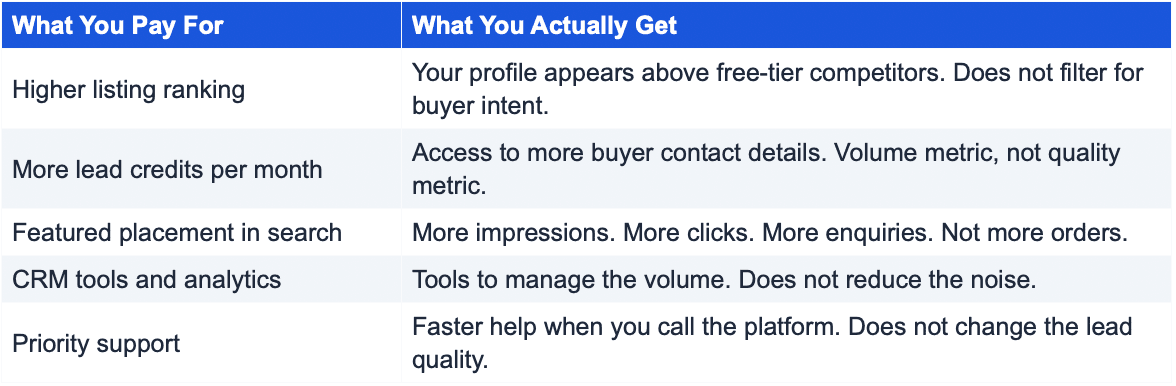
None of these features address the fundamental problem: the platform makes money when you see more enquiries, not when you close more orders. The incentive is to maximise the number of buyer actions, regardless of whether those actions represent real purchase intent.
This is not a criticism of any specific company. It is a structural observation about how the B2B marketplace model works. When revenue comes from subscriptions that promise volume, volume is what gets optimised.
The cost-per-order calculation
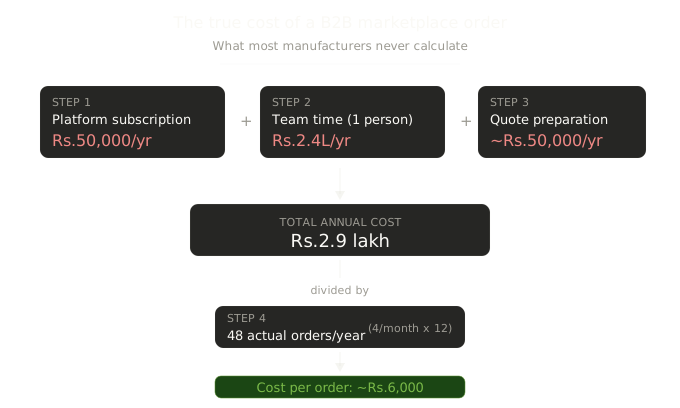
Most manufacturers track their marketplace subscription as a single line item. That often understates the true cost by 3 to 5 times. Here is how to calculate the real number.
Step 1: Total annual platform cost. Add the subscription fee, any additional lead credit purchases, any premium listing charges, and sponsored listing fees. For most mid-tier subscriptions, this is Rs.40,000 to Rs.1.2 lakh per year.
Step 2: Team cost allocated to lead processing. Count the hours your team spends on enquiry response, qualification calls, and follow-ups for leads from this channel. Multiply by the hourly cost (salary divided by working hours). Most shops with 200+ monthly enquiries have at least one person spending the majority of their time on this, which is Rs.1.5 to 3 lakh per year in allocated cost.
Step 3: Quotation preparation cost. Technical quotations for CNC machining or custom packaging are not trivial. Each one involves material costing, process estimation, and sometimes a drawing review. If your team prepares 15 to 20 detailed quotations per month from platform leads, and each takes 1 to 2 hours, that is another 20 to 40 hours monthly of technical capacity.
Step 4: Count actual orders from platform leads in the last 12 months. Not leads. Not quotations. Orders. Signed POs with advance payments.
Step 5: Divide total cost (steps 1+2+3) by total orders (step 4). This is your true cost per acquired order from the platform.
When manufacturers run this calculation for the first time, the number usually surprises them. Based on our analysis of manufacturer data, cost-per-order figures often fall between Rs.4,000 and Rs.15,000 for shops doing standard CNC machining. For a job that might generate Rs.50,000 to Rs.2 lakh in revenue, that acquisition cost is often 5 to 15% of the order value.
Compare that to orders from referrals, which often convert at significantly higher rates, sometimes in the 40 to 60% range.
Why referrals work and platforms struggle
The comparison with referrals reveals the core issue. When a trusted buyer refers you to another buyer, several things are already established before the first conversation happens.
- The buyer knows you are real. Your capabilities are vouched for.
- The buyer has a genuine requirement. Nobody asks for a referral as a browsing exercise.
- There is implicit trust. The referral source's reputation is on the line.
- The buyer is usually ready to move. Referrals happen when someone needs a solution, not when they are casually exploring.
On a B2B marketplace, none of these conditions exist. The buyer does not know if you are real. You do not know if the buyer is real. There is no trust infrastructure between you. The platform connects you based on keyword match, not on verified capability or intent.
This is not a technology problem. It is a model problem. The marketplace model was built to maximise connections. What manufacturing procurement actually needs is fewer, better connections where both sides have been verified before the first conversation happens.
What to do about it: A practical framework
This is not about cancelling your marketplace subscription tomorrow. For many manufacturers, it is still the only digital channel generating any enquiries. But there are steps you can take right now to measure and improve the quality of what you are getting.
1. Start tracking cost per order, not cost per lead. Use the five-step calculation above. Run it monthly. If the number is above 15% of your average order value, the channel is not working.
2. Qualify faster. Create a 3-question qualification script for your team. Before spending any time on a detailed quotation, confirm: does the buyer have a specific quantity? Do they have a timeline within 60 days? Have they sourced this type of product before? If the answer to all three is no, send a templated response and move on.
3. Track your response time for qualified leads separately. If a qualified lead comes in and you respond within 30 minutes, your conversion rate will be measurably higher than if you respond in 24 hours. Do not let junk leads bury the real ones.
4. Ask where your best orders actually come from. Look at your top 10 orders from last year. How did those buyers find you? If the answer is referrals, industry events, or direct search, you know where your real acquisition channels are.
5. Evaluate platforms on conversion rate, not lead volume. Any platform that sells you "more leads" without telling you the expected conversion rate is selling you noise. The platforms worth paying for are the ones that can tell you how many of their introductions turn into actual business.
The shift that is coming
The B2B marketplace model was built in the early 2000s when the primary problem was discovery. Buyers could not find suppliers. Suppliers could not find buyers. The internet solved that problem. It solved it so well that we went from too few connections to too many.
The next generation of sourcing infrastructure will not optimise for volume. It will optimise for outcomes. Verified suppliers. Qualified buyers. Introductions that lead to actual business. Where every recommendation explains why it was made, every participant is verified before they contact you, and success is measured by orders closed, not enquiries generated.
This is the gap that newer sourcing models are trying to solve. Instead of maximising volume, the focus is shifting toward verified suppliers, qualified buyers, and introductions that are more likely to convert into real business. Augmino is one attempt in that direction, focused on creating a trust layer where fewer, better connections replace the noise. If you are interested in being an early user, you can join the waitlist.
Download: the B2B Lead Quality Audit Template
We have built a simple spreadsheet template that helps you run the cost-per-order calculation described in this article. It tracks enquiry volume, qualification rates, quotation conversion, and actual orders by month. After 3 months of data, you will have a clear picture of which channels are actually working for your business.
The template takes 10 minutes to set up and 5 minutes per week to update. It covers any lead source, not just marketplaces.
See Also
Download
Lead Quality Audit Template
XLSX · 14.0 KB
Template that helps you track enquiry volume, qualification rates, quotation conversion, and actual orders by month.
Frequently asked questions
What is a good conversion rate for B2B marketplace leads?
Industry benchmarks for B2B e-commerce conversion sit around 1 to 2%. However, for manufacturing procurement with verified introductions, conversion rates of 15 to 25% are achievable because both parties are qualified before the first conversation.
How much should a B2B lead cost in Indian manufacturing?
The cost depends on the order value. A healthy cost per acquired order should be below 10% of the average order value. If you are spending Rs.8,000 to acquire a Rs.50,000 order, the economics are tight. Track cost per order, not cost per lead.
Why do B2B marketplaces send so many unqualified leads?
Marketplace revenue comes from subscriptions that promise visibility and volume. More enquiries justify higher pricing tiers. The business model incentivises maximising buyer actions, not buyer quality. This is a structural feature, not a bug.
How do I tell the difference between a real lead and a junk enquiry?
Real leads typically include: a specific product or component description, a quantity, a timeline within 60 days, and a company name that can be verified. Junk enquiries are vague, lack specifics, and often come from generic email addresses rather than company domains.
What is the real cost of responding to bad leads?
Beyond the subscription fee, the real cost includes team salary for lead processing, time spent preparing quotes for unqualified buyers, and the opportunity cost of delayed responses to genuine buyers. For most manufacturers, the total cost is 3 to 5 times the subscription fee alone.
How does Augmino handle lead quality differently?
Augmino verifies both buyers and suppliers before any introduction is made. Buyers submit structured requirements, not vague keyword searches. Suppliers are matched on verified capabilities, not keyword listings. Both sides commit before contact details are revealed, which eliminates casual browsing and spam.
Ready for fewer, better conversations?
Augmino connects verified Indian manufacturers with buyers who mean business.
Apply to Join