What Actually Happens Inside a Buyer's Organization After Your Quote Arrives


You send a strong quote. Then you hear nothing.
A week passes. You follow up. Still nothing. Another week. You wonder whether the buyer is ignoring you, whether someone else got the business, whether you priced it wrong.
If you are searching for why your buyer has not replied after your quotation, or what actually happens to an RFQ after you send it, here is the most likely answer: they are not ignoring you. They are running a supplier approval process across several internal functions, and most of it happens in rooms you will never see, with teams you will never speak to.
Understanding what is actually happening on the other side changes everything. It changes how you respond to the silence. It changes what you send without being asked. And it shows you where you can remove friction that is slowing your own approval.
This guide walks through what happens inside a buyer's organization from the moment your quote lands to the moment they place a first order, why it takes as long as it does, and what you can do to move through it faster.
Before qualification begins: the first screen
Not every quote enters the qualification process. Some are filtered out before a single internal meeting has been called.
When a quote arrives, a procurement manager makes a quick judgment about whether it is worth pursuing further. This judgment takes minutes, not days, and it is often the only evaluation some suppliers ever receive.
Common reasons a quote is set aside at this stage:
Generic content. The quote does not acknowledge the specific part, drawing, or application. It reads like a template sent to ten customers.
No drawing confirmation. The supplier has not confirmed they received and reviewed the drawing, which raises the question of whether the quote reflects what was actually asked.
No questions asked. A supplier who quotes a complex or ambiguous drawing without asking a single clarification question raises a concern. It often signals the supplier did not study the drawing carefully, or is making assumptions that may produce a different part than the one specified. Buyers generally prefer a thoughtful question over a silent assumption.
Copied capability statement. A capability summary that lists every process and industry the factory has ever touched signals that no one has thought about whether this particular buyer is a fit.
Expired certificates. A quality certificate included without comment on its scope or validity gives the opposite impression from the one intended.
Ignoring RFQ instructions. The buyer asked for an Excel template and received a PDF. The buyer requested EXW pricing and received FOB. The buyer asked for a response by a specific date and received it four days later. These are not minor formatting preferences. They signal whether a supplier reads and follows instructions before the relationship has started.
Pricing that does not make sense. A price dramatically below market rates raises quality concerns before the evaluation even starts. A price dramatically above comparable quotes does not invite a conversation, it invites a pass.
No relevant experience. A supplier making standard fasteners responding to an RFQ for aerospace precision components is a mismatch the buyer will not invest time in.
The practical implication: the quote itself is an evaluation. It should demonstrate that you read the drawing, understood the requirement, asked the right questions, and have done comparable work before.
The quote is not evaluated by one person
If your quote clears the first screen, the evaluation begins. And the first thing to understand is that the person who received your quote is almost never the person who can approve you as a supplier.
In a smaller company, the requester and the approver may be the same person. In the kind of mid-size or large international buyer that a precision manufacturer wants to win, your quote passes through several functions. Each one has a different question.
Procurement owns the commercial relationship. They source, compare, and shortlist. But they usually cannot approve a new supplier alone for anything strategic.
Quality asks whether you can make the part to specification, every time, not just in a sample.
Engineering asks whether you understand the drawing, the tolerances, and what the part actually does.
Finance asks whether you can be set up to be paid, and whether your company is stable enough to rely on.
Legal owns the contract.
IT or Security may get involved if your work involves sensitive data or connected systems.
Each of these functions exists because someone, somewhere, got burned.
Quality exists because a supplier once shipped parts that were in-spec on the sample and out-of-spec on the production run, and those parts made it to assembly before anyone caught it. Finance exists because a supplier went bankrupt mid-program and the buyer was left without a source. Legal exists because a supplier used a buyer's drawings to make parts for a competitor. Engineering exists because a drawing was misunderstood, a tool was built to the wrong dimension, and a program was set back by months. Procurement exists because prices changed after award in ways no contract had anticipated.
The process grew over time. Every extra step exists because a buyer was once burned by skipping it. Knowing that makes the process easier to understand.
A quote that satisfies procurement on price can stall completely at quality, or at finance, or at legal. The supplier who only communicates with their procurement contact is visible to one of these functions and invisible to the rest.
| Function | The question it owns | What satisfies it |
|---|---|---|
| Procurement | Is this commercially viable and worth pursuing? | Clear pricing, references, responsiveness |
| Quality | Can they make the part to spec, every time? | Certifications with scope, process evidence, sample data |
| Engineering | Do they understand the drawing and application? | Technical questions answered, tolerances confirmed |
| Finance | Can they be paid, and are they financially stable? | Registration, tax details, financial stability signals |
| Legal | Are the terms acceptable? | Agreement to contract terms, liability, IP |
| IT / Security | Where data is involved, is it safe? | Security posture, where relevant |
The stages, in sequence
Once the evaluation is under way, the qualification process follows a recognizable structure. Here is the full sequence before the detail:
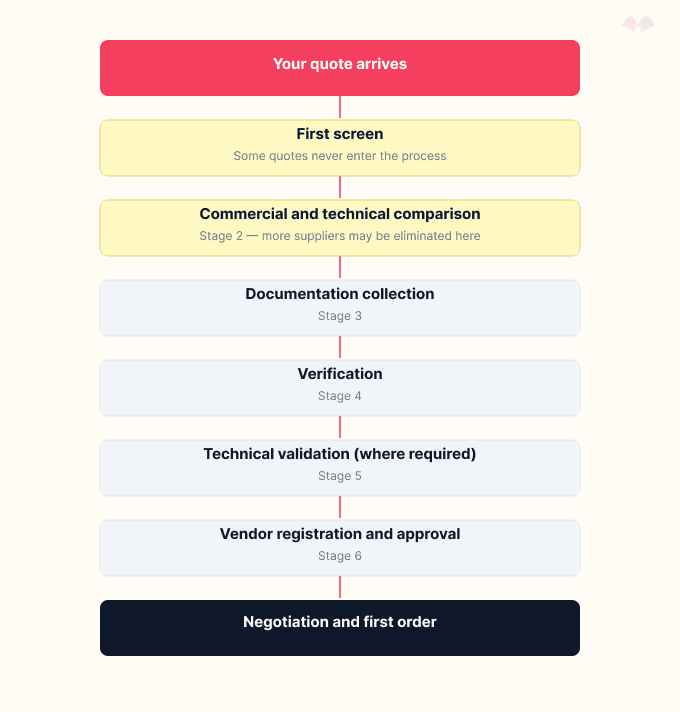
Each stage is described below, along with where you can influence the outcome.
Stage 1: The internal decision to evaluate a new source
This often starts informally. An email. A conversation between managers. A production problem that triggers a sourcing review. The decision is frequently unstructured and routed through individual managers rather than a defined workflow. This is one reason early-stage delays are so common and hard for a supplier to diagnose from the outside.
Stage 2: Commercial and technical comparison
Before requesting a single document from any supplier, the buyer compares the quotations received. Price, lead time, payment terms, tooling costs, and commercial assumptions are reviewed against each other and against the buyer's own cost expectations. At the same time, engineering reviews the technical fit: do the stated tolerances match the drawing requirements, has the supplier acknowledged the specification correctly, are the material assumptions right?
Many suppliers are eliminated at this stage before a document is ever requested. A quote that is commercially interesting but technically unclear may be returned with questions or quietly removed from consideration. A quote that is technically sound but commercially outside the expected range may be kept as a benchmark, not a live candidate.
Receiving a document request is usually a positive signal. It means the buyer considers you a credible candidate and is willing to invest further evaluation effort. It does not necessarily mean you are the only supplier still under consideration.
Stage 3: Documentation collection
The buyer asks for records. Finance needs company registration and tax details. Quality needs certifications with their scope clearly stated. Engineering needs capability and equipment information. Procurement needs references. How quickly you respond, and how complete your documents are, determines how fast this stage moves.
Stage 4: Verification
Documents are checked for accuracy and currency. A certificate is examined for its scope and its expiry date, not just its existence. Buyers check whether certificates are current, within their validity period, and appropriate for the work being sourced. Certificates that are approaching their expiry, or whose scope does not cover the manufacturing process required, receive much closer scrutiny.
Stage 5: Technical validation (where required)
For regulated industries, verification extends into formal technical validation. The buyer may require a Production Part Approval Process submission, a First Article Inspection report, or a pilot production run, depending on the industry and the risk level of the part. In automotive this typically follows the AIAG PPAP framework. In aerospace it follows AS9145. In both cases, you are documenting that your process can produce conforming parts repeatedly, not just once. The default expectation for a new part is usually a full submission: a part submission warrant, dimensional results, material certifications, and process evidence.
Stage 6: Approval and system setup
Sign-offs are routed to the relevant approvers. Your company goes through vendor registration, which involves being entered into the buyer's purchasing system with a vendor code that enables purchase orders to be raised. Commercial terms are finalized. Only when all of this is complete can a production order be placed.
One thing this sequence does not show: it is rarely as linear as a list makes it look. An engineering change can send the process back to the commercial comparison stage. A budget revision can halt final approvals and restart them under different terms. A change in procurement ownership inside the buyer's organization can reset the evaluation from the beginning. Suppliers who understand this are less confused by delays and better positioned to ask the right questions when they follow up.
| Stage | What happens | Your lever |
|---|---|---|
| 1. Internal decision | Buyer decides to evaluate a new source. Often slow and informal. | Largely outside your control |
| 2. Commercial and technical comparison | Quotations compared on price, lead time, tolerances, and technical fit. Many suppliers are eliminated here. | Clarity, technical accuracy, and a realistic price |
| 3. Documentation | Buyer requests records for each function | Provide complete, current documents fast |
| 4. Verification | Documents checked for accuracy, scope, and validity | Ensure certificates clearly show scope and expiry |
| 5. Technical validation | PPAP, FAI, or equivalent where required by industry | Have process capability data ready |
| 6. Approval and setup | Sign-offs routed, vendor registration completed, terms finalized | Respond quickly to final requests |
Why it takes as long as it does
The single biggest factor in how long this takes is how complex and how strategically important the supplier relationship is. The timelines below are rough guides, not guarantees.
| Supplier type | Typical qualification timeline |
|---|---|
| Simple, indirect spend (non-manufacturing) | 3 to 7 days |
| Standard manufacturing supplier | 2 to 6 weeks |
| Regulated industries (automotive, aerospace, medical) | 6 to 12 weeks or more |
| Complex global qualification with formal process validation | 3 to 6 months |
One documented case from Apex Analytix found that a global manufacturer's manual onboarding process averaged 50 days before moving to a centralized digital portal, which cut it to 8 days. The documentation bottleneck, not the evaluation itself, was responsible for most of the delay.
Three things drive the length.
The first is the number of functions that must sign off. Every handoff between teams is a potential wait.
The second is risk level. A supplier for a critical, direct component is evaluated far more thoroughly than a one-time, low-value vendor. The cost of getting it wrong is proportional to the depth of the review.
The third, and the one most within your control, is the completeness of your own documentation. A supplier whose records are organized, current, and submitted in full moves through verification quickly. A supplier who responds in fragments, with incomplete or inconsistent documents, extends every stage.
The conversation you never hear
At some point in most supplier evaluations, the functions involved have an internal discussion. The supplier is not in it. The outcome of that meeting often determines whether the process continues or quietly stops.
Here is what that conversation typically sounds like:
Procurement has found the most competitive quote on this part family in two years. The numbers work. They are pushing to move forward.
Engineering is less certain. There is a bore tolerance on the drawing that will be difficult to hold consistently at production volume. They are not sure this supplier has done work at this level of precision before.
Quality wants process evidence, not just a certificate. The ISO scope does not cover this specific manufacturing process. They want a PPAP or at least some dimensional data before they are comfortable.
Finance notes that the company is a smaller operation. If they lose one of their other key customers, the buyer is exposed.
Operations raises the lead time. Eight weeks is more than their current buffer allows. They cannot absorb a late delivery on this part.
Management may ask whether the incumbent supplier should be given the opportunity to match the new pricing before the buyer commits to a change.
Procurement pushes back. This supplier has already delivered similar components to another global manufacturer. They answered every technical question within 24 hours. And they are still significantly below the current cost. The case to move is real.
That is often the meeting. The supplier who sent the quote never knows it happened. Sometimes the incumbent retains the business at a renegotiated price. Sometimes the new supplier wins outright.
Knowing this conversation exists is useful. It explains why price alone rarely wins a new relationship. It explains why evidence of process capability, financial stability, and consistent delivery history makes as much difference as the number at the bottom of the quote.
What AI is changing about the buyer's process
More and more industrial buyers now use AI-assisted tools to handle the verification work that used to require a person at every step. This is not universal, but it is increasingly common among larger procurement organizations. Understanding it changes how you should prepare your submissions.
The document checks these tools run go well beyond looking at whether a certificate exists. Depending on the platform, these systems may cross-reference company names against sanctions databases, verify tax identification numbers against registration records, flag ownership structure changes, check for duplicate supplier entities, scan export history from customs data, and identify banking detail anomalies. Some generate a supplier risk score before a human reviewer has seen a single document. Certain platforms also monitor external news and public data continuously, alerting procurement teams to financial distress, factory disruptions, or sanctions changes that could affect supply continuity.
What this means in practice: a submission where your company name appears differently across your registration, certificate, and quote will be flagged automatically. An expired certificate will be caught and queued for human review before anyone in procurement has seen your quote. A capability statement that does not match the product categories in your registration may trigger a compliance flag.
For industrial manufacturing specifically:
- Submit each certificate as a separate, clearly named PDF. Do not bundle everything into one attachment.
- Use an identical company name across every document you submit. One version with "Pvt Ltd" and another with "Private Limited" creates a flag.
- Show the scope of each certification on the first page, not just the certificate number and expiry date.
- If the part type requires it, submit process capability data in AIAG or AS9145-standard format.
AI tools are also available on the supplier side. Tools now exist that let you check your own documentation package before sending it: flagging expired certificates, identifying company name inconsistencies, and surfacing missing documents before the buyer asks. More specifically, they can prepare customer-specific capability statements tailored to the RFQ, map your previous project experience against the technical requirements, and compare your submission against the buyer's stated evaluation criteria. Using these tools before submission removes error categories that are otherwise easy to miss.
What you should do at each stage
When the quote goes out
Do not wait to be asked for documents. Include, or explicitly offer to provide, the records each function will need. A certification with its scope clearly stated. A capability summary that maps to this specific part type and this specific tolerance range. A reference from a customer who has been buying comparable parts from you long enough to speak to consistency, not just quality.
A supplier who provides this without being asked compresses the documentation and verification stages into a fraction of their usual length.
When documents are requested
Treat completeness and speed as the priority. A certificate with its scope and expiry visible, a capability statement mapped to the actual drawing requirement, and a reference who can speak to your track record clear verification faster than a larger volume of less relevant material.
When it appears to stall
Ask a specific question rather than a generic one.
"Which stage of the evaluation has the process reached, and is there anything outstanding from our side?" gives the buyer a clear way to surface a blocker. "Has a decision been made?" reopens the commercial conversation when the commercial question may no longer be the open one. These feel similar from the outside but produce completely different responses.
The underlying point
Several functions are evaluating you simultaneously with different questions. Material that satisfies quality does not satisfy finance. A supplier who prepares for all of those questions, not just the commercial one, is the supplier who clears the process while others are still waiting in silence.
What happens after you are approved
Passing qualification means the buyer is willing to buy from you. It does not mean they will.
After a supplier completes the qualification process, several things can happen before a purchase order arrives.
Buyers often negotiate. They may ask for a revised quotation based on volume commitments, request value engineering ideas that reduce the part cost, or ask you to benchmark your pricing against the current supplier. For strategic parts, formal negotiation rounds are common before commercial terms are finalized.
Some suppliers are approved as a second source. The buyer qualifies you and keeps you as a backup to their primary supplier. You are approved and available, but orders may not come until the primary supplier misses a delivery or the buyer decides to dual-source.
Some qualified suppliers wait months before their first order arrives, because the demand that triggered the evaluation is project-based, seasonal, or tied to a product launch that has not happened yet.
None of this makes the qualification work pointless. An approved supplier is in a far stronger position than an unapproved one. But qualification converts into business through relationship, visibility, and timing, not automatically. Keeping your documentation current, maintaining contact with your procurement counterpart, and being ready to respond quickly when demand arises are what turn approved status into actual orders.
The pattern underneath
A buyer's qualification process is trying to answer one question across multiple functions: can we rely on this supplier before we commit?
Every stage exists because a buyer was once burned by a supplier who looked fine on price and failed somewhere else. The process is slow because verifying reliability from outside an organization is hard.
This is why the supplier who makes verification easy holds an advantage that has nothing to do with price. The factory that arrives with organized, current, and verifiable evidence is not just easier to approve. It is demonstrating the same operational discipline that the entire qualification process is designed to confirm.
Buyers rarely remember the cheapest supplier.
They remember the one who was easiest to approve.
See Also
Frequently asked questions
Why might my quote be dismissed before qualification even starts?
Some quotes are filtered out before a single internal evaluation begins. The most common reasons: the quote does not acknowledge the specific drawing or part, the supplier asked no clarifying questions on an ambiguous specification, the capability statement is generic rather than mapped to the requirement, certificates are expired or submitted without noting their scope, or pricing is so far outside the expected range that it signals either a misread of the RFQ or a quality concern. The quote itself is an evaluation. It should demonstrate that you read the drawing, understood what was asked, asked the right questions, and have done comparable work before.
Why does a buyer go silent after I send a quote?
Many suppliers search for why a buyer stops replying after an RFQ, and the answer is almost always the same: the silence usually means your quote has passed the first screen and entered the buyer's internal qualification process. This runs across several functions you never see: procurement, quality, engineering, finance, and legal. Each asks a different question, and the delay is often a handoff between functions rather than rejection or indifference. The useful response is to help the qualification stages clear, not to follow up on price.
Who actually approves a new supplier inside a buyer's organization?
Rarely one person. Procurement owns the commercial relationship and can shortlist you, but typically cannot approve a strategic supplier alone. Quality checks whether you can make the part repeatably. Engineering checks whether you understand the drawing. Finance handles payment setup and financial stability. Legal owns the contract. A quote can pass procurement on price and stall completely at quality, finance, or legal.
How long does supplier qualification take?
It depends on the complexity and strategic importance of the relationship. Simple, indirect spend can be approved in three to seven days. A standard manufacturing supplier typically takes two to six weeks. Regulated industries such as automotive, aerospace, and medical commonly take six to twelve weeks or longer. Complex global qualifications with formal process validation can run three to six months. The biggest factor within your control is the completeness and currency of your documentation from the start.
What documents does a buyer need to qualify me?
Different functions need different evidence. Finance needs company registration and tax details. Quality needs certifications with scope and expiry clearly shown. Engineering needs capability and equipment information. Procurement needs references. For production parts in regulated industries, the buyer may also require a formal Production Part Approval Process submission, which documents that your process can produce conforming parts repeatedly, not just in a sample.
What is the most common reason qualification stalls?
Two causes account for most delays. The first is the internal decision stage, which is often unstructured and email-based on the buyer's side, creating delays the supplier cannot see. The second is incomplete or out-of-date documentation from the supplier: a certificate that does not clearly show its scope or expiry, records submitted in pieces rather than as a complete set, or documents that create questions rather than answer them. The supplier whose evidence is organized and current removes the one cause they can actually control.
What should I do when qualification seems stuck?
Ask a specific question rather than a generic follow-up. "Which stage of the evaluation has the process reached, and is there anything outstanding from our side?" signals that you understand the process and gives the buyer a clear way to surface a blocker. This is more useful than asking whether a decision has been made, because it addresses the qualification stages directly rather than reopening the commercial conversation.
Does becoming an approved supplier guarantee purchase orders?
No. Qualification makes you eligible to receive business, not certain to receive it. After approval, whether orders come depends on demand, your pricing relative to the current supplier, the buyer's inventory position, and their sourcing strategy. Some buyers qualify a second source as a contingency and place their first order only when the primary supplier fails to deliver. Others use a new qualification to renegotiate with their incumbent and never place volume with the new supplier. What approval does mean is that certification, quality, and commercial concerns are no longer the reason you are not receiving business. If you are approved and still not receiving orders, the conversation shifts from qualification to relationship, demand timing, and competitive pricing.
Why does a buyer keep asking for more documents?
Because different internal functions evaluate different risks, and each one may ask for something different at a different point in the process. Procurement may already be satisfied. Quality may still need process evidence for a specific manufacturing step. Finance may still need registration documents for vendor setup. Legal may have flagged a term in the contract that needs a supporting document. Each additional request usually means the evaluation is progressing, not restarting from the beginning. The useful response is to provide what is asked for quickly and completely, then ask whether anything else is outstanding.
Ready for fewer, better conversations?
Augmino connects verified Indian manufacturers with buyers who mean business.
Apply to Join