How OEM Buyers Manage RFQs When Sourcing Prototypes From Contract Manufacturers


An OEM buyer sends the same prototype drawing to five contract manufacturers. Three weeks later, five quotes come back. The prices are 340 dollars, 410 dollars, 290 dollars, 520 dollars, and 375 dollars, for what should be the same part.
None of the five manufacturers actually quoted the same job. One assumed the prototype would reuse the tooling planned for full production. One assumed hand finishing instead of the finish on the drawing. One quietly priced a rush timeline nobody asked for. One left out first article inspection. One quoted it as a one-off with no path to a production price at all.
This is not a pricing problem. It is a process problem. A prototype RFQ carries more open questions than a production RFQ. If the buyer does not close those questions before sending it, five suppliers will each close them differently, inside the price.
What makes a prototype RFQ different from a production RFQ
A prototype RFQ is harder to compare for three reasons.
The quantity is small. A manufacturer's fixed setup cost gets spread across very few parts, instead of thousands.
The specification is often still moving. The manufacturer has to guess how much of it might change before the quote is even final.
And there is usually no committed production volume yet. The manufacturer cannot promise today what a production part will eventually cost.
A buyer who runs a prototype RFQ through the exact same process as a production RFQ will keep getting quotes that cannot sit next to each other on one sheet. And they will keep being surprised at how different the eventual production price turns out to be.
Signs your prototype RFQ process is not working
- You cannot put two quotes on one line, because each supplier priced something slightly different.
- Every round of quotes needs a follow-up call just to find out what was actually included.
- Nobody can say which supplier last saw which version of the drawing.
- The lead time you were quoted for the prototype had nothing to do with the lead time you later got for production.
- A spec problem only surfaces after the prototype arrives, not when the RFQ went out.
- Two people on your team have sent RFQs for the same part without knowing the other one did.
If two or more of these sound familiar, the problem usually is not the suppliers. It is the process around them.
The 4-stage RFQ process
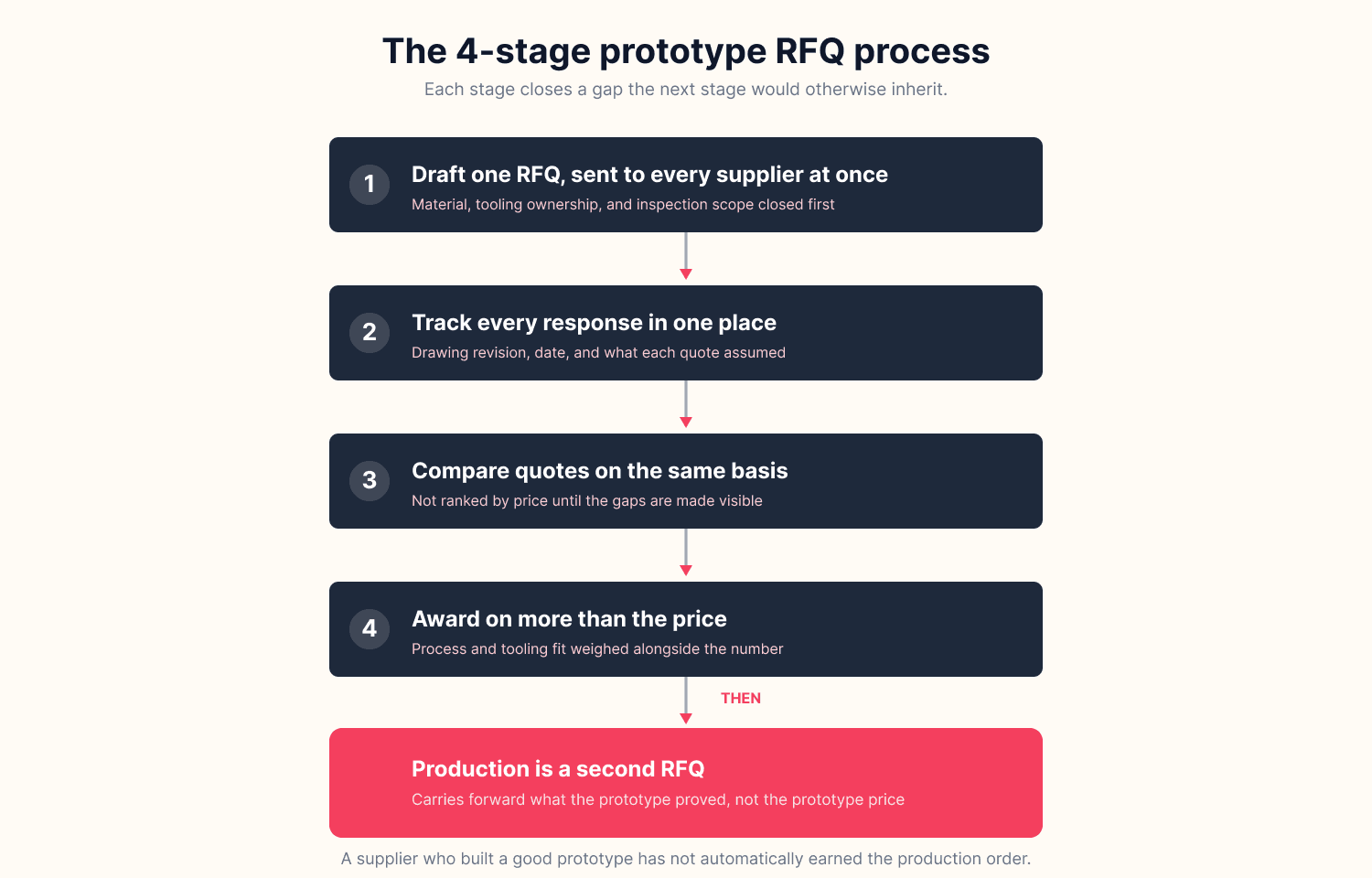
Stage 1. Draft one RFQ sent to everyone at once
Every supplier should receive the same document, with the same open questions already closed. For the actual field-by-field checklist, our general guide to writing an RFQ covers that in full. What changes for a prototype is a short list on top of that checklist:
- State the material grade exactly, not "equivalent."
- State whether the tooling built for this prototype is meant to carry into production or is throwaway.
- State whether first article inspection is expected.
- State which development stage this prototype represents. That single line changes what a manufacturer quotes.
Before the RFQ goes out, a short review with someone from engineering and someone from supply chain catches a common failure. Procurement alone tends to weigh price and lead time. Engineering alone tends to weigh tolerance and material. A prototype RFQ specified by only one side of that conversation quietly under-specifies the other.
Manufacturing and hardware teams commonly describe a design's progress using three named stages.
| Stage | What it means | What the quote should reflect |
|---|---|---|
| EVT (engineering validation) | An early, rough prototype meant to test whether the design works at all | Looser tolerances and manual finishing are fine |
| DVT (design validation) | A more refined prototype meant to test whether the design can actually be manufactured and meets the real requirements | Falls between EVT and PVT: more accurate than a rough prototype, but not required to match production tooling yet |
| PVT (production validation) | A prototype built on the same tooling and line the buyer will use for full production, meant to prove the process itself, not just the part | Must use the same tooling, the same line, and the same quality checks that full production will use |
Telling a manufacturer which of these three a prototype RFQ is for removes one of the biggest sources of mismatched assumptions.
Between the RFQ going out and quotes coming back, one habit prevents a quieter version of the same problem. If Supplier A asks which tolerance applies and gets a private answer, Supplier B never sees it. Every clarification question, and its answer, should go to every supplier, not just the one who asked. Otherwise the round ends with suppliers quoting against different information, the same mismatch Stage 1 was supposed to close.
Stage 2. Track every response in one place not five email threads
Once RFQs go out, the risk shifts from "what did we ask for" to "what did we actually get back, and when." A common pattern for teams managing several contract manufacturer relationships is a separate email thread and a separate spreadsheet per supplier, tracked by memory more than by system. That pattern is slow and it is where quotes go stale without anyone noticing.
A shared tracker, even a simple spreadsheet, should log:
- Which drawing revision each supplier quoted against
- The date sent
- The date received
- A one-line note on what each quote assumed
Without this, a team re-asks the same question to the same supplier weeks apart, or awards against a quote that was actually priced against an older drawing. The free Prototype RFQ Tracker below already has these fields laid out, so there is no need to build this sheet from scratch.
Stage 3. Compare quotes on the same basis not the same number
A raw price is not comparable until it has been normalized, meaning adjusted so every quote reflects the same assumptions. Going back to the opening example, here is what that looks like once the gaps are made visible.
| Supplier | Quoted price | What the quote actually assumed | What normalizing it reveals |
|---|---|---|---|
| A | 340 dollars | No first article inspection | Understated, inspection cost still due |
| B | 410 dollars | A rush timeline nobody requested | Overstated for the buyer's real deadline |
| C | 290 dollars | Hand finishing instead of the drawing's finish | Not actually a valid quote against the drawing |
| D | 520 dollars | Tooling built for reuse into production | Correctly priced, but not comparable to a throwaway-tooling quote |
| E | 375 dollars | One-off, no production pricing path | Complete for the prototype, incomplete for the bigger decision |
Once normalized, the real spread is smaller than the raw numbers suggest, and the real comparison is not just about price. Supplier D's higher number buys something the others did not offer at all, a tooling investment that will matter the moment this part moves toward production.
Stage 4. Award on more than the number
Awarding a prototype RFQ is not simply picking the lowest normalized price. It is deciding whether this supplier's process is the one you want carrying this part forward, or whether the prototype and the eventual production run should go to different suppliers entirely. Both are legitimate choices. The mistake is making that choice by accident, because nobody asked the question before signing off.
Prototype to production is a second RFQ not an automatic step up
A supplier who built a good prototype has not automatically earned the production order. A buyer should not assume production pricing simply scales down from the prototype price. Tooling that was built as a one-off for a handful of prototype units is often not the tooling that should run thousands of production units. A process that a machinist watched closely by hand for five parts is not the same process running unattended for a full shift.
Treat the move from prototype to production as its own RFQ, built on what the prototype proved rather than starting from zero. Carry forward the drawing revision that the prototype actually validated, the inspection results from the prototype run, and a clear answer on whether tooling gets reused, rebuilt, or replaced. What should not carry forward unexamined is the price. A production quote deserves its own comparison, using the same discipline as the prototype round.
Bring the contract manufacturer in before the design is locked
The earlier a contract manufacturer sees a design, the more useful they can be. A manufacturer who only sees a drawing after it is finished can only quote it or flag problems too late to fix cheaply. A manufacturer brought in while the design is still open can flag a feature that will be expensive to hold in production, suggest a tolerance that is tighter than the part actually needs, or warn that a timeline assumption will not survive contact with their real schedule. None of that requires a formal contract. It requires asking for feedback before the drawing is called final, not after.
If your prototype RFQs currently live across scattered email threads and one-off spreadsheets, start with the free Prototype RFQ Tracker below. It will not replace a full procurement system, but it gives every prototype round the same structure from day one.
See Also
Download
Augmino Prototype RFQ Tracker
CSV · 406 B
A simple spreadsheet for tracking multiple prototype RFQs side by side across suppliers: revision sent, quantity quoted, unit price, lead time, whether tooling and first article inspection were included, and status. For an OEM buyer running more than one contract manufacturer through the same prototype RFQ round.
Frequently asked questions
What is the difference between a prototype RFQ and a production RFQ?
A prototype RFQ covers a small quantity, often with a specification that is still settling, and usually with no committed production volume behind it. A production RFQ covers a committed quantity against a finished specification, so the manufacturer can price tooling, setup, and materials against a known volume. Comparing a prototype quote to a production quote without adjusting for these differences will make the production number look misleadingly worse or better than it really is.
What do EVT, DVT, and PVT mean?
They are three commonly used stages that describe how far a design has progressed. EVT is an early prototype testing whether the design works. DVT is a refined prototype testing whether the design can be manufactured and meets requirements. PVT is a prototype built on the actual production tooling and line, testing the process itself. Naming which stage a prototype RFQ belongs to helps a manufacturer quote it accurately.
How many contract manufacturers should I send a prototype RFQ to?
Enough to have a real comparison, not so many that tracking and normalizing the responses becomes its own project. Three to five is a workable range for most prototype rounds. Sending it to more suppliers does not fix a badly specified RFQ, it just multiplies the number of different assumptions coming back. The exception is an early EVT round where the specification is still changing fast. A single trusted supplier can be more practical there than a full competitive round, since the spec may not hold still long enough to make comparison meaningful.
Does the supplier who builds the prototype automatically get the production order?
No, and it should not be assumed either way without a decision. Some buyers deliberately keep prototyping and production with different suppliers. Others want continuity because the same team already understands the part. Decide this on purpose, and say so in the prototype RFQ, so the supplier is not guessing either.
Should I ask suppliers to quote both prototype and production pricing?
Often yes, if a production volume already exists even as an estimate. Ask for the prototype quantity and the production quantity priced separately, in the same RFQ. It saves running a second RFQ later just to find out the production number, and it surfaces early whether a supplier's prototype price was subsidizing a production order they expected to win.
How do I compare quotes that all assumed something different?
Normalize each quote to the same basis before comparing the numbers. Note what each supplier actually included, such as inspection, finishing, and tooling ownership, and adjust or flag the gaps before ranking anything by price. A lower number that is missing a real cost is not actually the lower number.
When should I involve my contract manufacturer in the design?
Before the drawing is treated as final. Feedback on manufacturability is far cheaper to act on while a feature can still be changed than after tooling has been cut against it.
Do I need special software to track prototype RFQs?
No. A shared spreadsheet that logs the supplier, the drawing revision sent, the quote received, and what it assumed is enough for most teams. The discipline of keeping it updated matters more than the tool.
Ready for fewer, better conversations?
Augmino connects verified Indian manufacturers with buyers who mean business.
Apply to Join