Payment Protection for a First Order: Escrow, Milestones, and Inspection-Linked Release


The safest way to protect payment on a first order with a new manufacturing supplier is simple. Stop paying against a promise. Start paying against a checkpoint. That means splitting payment into stages. Hold the largest portion in escrow, or with your own bank. Release it only after a passed inspection, not a shipping date. The mechanics below show how to structure that for an industrial first order specifically, not a general trade transaction.
This piece assumes you already know the standard instruments: Documents against Acceptance, Documents against Payment, Letter of Credit, and Open Account. If you need those defined and risk-ranked, that ground is already covered in our guide to international payment terms for Indian manufacturing exports. This piece is about something narrower. It's about how to sequence payment on a first order, specifically when you have no history with the supplier to fall back on.
Your leverage ends the moment the deposit clears
A buyer has maximum leverage the day before money moves. Every question gets answered. Every sample gets expedited. Every capability gets confirmed. The moment a deposit clears, some of that leverage moves with it. Whether the buyer meant it to or not.
This isn't a claim that suppliers act in bad faith once paid. It's a claim about incentives. A supplier with 30% of an order's value already in hand has less to lose from a slipped date or a quiet material substitution than one who is still waiting to be paid at all. The fix isn't to distrust the supplier. It's to design the payment schedule so leverage never fully transfers before the thing it's meant to guarantee actually happens.
Why a first order needs a different structure than a repeat one
On a repeat order, a buyer has a track record. Three shipments landing on spec, on time, become their own kind of collateral. A first order has none of that. The buyer has to trust a supplier's capability. Trust their honesty about material substitutions. Trust their ability to hit a delivery window. All at once, with no prior data point to lean on.
That's exactly the situation the standard instruments weren't built to solve alone. A Letter of Credit protects a buyer against documentary non-compliance. It releases payment when the required shipping documents match the terms, whether or not what's inside the container matches the buyer's specification. It does almost nothing to protect a buyer against delivery of the wrong thing, on time, with paperwork that looks correct. That gap is what escrow and inspection-linked release are for. They don't replace the instrument you use to move money across a border. They control WHEN, inside that instrument, the money is allowed to move.
How escrow works for a first order
In an escrow structure, the buyer's payment sits with a neutral third party, not the supplier. It stays there until an agreed condition is met. For a first order, the condition should be defined narrowly enough that there's no argument about whether it was met: a passed third-party inspection, not "supplier confirms goods are ready."
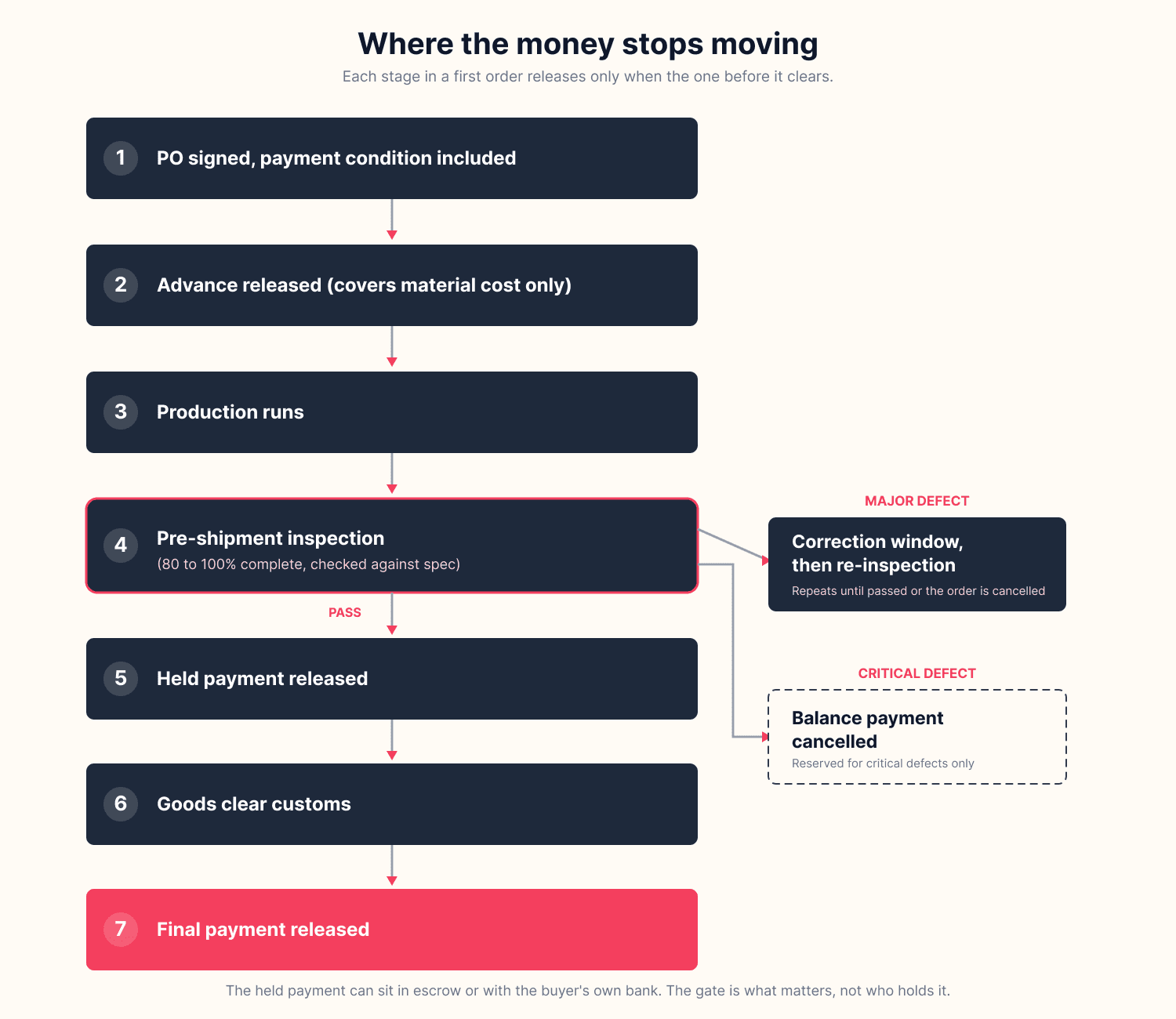
A worked example. A buyer places a first order worth $40,000 with a supplier they've never used before. Instead of 50% advance and 50% before shipment, they split it three ways:
- $12,000 released on order confirmation. This covers the supplier's real upfront cost for raw material.
- $16,000 held in escrow. Released only after a passed pre-shipment inspection.
- The final $12,000 released after the goods clear customs at the buyer's port.
No stage after the first is released on the supplier's word alone. Every later stage is released against a fact a third party confirmed, not a claim the supplier made.
The number split is illustrative, not a template to copy exactly. What matters is the structure. The first release covers real upfront cost, not profit. Every release after that is tied to a checkpoint the supplier doesn't control.
Escrow isn't free. Providers charge a fee scaled to transaction size, and the percentage is often higher on smaller orders than on large ones, not a flat rate across every deal. State in the purchase order which party pays it, the same way you state who pays for inspection, so it isn't a surprise on the final invoice.
Inspection-linked release: tying payment to a passed inspection, not a promise
Inspection-linked release ties a specific stage of payment to the outcome of a passed inspection, not to a shipping date or the supplier's word that the goods are ready.
Pre-shipment inspection is normally performed once 80 to 100% of an order is manufactured and export-packed. A third-party inspector checks the goods against the purchase order and the agreed specification. They sort any defects into minor, major, or critical. Then they issue a report, usually within 24 hours, along with photos.
The part buyers miss is that the inspection report is only useful as payment protection if the payment terms are written to depend on it. An inspection that happens after the balance payment already cleared is a record for a dispute, not a gate that prevented one. The report has to sit BETWEEN the balance payment and the supplier, not after both.
A second worked example. A buyer sourcing precision-machined components for the first time writes the purchase order so the final 30% of payment depends on a PASSED inspection, not just an inspection having happened. If the inspection finds a major defect, the supplier gets one correction window before a re-inspection. If it finds a critical defect, the buyer can cancel that balance payment entirely. The leverage a buyer has before money moves stays in place through the whole production cycle, not just through the deposit stage.
Advance, escrow, and inspection-linked release, compared
| Structure | Buyer leverage after deposit | Supplier cash-flow impact | Best used when |
|---|---|---|---|
| Advance only (e.g. 50/50, no third-party gate) | Ends at deposit | Fastest cash access | Long-standing, trusted relationship |
| Escrow, released on delivery confirmation | Held until buyer confirms receipt | Delayed but predictable | Repeat supplier, moderate order value |
| Inspection-linked release | Held until a passed third-party inspection, not a buyer's word | Delayed, tied to inspection turnaround (often 24 hours after inspection) | First order, new supplier, or any order where a defect would be expensive to discover after shipment |
None of these replace the underlying payment instrument. An LC still needs a bank behind it. An escrow account still needs a wire behind it. What changes is the sequencing, and the release condition, inside whichever instrument you already use.
Is your first order ready for this structure?
This kind of payment sequencing adds friction. It's worth that friction on some orders and unnecessary on others. Before writing an inspection-linked clause into a purchase order, check whether the situation actually calls for it:
- This is the first order with this specific supplier, with no prior shipment history to draw on.
- The order value is high enough that a defect discovered after payment would be expensive to absorb or dispute.
- Nobody from the buyer's side has visited the facility or seen the process in person.
- The specification has tolerances, material grades, or compliance requirements where "close enough" isn't acceptable.
- The supplier was found through a directory or a cold introduction, not a referral from someone the buyer already trusts.
- A defect on this order would be hard or slow to return, given shipping distance or customs friction.
If two or more of these are true, the extra step of writing an inspection-linked clause into the purchase order is worth the friction. If none of them are, a simpler advance-and-balance structure is probably proportionate.
Setting it up in the purchase order
The clause doesn't need to be complicated. It needs three things stated plainly:
- Which stage of payment depends on inspection.
- What counts as a pass. Tie it to the agreed specification and drawing, not a general "satisfactory" standard.
- Who performs the inspection. A named third party, agreed before the order is placed, not chosen by either side after a dispute starts.
Put the clause in the purchase order itself, not in a side email. That way it's enforceable against the same document that sets the price and the specification.
If the supplier pushes back
A new supplier may resist escrow or an inspection-linked clause. That isn't automatically a red flag. Cash flow, unfamiliarity with the structure, or a previous buyer who never asked for one are ordinary reasons, not signs of risk by themselves.
The conversation goes better framed around what each side is protecting against, not who wins the clause. A supplier worried about cash flow may accept a milestone schedule instead of one balance held to the end. A supplier worried about inspection delays may accept the structure once the inspecting party and the turnaround window are agreed in advance, rather than left open to be chosen after a dispute starts.
If a supplier refuses every version of a checkpoint-based structure on a first order, treat that refusal itself as one more data point in deciding whether to place the order at all, not as a clause to negotiate past at any cost.
See Also
Frequently asked questions
How much of a first order should I pay in advance?
Enough to cover the supplier's real upfront material cost, not enough to remove their incentive to deliver correctly. A common range is 20 to 30% on order confirmation. The remainder is held against inspection and delivery milestones, rather than paid in one balance.
What is the difference between escrow and a Letter of Credit for a first order?
An LC is a bank's conditional promise to pay against matching documents. Escrow holds the buyer's own funds with a neutral third party. The funds stay there until an agreed condition is met, commonly a passed inspection. They can be used together: an LC as the payment instrument, with its release condition written to depend on an inspection report.
Who pays for the pre-shipment inspection?
Either side can, and it's usually negotiated into the order terms upfront. Buyers new to a supplier often absorb this cost themselves, since it's protecting their own payment decision.
Who pays for escrow fees?
This is negotiable and should be stated in the purchase order, the same as inspection cost. Providers charge a fee scaled to transaction size, often a higher percentage on smaller orders than on large ones, so check the specific provider's schedule rather than assuming a flat rate.
What happens if the inspection finds a defect?
A well-written clause gives the supplier a defined correction window and a re-inspection, rather than an automatic cancellation. Reserve outright cancellation of the held balance for critical defects, not minor ones.
Can I use inspection-linked release on a small order?
It's proportionate on some small orders and unnecessary friction on others. Use the readiness diagnostic above rather than a fixed order-value threshold.
Does this replace the need to verify the supplier before placing the order?
No. Payment sequencing protects the money on an order you've already decided to place. It doesn't substitute for qualifying the supplier's capability and legitimacy beforehand.
How long does a pre-shipment inspection typically take?
Once 80 to 100% of the order is manufactured and packed, the inspection itself is usually a single visit. The written report and photos arrive within about 24 hours.
Ready for fewer, better conversations?
Augmino connects verified Indian manufacturers with buyers who mean business.
Apply to Join