How to Assess Product Quality and Authenticity Before You Place a Large Order


The sample looked right. The certificates were on file. You decided the supplier was real.
Now you are about to place a large order. And the question that actually decides how this goes is different from the one you already answered.
Not: is this supplier legitimate?
But: will this specific order arrive as the material, grade, and build we agreed?
Those are two separate questions. Most buyers answer the first and assume the second will follow. It does not always. A genuine factory can ship a batch that quietly drifted from the sample. A real-looking certificate can accompany cheaper material than it claims. A part quoted one way can be made another way. A legitimate-looking component can be a counterfeit that slipped in one tier up.
This guide is a step-by-step verification protocol for the moment before you commit large volume. It covers how to bind the sample to the bulk, how to confirm the material is what the certificate says, how to confirm the part was made by the process you paid for, what a pre-shipment inspection covers and what it misses, and how to verify anything in a year when a convincing certificate or factory video can be produced by AI in minutes.
None of it requires a flight. All of it requires deciding, before the money moves, which proof you will hold yourself rather than accept on a supplier's word.
The verification sequence covers eight steps: sealing reference samples, obtaining first-article data with measured values, reconciling the material heat number against the hard-stamp, running independent material testing, confirming the process by routing and records, scoping the pre-shipment inspection for material and components, screening bought-in components through authorised sources, and releasing final payment only after a passing independent inspection.
Verify the product, not just the supplier
Supplier verification answers one question: is this a legitimate company that can make this?
Product verification answers a different question: will this specific order arrive as the grade, build, and quality we agreed?
The gap between those two questions is where large orders go wrong. A listing or a quality badge confirms the seller. It does not travel down to the part in the box. The checks below do.
Why the first sample can mislead you: the golden-sample gap
The approved sample, often called the golden sample, proves a design can be built. It does not prove the process is stable across thousands of units.
Picture approving one perfectly machined shaft. In production, the cutting tool wears gradually. Every shaft stays within tolerance for hours, then drifts toward the limit as the tool dulls. The approved sample never showed that drift, because it was made on a fresh tool in a few minutes. Process-capability data shows it. A single golden part cannot.
The sample is often produced under closer supervision than routine production. To bind it to the bulk, four things do most of the work.
Seal multiple reference samples. Make three or four identical units, each signed, dated, and sealed against tampering. The buyer keeps one. The factory keeps one on the line. The inspection agency keeps one to compare the batch against when the order ships. A sample only one party holds is not a reference. It is a memory.
Get a control plan, not a promise. A control plan states how each critical characteristic stays in tolerance from one lot to the next. It is the contract for consistency, written down before production starts.
Ask for measured values, not a tick box. A pass or fail result hides drift. A dimension that is technically in tolerance but sitting right at the edge is a warning the tick box will never show. First-article evidence should record what the number actually was.
Require a process-capability study on random production parts. A capability study shows the process holds the tolerance across a run, not just on one supervised piece. Expectations vary by industry and customer: a Cpk of 1.33 or higher is a common general baseline, with critical characteristics often required at 1.67 or higher.
| Artifact | What it proves | Its blind spot | What binds it to the bulk |
|---|---|---|---|
| Golden sample | The design can be built | Nothing about volume consistency | Sealed copies held by buyer, factory, and inspector |
| First-article inspection | The first unit met the drawing | A starting point, not repeatability | Measured values plus a control plan |
| Capability study (Cpk) | The process holds tolerance | Only on the characteristics selected | Run on random production parts, not one supervised piece |
How to verify the material is what the certificate says
The exact method depends on the product, but the principle is constant: tie the delivered goods back to independent evidence of what they are made from. Metals rely on heat numbers and material test certificates. Plastics and rubber rely on resin or compound grade and batch traceability. Electronics rely on authorised-source components and lot traceability. Chemicals and coatings rely on a batch certificate of analysis (CoA), and many parts ship with a certificate of conformity (CoC) that should be checked against the actual order, not just filed. Whatever the category, you are looking for a traceable link between the paper and the physical thing, plus a way to test the physical thing independently.
Metals make the clearest worked example. A material test certificate reports chemical composition and mechanical properties tied to a heat number, the unique identifier for the melt batch.
There are two certificate types under the European standard EN 10204. A 3.1 certificate is issued by the manufacturer's own quality department, independent of the production line. A 3.2 certificate is validated by both the manufacturer's own inspection authority and an independent inspector, so the witness is not only the organisation that made the material.
For a material-critical order, the 3.2 is the stronger instrument. It adds cost and lead time, because an independent inspector has to witness the testing, so decide early and write the requirement into the purchase order. You cannot upgrade from 3.1 to 3.2 after the fact without the buyer's written approval and proper witnessing.
Two checks catch most substitution.
First: reconcile the heat number on the certificate against the hard-stamp on the physical material. They must match exactly. This is the single most important step to catch substitution, and it is the one most buyers never perform. A certificate whose heat number does not match the stamp on the bar, pipe, or plate is not evidence of conformance. It is evidence of a problem.
Second: run independent positive material identification on random pieces at incoming inspection. A portable XRF analyzer confirms the alloy matches the grade claimed. Know its limit: handheld XRF cannot reliably read carbon and most light elements, and carbon is often what separates one grade from another. Use portable PMI to confirm the alloying metals, and send a sample to a lab for combustion analysis where carbon content is grade-critical.
Substitution follows a predictable pattern. A smaller mill or shop without its own test capability issues a certificate without performing the test, and lower-grade, recycled, or off-spec material ships against a higher-grade claim. A convincing certificate is much easier to fake than the material itself, which is why you test the material, not just the paper.
Verify the process, not just the part
A part can pass dimensional inspection and still be wrong, because it was made by a cheaper process than the one you paid for. This is one of the most overlooked authenticity checks.
The pattern repeats across categories. A part quoted as a casting arrives fabricated and welded. A part quoted as forged-then-machined arrives machined from solid billet. A part quoted as CNC-machined arrives laser-cut. A part quoted as injection-moulded arrives vacuum-formed. The finished piece can look identical and even measure correctly, while its strength, grain structure, fatigue life, or tolerance behaviour is not what the design assumed.
Confirm the process with records, not assurances:
- Agree the process in writing in the PO or the control plan, not just the final dimensions.
- Ask for the routing or traveler that shows each operation the part actually passed through.
- Request production records for the run: machine logs, heat-treat charts, process parameters.
- Observe the floor on a live, unscripted video call, or through your inspection agency, to confirm the equipment for the quoted process is actually in use.
If the records and the route do not match the process you bought, the part is not authentic to its specification, however well it measures.
What a pre-shipment inspection covers and what it misses
A pre-shipment inspection checks product quality, quantity, packaging, labelling, and conformity, usually once at least most of the order is produced and packed. It is performed before the goods leave the factory and, structured correctly, before final payment, which is what gives it leverage. It uses random sampling under the Acceptance Quality Limit system defined by ISO 2859-1. Inspection levels and defect limits are buyer-configurable. Many buyers set critical defects at zero and accept a small, agreed percentage for major and minor defects.
Understand what AQL is and is not. It is statistical sampling: it inspects a fraction of the order and controls the rate of defects, not zero-defect certainty. A standard inspection is a snapshot. A cosmetic-and-functional inspection will not catch wrong-grade material that passed a visual check, a wrong process, or a counterfeit component sealed inside an assembly, unless you told it to look.
So scope the inspection for authenticity. Add material identification, process and marking checks, or random sample pulls for independent lab testing to the inspection brief. Use an independent agency, not one arranged by the supplier. An inspection that was never told to look for substitution will not find it.
How to spot counterfeit, substituted, or grey-market inputs before you commit
For assemblies that contain bought-in components, especially electronics, the authenticity risk moves one tier down to the inputs. This is not a niche problem.
ERAI, the organisation that tracks counterfeit and nonconforming electronic parts, recorded 1,055 suspect counterfeit and nonconforming components in 2024, a 25% increase from 2023 and the highest total since 2015. More telling than the count is the target. The old assumption that counterfeiting hits only hard-to-find or obsolete parts no longer holds: active parts, including those readily available through authorised sources, made up more than a quarter of all cases in 2024 and were reported more than twice as often as parts with long lead times. A current, easy-to-source design is not automatically safe.
There is a quieter version of the same problem: substitution after approval. A supplier approves a sample built around a specified brand of bearing, controller, valve, or resin, then ships the production run with an unbranded clone or a generic equivalent that costs less. The assembly looks the same. The branded part you specified, and qualified the design around, is not the part in the box. Treat any branded or grade-specified input as something to verify at receipt, not assume.
Three controls reduce the exposure.
Prefer authorised or franchised distribution and treat the open market as high-risk. Where open-market sourcing is unavoidable, require full chain-of-custody documentation for every lot. Where practical, record the serial or lot numbers of critical branded components before shipment, so a later substitution is provable.
Use the established inspection playbook for high-stakes parts. External visual examination, a marking-permanency test (a gentle solvent wipe to check whether markings are genuine or re-marked), X-ray imaging to confirm internal construction, and electrical test against manufacturer data. Recognised standards include AS6081 and IDEA-STD-1010. Even a clean panel can miss a sophisticated counterfeit, so sample in proportion to the risk of the specific component rather than blanket-testing everything.
Write the right to reject into the contract. Define an inspection period and an explicit right to reject on verified nonconformance, so a bad lot is a returnable lot and not a sunk cost.
AI-faked certificates and automated cross-checks: verifying in 2026
The verification problem shifted in 2026 because the evidence itself changed.
The tools that fake evidence have caught up with the tools that produce it. Generative AI can now create a convincing test certificate, a vendor profile, an invoice, even a factory tour video, that appears authentic even when it does not represent the actual factory or production it claims to show. Industry reporting through 2025 and 2026 describes a sharp rise in AI-generated document fraud, polished enough that experienced procurement teams and some automated checks miss it. The old habit of trusting a document because it looks professional no longer holds. Looking professional is now the cheapest thing to fake.
The more useful shift for a buyer is on the defence side, and it is bigger than spotting deepfakes. AI now lets you cross-check documents against each other automatically. A certificate, the purchase order, the original RFQ, the drawing revision, the company registration, the HS code, and the supplier's previous submissions and quality history should all agree. A mismatch between any of them, a heat number that does not appear on the certificate, a drawing revision that does not match the PO, a company name that differs across documents, is exactly the kind of inconsistency automated cross-document checks now surface. Intelligent document processing, metadata analysis, and anomaly detection make this practical at scale.
Use these tools as a screen, not a verdict. Then shift weight toward evidence that is hard to synthesise:
- A live, unscripted video walkthrough, with requests the supplier could not have prepared for: "turn the camera to the heat-treat furnace now," or "show me the last traveler sheet on that machine." A recorded tour proves nothing about today.
- Sealed-sample reconciliation you perform yourself, not a comparison forwarded by the supplier.
- Heat-number and hard-stamp matching on the physical material, done when the goods arrive.
- Independent lab tests commissioned by you. The moment a test is organised by the party being tested, it is no longer independent.
Anything a supplier can send you, something can now fake. Evidence you generate or reconcile yourself is the part that still means something.
Tie payment to verification
Verification only has teeth if it sits before the money.
Keep leverage by releasing funds against verified milestones instead of prepaying in full. Use staged deposits, milestone escrow where a neutral party releases funds on completion, or a letter of credit that pays only when agreed shipping and documentation conditions are met. Whatever the structure, tie the final tranche to a passing independent pre-shipment inspection.
One discipline matters more than the instrument: never release the final payment simply because photos arrived, a video arrived, or an inspection report was forwarded to you. Each of those can be staged or synthesised. Tie the last payment to buyer-controlled evidence, an inspection you commissioned, a test you ordered, a reconciliation you performed. The order in which money and proof move is itself a control.
The verification sequence
Run the steps as a sequence, each one gating the next, with final payment released only at the end.
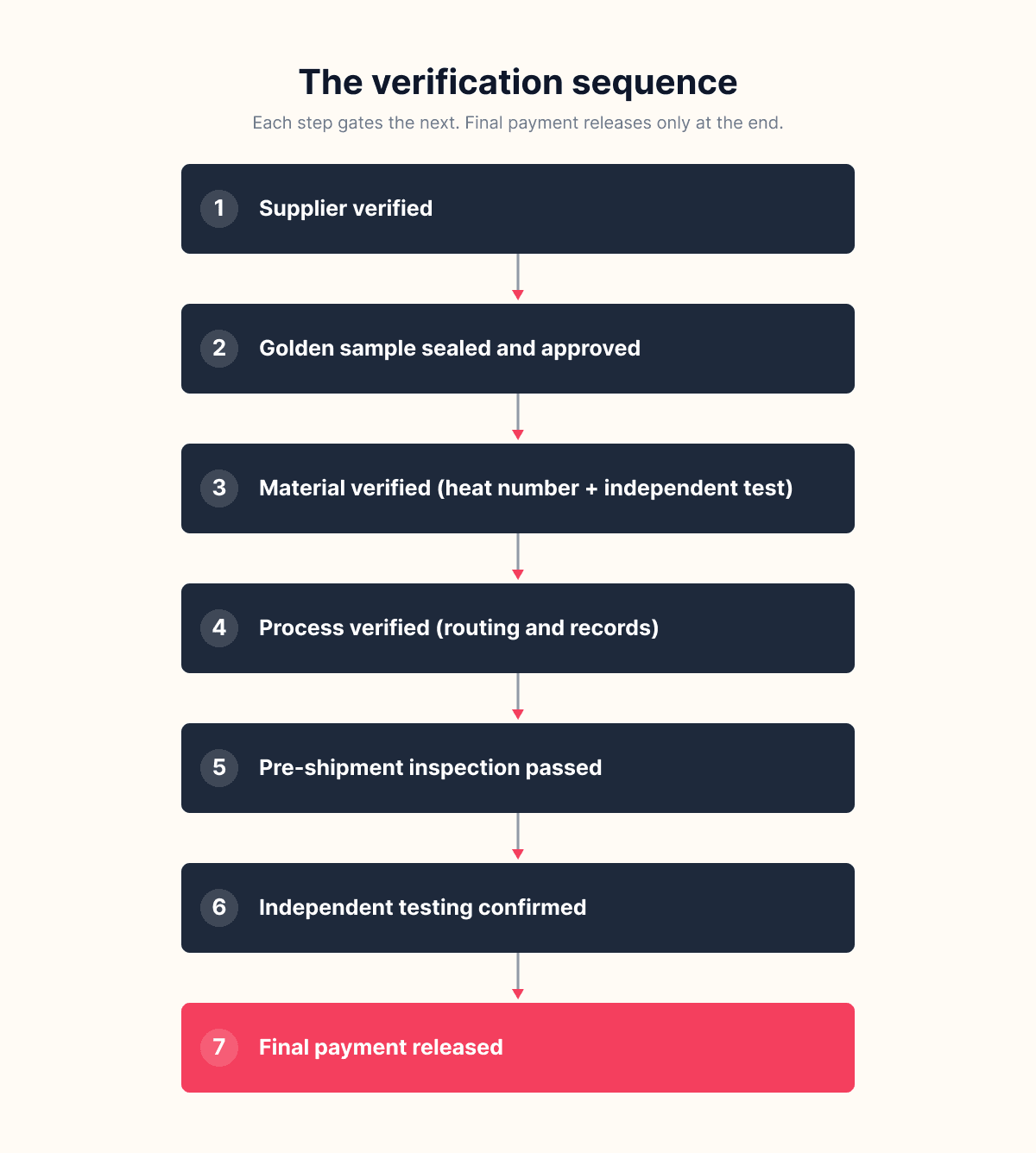
The full checklist:
| Step | The check | Why it matters | The proof you keep |
|---|---|---|---|
| 1 | Seal reference samples with buyer, factory, inspector | Stops the bulk drifting from the approved part | Signed, dated, sealed sample held by each party |
| 2 | Obtain control plan + measured first-article data | Shows consistency, not a one-off pass | Control plan and FAI with actual values |
| 3 | Reconcile heat number against hard-stamp | Catches material substitution | Photograph of matching numbers |
| 4 | Independent material test on random pieces | Confirms the grade, not just the paper | PMI result and lab report |
| 5 | Confirm the process by routing and records | Catches a cheaper process than quoted | Routing/traveler and production records |
| 6 | Scope pre-shipment inspection for material + components | A cosmetic check misses substitution | Inspection brief and independent report |
| 7 | Screen bought-in components through authorised sources | Catches counterfeit and clone inputs | Chain-of-custody and test results |
| 8 | Tie final payment to a passing independent inspection | Keeps leverage until the goods are proven | Payment terms linked to inspection certificate |
None of this requires a flight or a long relationship. It requires deciding, before the order, which proof you will hold yourself rather than accept on a supplier's word.
The buyers who meet the fewest quality surprises are rarely the ones who trust the most. They are the ones who verify the most.
See Also
Frequently asked questions
What is the difference between verifying a supplier and verifying a product?
Verifying a supplier confirms the company is legitimate and capable. Verifying a product confirms this specific order will arrive as the grade, build, and quality agreed. A genuine supplier can still ship a batch that drifted from the sample, used a cheaper material, or used a cheaper process, which is why product verification is a separate check and necessary before a large order.
Why does the first sample often not match the bulk order?
The approved sample is usually made under closer supervision than routine production and proves only that the design can be built. Production runs on ordinary shifts with normal variation, such as tool wear. Without sealed reference samples, a control plan, and a capability study on random production parts, the bulk can drift from the sample without anyone deciding to cut quality.
How do I verify the material is the grade the supplier claims?
Tie the delivered goods to independent evidence of what they are made from. For metals, reconcile the heat number on the certificate against the hard-stamp on the material and run independent positive material identification on random pieces, sending a sample to a lab where carbon content separates grades. For plastics, electronics, and chemicals, verify resin or component grade and batch traceability against an independent test.
How do I check the part was actually made by the process I paid for?
Agree the process in writing, then confirm it with records rather than assurances: the routing or traveler showing each operation, production and heat-treat records for the run, and a live or third-party look at the floor. A casting quoted but fabricated, or a forging quoted but machined from billet, can measure correctly while behaving differently in service.
What does a pre-shipment inspection not catch?
A standard inspection uses statistical sampling, so it controls the rate of defects rather than guaranteeing zero. A cosmetic-and-functional inspection will not catch wrong-grade material, the wrong process, or a counterfeit component sealed inside an assembly unless you explicitly scope material, process, and component verification into the brief.
How do I know a test certificate or factory video is not AI-generated?
Assume any document or video sent to you can be synthesised. Cross-check documents against each other for inconsistencies, then verify with evidence that is hard to fake: a live, unscripted video walkthrough, sealed-sample reconciliation you perform, heat-number matching on the physical material, and independent lab tests you commission directly.
What is product substitution after approval?
It is when a supplier qualifies a sample built around a specified brand or grade of input, then ships the production run with a cheaper clone or generic equivalent. The assembly looks identical, but the part you specified is not the part delivered. Verify branded and grade-specified inputs at receipt rather than assuming they carried through from the sample.
How should payment be structured to protect a large first order?
Release funds in stages against verified milestones rather than paying in full upfront. Use staged deposits, milestone escrow, or a letter of credit, and tie the final tranche to a passing independent pre-shipment inspection. Never release the final payment on forwarded photos, video, or reports alone; tie it to evidence you control.
Ready for fewer, better conversations?
Augmino connects verified Indian manufacturers with buyers who mean business.
Apply to Join