Comparing CNC Machining Quotes: Why Same Part Gets Different Prices


Comparing CNC machining quotes is hard because a cheap quote and an expensive quote can both be correct, just for different jobs. When an RFQ leaves a field open, each shop fills it with its own default assumption, and that assumption gets buried inside the number instead of written down anywhere. A fair comparison means putting every quote on the same basis first, before ranking anything by price. Skip that step and the cheapest quote is often just the most incomplete one.
Here are the five fields that most often make CNC quotes incomparable, at a glance.
| Field | What goes wrong when it's left open |
|---|---|
| 1. Tolerance class | A shop quotes a looser class than the drawing needs |
| 2. Surface finish | An Ra callout gets skipped or assumed at the shop's default |
| 3. Material grade and certification | Certificate type left to guess, priced too thin or too costly |
| 4. Secondary operations | A finishing step named only in a note quietly disappears |
| 5. Quantity breakpoint | Unit price built on a different release quantity than intended |
Same Bracket Four Shops Four Different Prices
A buyer needs an aluminum mounting bracket machined from 6061-T6 bar stock, 500 units a year, for an industrial control panel. The drawing calls out two dowel-pin bores on a tighter fit than the rest of the part, and a clear anodized finish on the face that faces the operator. The buyer sends the same drawing to four CNC shops.
Three weeks later, four quotes land. The unit prices, at the full 500-piece quantity, are 14.90 dollars, 17.25 dollars, 22.80 dollars, and 26.10 dollars.
None of the four shops actually quoted the same job. This is an illustrative scenario built to show the mechanism, not a real transaction. But it is a pattern that buyers who run more than one CNC shop through the same RFQ round will recognize.
What Each Quote Actually Assumed
A raw price is not comparable until someone checks what it was built on. Here is what normalizing these four quotes reveals.
| Shop | Quoted unit price (qty 500) | What the quote actually assumed | What normalizing it reveals |
|---|---|---|---|
| A | $14.90 | Priced to a general medium tolerance across the whole part, not the tighter fit the two dowel-pin bores need | Understated. Does not actually meet the drawing |
| B | $17.25 | Machined to the correct tolerance, but left the anodized finish off entirely | Understated. Missing a required operation, not a valid like-for-like quote |
| C | $22.80 | Correct tolerance on the bores, anodize as specified, a standard material certificate | The real like-for-like price |
| D | $26.10 | Correct spec, but priced against a 100-unit quarterly release instead of the full 500-unit annual quantity the buyer meant to commit as one order | Not comparable. A different quantity basis, not a different cost structure |
Once normalized, the real spread is smaller than the raw numbers suggest, and it is not really a four-way price comparison at all. Shop A and Shop B are not cheaper quotes. They are quotes for a part that does not match the drawing. Shop C is the one number that means what it looks like it means. Shop D might still be the better long-term partner, but its price needs to be re-run at the real quantity before anyone can tell.
The Five RFQ Fields Behind Every CNC Quote Spread
Each of the four quotes above went sideways on one of a small, repeatable set of fields. These are the fields that decide whether a CNC quote can sit next to another one on the same sheet.
Tolerance class. A drawing that says "hold general tolerances" without naming a standard leaves a shop to guess. ISO 2768 is a commonly used general-tolerance standard for machined parts, defining four classes often labeled fine, medium, coarse, and very coarse. For a dimension in the 6 to 30 millimeter range, the fine class allows about plus or minus 0.1 millimeters, the medium class about plus or minus 0.2 millimeters, roughly double. A shop that quotes to the looser class when a feature needs the tighter one is not being efficient. It is quoting a different part.
Surface finish. Surface roughness is usually specified as an Ra value. A drawing with no Ra callout typically gets priced at a shop's own standard as-machined finish, commonly around Ra 3.2 micrometers, or about 125 microinches. A mating or cosmetic surface that needs a finer finish, say Ra 1.6 or Ra 0.8 micrometers, usually needs extra passes or a secondary process to get there. Leave the RFQ silent and some shops will quote their default finish while others quote a finer one they assume is expected. The two numbers will not mean the same thing.
Material grade and certification. "Aluminum 6061" and "6061-T6, mill certified" are not the same request. A certificate itself also comes in more than one form. Under EN 10204, a widely used framework for metallic material inspection documents, a Type 2.1 certificate is just a declaration of compliance with no test data. A Type 3.1 certificate carries actual test results from the specific batch supplied. A Type 3.2 adds an independent third-party witness on top of that. An RFQ that just says "certificate required" leaves the shop to guess which type. A shop that assumes the costlier version is not being generous. It is pricing a different deliverable than the one another shop assumed.
Secondary operations. Anodizing, plating, heat treatment, and passivation are usually priced as separate line items on top of the base machining cost, not bundled in by default. Passivation on stainless parts is commonly evaluated against ASTM A967, a named specification for chemical passivation treatments. A finish requirement mentioned only in a drawing note, and never placed in the line-item scope, will sometimes get quoted and sometimes quietly dropped, and the buyer usually does not find out which until the parts arrive.
Quantity breakpoint. CNC pricing carries a fixed setup cost, covering programming, fixturing, and first-article inspection, spread across however many units a shop believes it is quoting. One published example shows a single prototype part at roughly 180 dollars falling to around 30 dollars a unit once the batch reaches 100 pieces, as that same setup cost divides across more parts. State an annual volume without saying how it will actually be released, one order or several smaller ones, and each shop is free to amortize that fixed cost differently. The resulting unit prices will not describe the same commitment.
Signs Your CNC RFQ Isn't Built for a Fair Comparison
A few honest signals suggest the problem sits in the RFQ, not in the shops that quoted it.
- Two quotes for the same drawing are more than 30 or 40 percent apart with no obvious reason why.
- A follow-up call is needed after every round just to find out what each quote actually included.
- Nobody can say, without checking, whether a quote assumed the annual volume or a smaller release quantity.
- A finish or certificate mentioned in a drawing note never shows up as its own line item on any quote.
- The cheapest quote keeps turning out to be the one missing a step, once someone checks.
If two or more of these sound familiar, a review of the RFQ document itself, not another round of quotes, is usually the faster fix. Our general guide to specifying a precision component covers how to write these fields into a drawing and RFQ so a shop is not left guessing in the first place.
How to Normalize a CNC Quote Before You Compare Price
Once quotes are in hand, normalizing them is a short, repeatable pass rather than a full re-quote.
| Step | What to check | Why it matters |
|---|---|---|
| 1. Match the tolerance class | Does the quote's process plan match the tightest class the drawing actually calls out, feature by feature | A quote priced to a looser class is not a lower price, it is a different part |
| 2. Match the surface finish | Is the quoted Ra value the one the drawing specifies, on every surface that needs it, not just the shop's default | A missing Ra callout usually means the shop priced its own standard finish |
| 3. Match the certificate type | Does the quote name a specific certificate type, and is it the type actually required, not a costlier or thinner one assumed by default | A certificate line with no type named is a guess wearing a checkbox |
| 4. Match the secondary operations | Is every finishing step in the drawing's notes actually priced as its own line item | A step mentioned only in a note is the most common one to quietly disappear |
| 5. Match the quantity basis | Is the quoted unit price built on the same order quantity and release schedule the buyer actually intends | A lower unit price against a smaller batch is not a lower total cost |
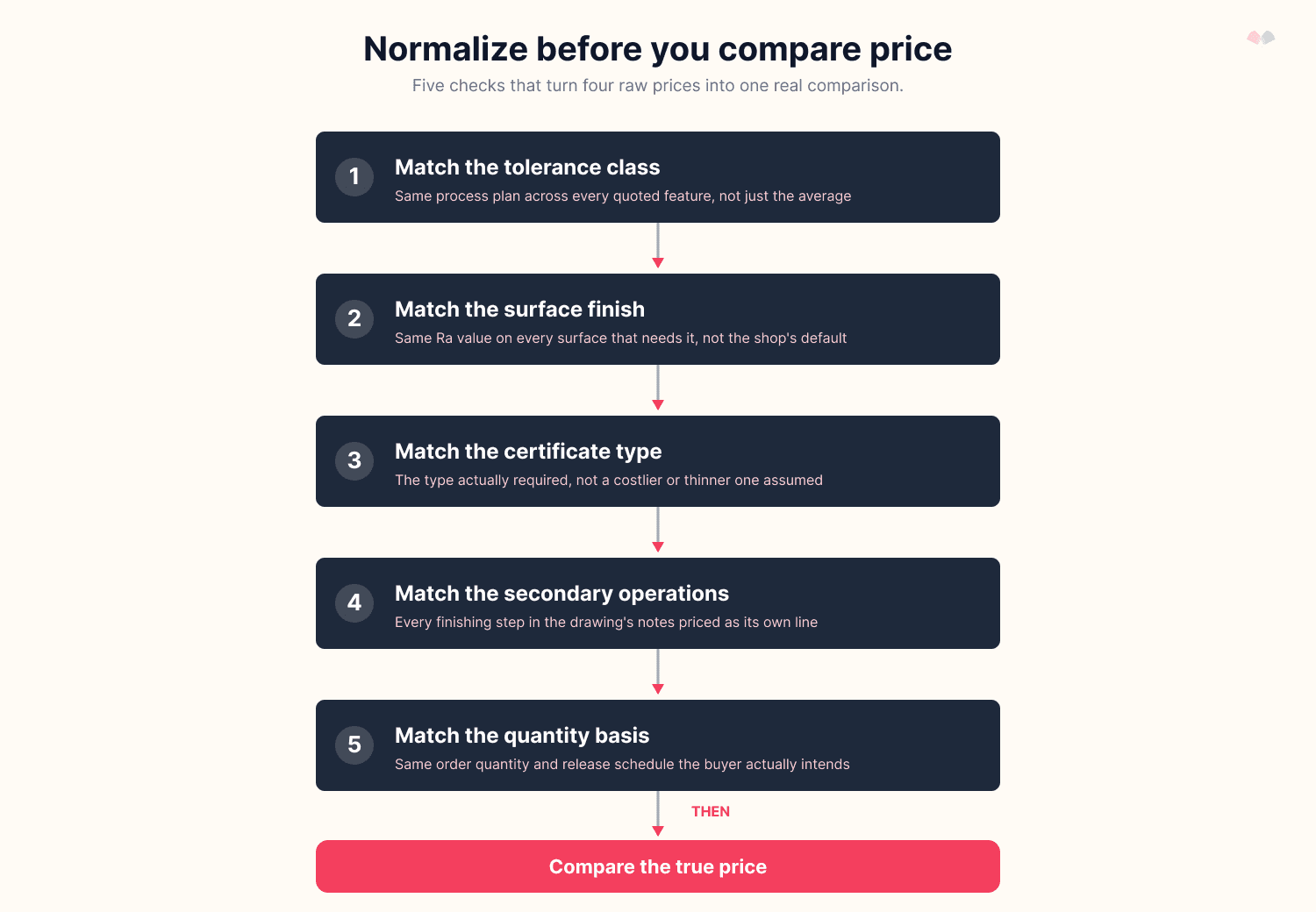
Running a quote through this pass before ranking it by price usually narrows a wide-looking spread into a small one, and occasionally reverses which quote actually looks best.
Normalizing puts every quote on the same basis. It does not tell you whether that basis is priced fairly. For that, a buyer needs an independent estimate of what the part should cost, built from the same material, process, overhead, and margin layers a shop uses to price it. Our should-cost model template guide covers building one without specialist software, useful once Shop C's normalized number above is the one left standing and the question becomes whether $22.80 itself is a fair price.
Bring the shop in before the drawing is called final
A shop that only sees a drawing after it is finished can only quote it as written, gaps and all. A shop that sees it while still open can flag a tolerance tighter than the part needs, or a finish that will need an extra step nobody budgeted for. That does not need a formal contract, just an invitation before the drawing is marked final. Our general RFQ guide covers the full field-by-field document, and our prototype RFQ process guide covers this same normalization mechanic for buyers still at the prototype stage, before a production quantity exists at all.
See Also
- How to Specify a Precision Component for Indian Manufacturing Suppliers
- Material Test Certificate Verification Guide
- Payment Protection For First Order
- Buyer Reference Check Script for Industrial Suppliers
- Sourcing CNC Machined Components Buyer Guide
- How OEM Buyers Manage RFQs When Sourcing Prototypes
Frequently asked questions
Why do CNC quotes for the same part come back at such different prices?
Usually because the RFQ left a field open and each shop filled the gap with its own default assumption. The five fields most likely to cause this are covered in detail above. The price difference is often a specification difference wearing a price tag.
What is a tolerance class and why does it change a quote?
A tolerance class is a standard grouping of allowed dimensional deviation, commonly referenced through frameworks like ISO 2768. A tighter class usually needs closer process control and more inspection, which costs more. Naming the class explicitly, rather than writing "hold tolerance," is what keeps two shops quoting the same actual requirement.
Do I need a third-party witnessed material certificate for every CNC order?
Not usually. Certificate types carry different levels of rigor and cost, and the more heavily verified types are typically reserved for regulated or safety-critical parts. Naming the exact type your part actually needs, rather than writing "certificate required", is what prevents one shop from quoting a level of assurance you never asked for.
Why did one of my quotes leave out anodizing or plating?
A finishing step mentioned only in a drawing note, rather than called out as its own line item, is the one most likely to get missed or silently dropped from a quote. It is rarely intentional. It is usually a scope gap in how the RFQ was structured.
How many CNC shops should I send an RFQ to for a fair comparison?
Enough to get a real spread without turning the review into its own project. A handful is usually workable for most rounds. More shops does not fix a badly specified RFQ, it just multiplies how many different assumptions come back.
What quantity should I put on a CNC RFQ if my annual volume isn't fixed yet?
State your best estimate of the annual volume and how you expect it to be released, in one order or in smaller batches over the year. A shop's unit price depends heavily on that release pattern, not just the total number, so leaving it vague is one of the more common reasons quotes stop being comparable.
Can I compare a quote from an automated shop against one that machines a feature by hand?
Only after checking that both quotes are actually built on the same tolerance and finish requirement. A shop quoting manual finishing to hit a tight Ra value is not automatically less capable, but its price reflects a different process than a shop machining the same feature directly. The normalization pass above applies here as much as anywhere.
Ready for fewer, better conversations?
Augmino connects verified Indian manufacturers with buyers who mean business.
Apply to Join