How Buyers Verify Who Is Actually Manufacturing Their Part


Six weeks into production, a buyer's parts started failing a hardness check they had never failed before.
The factory was real. The buyer had visited it twice. The machines on the floor matched what was quoted. Nothing about the relationship looked like a broker problem or a paperwork problem.
The part in question needed a heat treatment step after machining, a process that hardens the metal by heating it and cooling it in a controlled way. The factory did not own a furnace for this. It never had. For two years, that step had been sent to a shop across town. The parts had come back fine every time. Then that shop changed its process slightly to handle a bigger customer's order. Nobody told the buyer, because nobody had ever told the buyer the step was outsourced in the first place.
Nothing here was fraud. The factory that machined the part was exactly who it said it was. It just never mentioned that one operation in the middle of the job happened somewhere else, under a process the buyer had never seen and never asked about.
A different problem than "is this a real factory"
Most supplier vetting effort goes toward one question. Is the entity you are dealing with an actual manufacturer or someone standing in front of one? That question matters. There is a separate guide on spotting the signals that tell a real factory from a broker.
A second, separate question is who legally holds the contract and the risk if something goes wrong, whether you are buying through an agent, a trading company or a verified platform. That question also has its own answer.
This piece is about a third question, one that only comes up after the first two are already settled. You are dealing with a real factory. The contract is clear. And the part still was not entirely made where you think it was made.
Subcontracting is normal. Silence about it is the actual problem.
No single factory does everything under one roof. A CNC shop rarely owns a plating line. A sheet metal shop rarely runs its own heat treatment furnace. A specific coating, a specific hardness spec or a specific finish often needs a separate, specialised operation that only a handful of shops in a region actually run well.
Sending that one step out to a shop that specialises in it is often the right engineering decision, not a shortcut. A factory that insisted on doing every operation in-house, badly, would be a worse choice than one that outsources the step to a specialist and manages that relationship well.
The problem is not that the step left the building. The problem is that the buyer was never told it left the building, so nobody was watching it.
The same gap shows up on the inspection side, not just the manufacturing side. A factory can machine a part entirely in-house and still send the finished piece out for CMM inspection, metallurgical testing or lab analysis it does not have the equipment to run itself. That result is only as trustworthy as knowing who actually produced it, the same question this guide asks about heat treatment or plating.
What actually goes wrong when this is invisible
When a subcontracted step is undisclosed, a few things quietly become true.
The buyer's own audit or site visit checked one building's controls. It never touched the second shop's controls, because the buyer did not know a second shop existed.
Any quality certificate the buyer relied on usually covers the same gap. A quality system certificate is awarded to a site's own management system for controlling its processes, including how it selects and manages outside providers. It is not usually the same thing as a direct, independent audit of that outside provider's own floor. The certificate is real. It simply answers a narrower question than most buyers assume it answers.
If the subcontractor changes a process, changes ownership or gets replaced with a different shop, nothing on the buyer's side flags it. The part can drift from what was originally qualified without a single document changing.
And if something does go wrong, the buyer has spent weeks building a relationship with one factory while the actual point of failure sits with a shop they have never spoken to, never audited and do not have a direct way to reach.
None of this means the buyer was lied to. It usually means one operation lived outside the part of the process the buyer thought to ask about.
Signs your current process is not built to catch this
A quick self-check before the how-to below. If most of these are true for how you currently qualify and audit suppliers, this gap is probably open right now, even with suppliers you already trust.
- You have never asked a supplier for a full list of every operation their part goes through, start to finish.
- Your quotes list a process like heat treatment, plating or a coating as one line item, with no name attached to who actually performs it.
- Your factory audit covered the building you visited. Nobody asked whether every operation in the routing happens inside that same building.
- You have reviewed a quality certificate without checking exactly what site and which processes it covers.
- You have never seen an outbound shipping record, a courier slip or a subcontractor invoice tied to your own part during an audit.
- You would not be able to say, right now, how many different locations a part of yours physically passes through before it ships.
A practical way to verify who actually makes the part
Follow the steps in order:
Step 1: Ask for a full process map, not a capability list
A capability list tells you what a factory can do in general. A process map tells you what actually happens to your specific part, operation by operation, from raw material to the finished piece ready to ship.
Ask the factory to write out every step in order. For each one, ask them to mark whether it happens on their own site or somewhere else. If it is somewhere else, ask them to name that shop. A factory that already tracks its own routing internally, which most serious ones do, can produce this in a day or two because the information already exists in their own planning documents.
Step 2: Match the map against what you actually saw on the floor
If the process map says heat treatment happens on-site and your last visit never showed you a furnace, that is worth a direct question, asked plainly rather than as an accusation. Sometimes the answer is simple. A new machine arrived after your last visit. Sometimes it reveals the map was written loosely rather than checked against reality.
Step 3: During an audit, ask to see the paperwork that shows where a step actually happened
Two records are hard to fake because they exist for reasons that have nothing to do with satisfying a buyer's question. An outbound shipping or courier record shows a part physically leaving the site for a named destination and coming back. A subcontractor invoice shows a named vendor was paid for a named operation on a given batch. A factory that actually runs everything in-house will not have these records for that operation. A factory that does subcontract can usually produce a few recent examples without much delay, because ordinary paperwork like this already gets filed somewhere.
A photo or PDF of either record is not automatically proof on its own. A document can be generated to look convincing, the same way any document can and that gets easier every year. The stronger version of this ask is not just seeing the record but seeing the actual tracking or invoice number on it, then checking that number independently against the courier's own site or a direct call to the named vendor. A record you can trace outside the factory's own paperwork is harder to fabricate than one you only ever see inside it.
Step 4: Ask one specific question about a process the factory claims to run in-house
If a factory says it heat-treats in-house, ask a detail only someone who actually runs that process would know without checking, like the type of furnace, the general temperature range for the material in question or how they confirm the part reached the right hardness afterward. A team that runs the process daily answers this without much hesitation. A vague or delayed answer is not proof of a problem, but it is a fair reason to ask the process-map question again, more directly.
Step 5: Ask for a simple, standing disclosure agreement
Once a process map exists, the easiest way to keep it accurate is to ask for one plain commitment going forward. If any new operation gets sent out to a different shop or an existing subcontractor changes, the factory tells you before the next shipment rather than after a problem shows up. This costs the factory almost nothing to agree to if their process is stable. It turns a one-time question into an ongoing habit.
Which operations deserve the closest attention
Not every outsourced step carries the same risk if it changes without warning. When time is limited, spend it checking the operations where a defect will not show up until the part is already in use.
Special processes belong in this group. Heat treatment, welding, plating, anodizing, coating, passivation, NDT and calibration all fall here. A mistake in any of them can pass a dimensional check on the factory floor and still fail months later, the same pattern the buyer in the opening story ran into.
Packaging, labeling and laser engraving sit at the other end. A vendor change for one of these does not touch the part itself. A heat treatment vendor change can shift the part's properties without changing a single dimension a caliper would catch.
A simple process map template
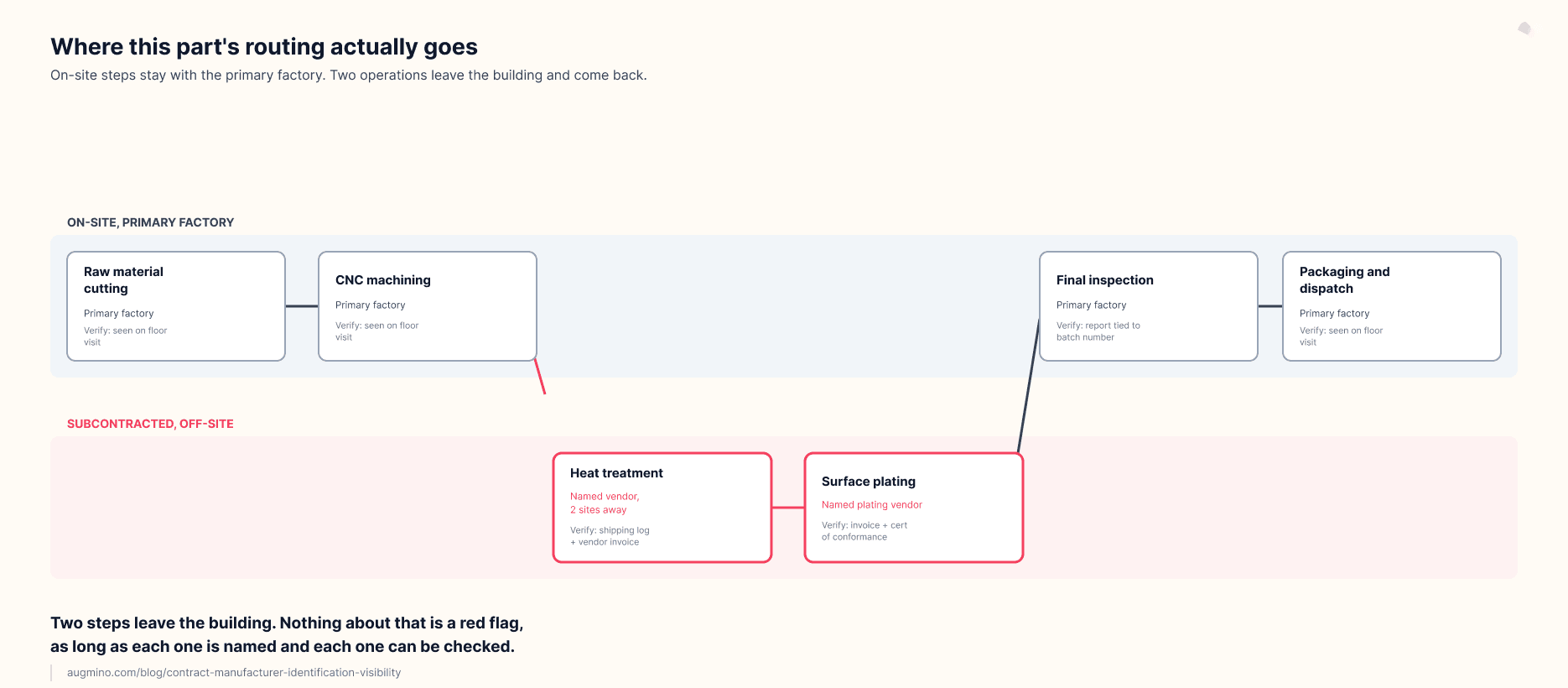
Below is the shape of a completed map for the heat-treatment example above, filled in as an illustration of what a real answer should look like.
| Operation | On-site or subcontracted | Performed by | How to verify |
|---|---|---|---|
| Raw material cutting | On-site | Primary factory | Seen directly during floor visit |
| CNC machining | On-site | Primary factory | Seen directly during floor visit |
| Heat treatment | Subcontracted | Named heat-treat vendor, two locations away | Outbound shipping log plus vendor invoice for the batch |
| Surface plating | Subcontracted | Named plating vendor | Vendor invoice plus a sample certificate of conformance for the plating batch |
| Final inspection | On-site | Primary factory | Inspection report tied to the batch number |
| Packaging and dispatch | On-site | Primary factory | Seen directly during floor visit |
The value of this table is not the specific example. It is having every operation named somewhere, instead of the routing living only in one production planner's head at the factory.
Three questions for your next supplier visit
A full process map takes time to build. If the next visit is coming up before that is ready, three questions cover most of the same ground in one conversation.
- Which operations leave this building?
- Who performs them?
- How would I know if any of that changes next month?
What this does not mean
This is not a reason to treat every subcontracted operation as a red flag or to demand every process happen under one roof. Plenty of well-run supply chains rely on specialist shops for exactly the steps described here. Insisting otherwise usually trades a known, managed process for a worse in-house one. The goal is visibility into the routing that already exists, not forcing every factory into a shape it was never built to be.
It is also not proof that a certificate or an audit report is worthless. Both are real evidence of what they actually checked. The fix is asking what they checked, not assuming they checked everything.
Where AI fits and where it does not
A newer category of tool does a version of this work at a much larger scale. Platforms built for multi-tier supply chain mapping use AI to flag sub-tier relationships a company was never told about directly, aimed at manufacturers managing thousands of suppliers at once. General Motors has used a suite of these tools, including one that maps relationships between its direct suppliers and their own sub-tier partners, across its roughly 18,000 suppliers since 2022.
This category of tool exists and it is where large-scale supply chain risk management is heading. It is not built for a buyer sourcing from one or two Indian job shops and checking whether a single heat treatment step is disclosed. The process map, the floor visit and the paperwork check above solve that problem at the scale most readers of this guide actually operate at. The direction is worth knowing about. The five steps above are still the right tool for the job in front of you.
Where this leaves you
The next time a factory's process, capability or quote mentions an operation like heat treatment, plating or a specific finish, treat the name of that step as a question, not a fact. Who actually performs it? Can that be shown in a record that would exist anyway?
A process map does not replace the checks covered in how buyers verify a supplier before the first order. It fills in the one part of the routing those checks were never built to see.
See Also
Download
Augmino Manufacturing Process Map Template
XLSX · 6.6 KB
Manufacturing Process Map Template
Frequently asked questions
How do I verify who is actually manufacturing my part?
Ask the factory for a full process map naming every operation from raw material to finished part, marking which ones happen on-site and which are sent elsewhere. The steps for building and checking that map are covered above.
What is contract manufacturer identification?
It means confirming which physical site performs each step in making a part, not just confirming the name on the purchase order. The gap between the two is what this guide walks through.
Is it normal for a factory to subcontract part of the manufacturing process?
Yes. It is often the better engineering choice for a specialised step like heat treatment or plating. The issue is disclosure, not the subcontracting itself, explained further above.
How do I know if my supplier is hiding a subcontractor?
Most cases are not hiding so much as never disclosing by default. A process map, matched against what you saw on a floor visit and backed by shipping records or subcontractor invoices, is the practical way to check, detailed in the steps above.
What questions should I ask about subcontracted manufacturing processes?
Ask which operations are subcontracted, who performs each one and for a specific technical detail about any process claimed in-house. The full question set is in the verification steps above.
Does an ISO 9001 certificate cover subcontracted operations?
It certifies how the primary site manages and selects its outside providers, which is not the same as a direct audit of that provider's own floor. What this means for your own verification is covered in the section above.
How do I check manufacturing visibility during a supplier audit?
Ask to see outbound shipping records and subcontractor invoices tied to your own batches, alongside the process map. Why these two records are hard to fake is explained in Step 3 above.
Ready for fewer, better conversations?
Augmino connects verified Indian manufacturers with buyers who mean business.
Apply to Join