Who Bears the Currency Risk When Paying an Indian Supplier


A supplier in Rajkot quotes a German buyer 4,200 rupees a unit. The buyer reads that number and converts it in his head into euros the same afternoon. The supplier reads the same number in rupees, because that is the only currency his rent, his wages and his steel bill come in.
Three weeks pass before the purchase order is signed. In that time the rupee moves against the euro, the way it moves against most currencies most weeks. Nobody agreed who absorbs that gap. It lands on whichever side has less leverage to argue about it once the invoice shows up.
That is the whole question this piece answers. Who carries the currency risk in a cross-border order depends on one decision almost nobody writes down on purpose: which currency the quote and the eventual invoice are denominated in. Get that one choice clear and the rest is mechanics.
The Rule That Decides Who Is Exposed
Here is the short version. In most transactions, whoever's home currency is NOT the invoice currency is the one carrying the risk, unless they already have a natural offset, like a supplier who imports raw material in the same foreign currency they are invoicing in, or a buyer who earns revenue in the same currency they are paying in.
If an Indian supplier invoices a foreign buyer in US dollars, euros or pounds, the buyer's payment amount in their own currency never moves. The supplier is the one converting a fixed foreign-currency number into rupees on payment day. That rupee amount can come in higher or lower than what they expected when they quoted.
If the same supplier invoices in Indian rupees instead, the numbers flip. The supplier's rupee revenue is locked the day the quote is signed. Now it is the foreign buyer who has to go find that many rupees using their own currency. How much of their own money that takes depends on the exchange rate on the day they actually pay.
Neither arrangement is automatically the fair one. It depends on who is better placed to manage the risk. That is a real negotiable choice, not a fixed default either side has to accept.
Why This Is Not a Theoretical Problem Right Now
The rupee has had a rough stretch by any recent measure. It closed out 2025 down about 4.7 percent against the US dollar for the year, its worst annual showing since 2022 and Asia's worst-performing currency that year, a slide Bloomberg tied mainly to steep US tariffs on Indian exports and heavy foreign investor outflows from Indian equities.
It kept sliding into 2026. The rupee opened the year near 90 to the dollar, then weakened further as the Iran-Israel conflict pushed crude oil prices sharply higher, since India imports most of its oil and a pricier oil bill puts more pressure on the currency. By mid-May 2026 it had touched an all-time low above 96 to the dollar, down roughly 6 percent from where it stood when the conflict began just a few months earlier.
It has not snapped back since. Through July 2026 the rupee kept trading in the mid-90s against the dollar, only easing slightly after the Reserve Bank of India stepped in and sold dollars aggressively to slow the fall. That is a real recent multi-month move, not a one-day blip. It happened over almost exactly the kind of window a manufacturing order sits between quote and payment.
A rupee move of a percent or two in three weeks is not a crisis for either side. A move of several percent over a few months, in a contract that never named who absorbs it, becomes someone's shrinking margin or someone's unplanned extra cost, usually discovered for the first time on an invoice.
Invoicing Currency Is a Choice, Not a Default
A lot of buyers assume an Indian supplier has to invoice in rupees or has to invoice in dollars, as if the currency were fixed by law. Neither is true. Under India's foreign exchange rules, an export contract and its invoice can be denominated in a freely convertible currency such as the US dollar, euro or pound or in Indian rupees. The choice sits with whatever the buyer and supplier agree to.
One asymmetry is worth knowing. The money that actually changes hands, called the export proceeds, generally has to be realized in a freely convertible currency, with narrow exceptions for specific rupee settlement arrangements. New rules from 1 October 2026 also give rupee-invoiced exports a longer realization window, 18 months instead of 15. That deadline mechanic is covered in full in RBI's export realization rules. Here it matters only as a small nudge toward rupee invoicing when a buyer will accept it.
| Invoice currency | Who is protected from a rate move | Who absorbs the risk | Realization window (from 1 Oct 2026) |
|---|---|---|---|
| Foreign currency (USD, EUR, GBP) | Buyer, whose payment stays fixed in their own currency | Indian supplier, converting a fixed foreign sum into rupees on payment day | 15 months from shipment |
| Indian rupees (INR) | Indian supplier, whose rupee revenue is locked at signing | Foreign buyer, who has to source that many rupees at whatever rate applies on payment day | 18 months from shipment |
Neither column is the "correct" one to pick. A larger supplier used to handling foreign exchange or one that already buys imported raw material in dollars and has a natural offset may be perfectly comfortable invoicing in a foreign currency. A smaller shop new to exporting or one whose costs are entirely rupee-denominated usually has a stronger case for pushing the risk back onto the buyer by invoicing in rupees.
How Buyers and Suppliers Usually Share the Risk
Nothing says one side has to carry all of it. Picking an invoice currency decides who is exposed by default, but that exposure is still a negotiable point, the same as price or lead time, and industrial contracts often end up splitting it rather than assigning it whole to one party. A few patterns that show up in practice:
- A short validity window. The quote holds at a fixed rate for a set number of days, after which it gets reconfirmed. This does not remove the risk, it just bounds how long either side is exposed before the price is revisited.
- A renegotiation trigger. The price stands as quoted unless the rate moves past an agreed threshold, commonly two to five percent, at which point either side can ask to revisit it.
- A first-loss absorption. One side, often the supplier, absorbs the first percent or two of movement as a cost of doing business, with anything beyond that split or passed through.
- An even split beyond a threshold. Past an agreed trigger, both sides absorb half the additional movement instead of one side taking it all.
- A forward contract booked right after the purchase order is signed. Whoever carries the exposure locks in a rate immediately, so the risk is real only for the days between quote and PO signing, not the full quote-to-payment window.
None of these require sophisticated financial instruments. They require writing down, in the quote or the purchase order, which pattern applies before either side has a reason to disagree about it later.
What a Rate Move Actually Does to One Order
Numbers make this concrete faster than any explanation. Take a CNC machining order worth 48,000 dollars, invoiced in US dollars, with 60 days between the quote date and the day payment actually clears. The rates below sit inside the real range the rupee moved through between January and May 2026, not a forecast of what will happen next.
| Scenario | Rate at quote | Rate at payment | Rupee value expected | Rupee value actually received | Result for the supplier |
|---|---|---|---|---|---|
| Rupee weakens | ₹90/$ | ₹96/$ | ₹43,20,000 | ₹46,08,000 | Gain of ₹2,88,000 |
| Rupee strengthens | ₹90/$ | ₹85/$ | ₹43,20,000 | ₹40,80,000 | Shortfall of ₹2,40,000 |
| Rate holds steady | ₹90/$ | ₹90/$ | ₹43,20,000 | ₹43,20,000 | No change |
Same order, same buyer, same work delivered. The only thing that changed is a number neither side controls. Under dollar invoicing, that swing sits entirely with the supplier. Flip the invoice to rupees and the same swing lands on the buyer instead.
Signs You Are Carrying This Risk Without Realizing It
A quick check before your next order.
- Your quotes and invoices are in a foreign currency, but nobody has ever compared the rate you quoted at against the rate you actually got paid at.
- A single order's margin would meaningfully change if the rupee moved three to five percent between quote and payment. You have never worked out by how much.
- You routinely quote weeks or months ahead of the shipment and payment dates, so there is real time for a rate to move before money changes hands.
- You have repeat orders with the same buyer, which makes this worth solving once with a real process, not re-deciding order by order.
- Your bank has never asked whether you want to lock in a rate. You have never asked them either.
- Nobody on either side of the deal could say, right now, which of you is supposed to absorb a rupee move if one happens before payment.
If two or more sound familiar, the fix below is worth setting up before your next order, not after a rate move already cost somebody money.
The Basic Tool: Locking In a Rate Ahead of Time
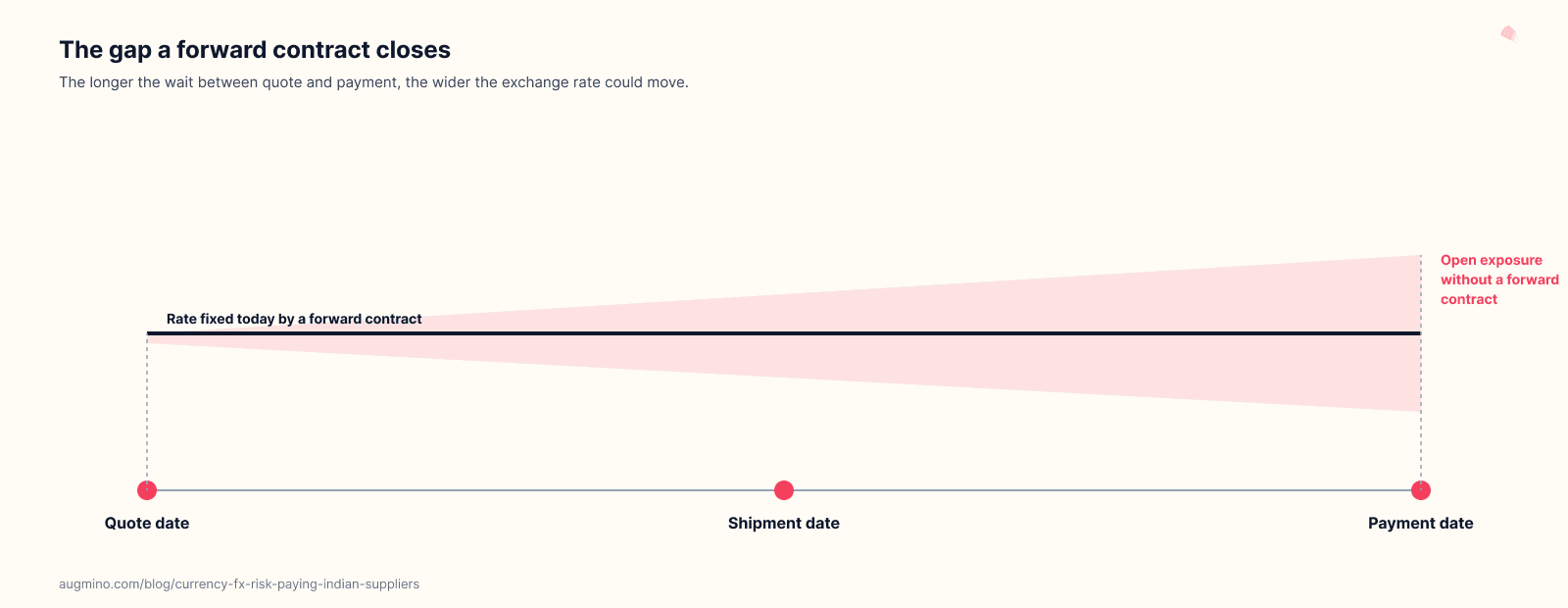
The standard tool for this is called a forward contract. In plain terms, it is an agreement with a bank, made today, to convert a fixed amount of one currency into another at a fixed rate on a set future date, no matter what the market rate turns out to be that day. An exporter expecting 48,000 dollars in 60 days can book a forward contract now and know the exact rupee amount they will get.
The Reserve Bank of India makes this accessible to a small manufacturing exporter, not just a large company with its own treasury desk. Under RBI's current framework, exporters can hedge on a "contracted exposure" basis, meaning they already have a firm order or invoice in hand. They can also hedge on an "anticipated exposure" basis, covering a transaction not yet contracted, sized off expected or historical export turnover, even before a specific order gets signed. For smaller amounts, any exporter can book forward contracts up to USD 250,000 on a simple declaration, without further supporting documentation, so meaningful hedging capacity is real even for a modest-sized shop. It takes one phone call to whichever bank handles the company's foreign exchange and a clear answer to two questions: how much and by when.
A forward contract is a flat line cutting straight through a widening band of uncertainty. It does not predict where the rate will land. It simply removes the question by fixing the answer in advance.
Questions to Ask Before Accepting a Foreign-Currency Quote
Before signing off on either side of a cross-border quote, a short set of questions surfaces most of what matters:
- Which currency are your raw materials or major inputs purchased in? A natural offset changes how much of this risk is actually yours.
- Has this order already been hedged, or is it still open?
- How long is the quoted rate valid before it needs reconfirming?
- What happens to the price after that window closes?
- Who absorbs a rate move of three to five percent, and is that written down anywhere?
- Is the exchange rate in the quote fixed, or just indicative of the day it was written?
A buyer or supplier who can answer all six before the purchase order is signed has, in effect, already written the currency clause. The ones who cannot are the ones who find out the answer on an invoice.
The One Sentence Most Quotes Are Missing
None of this requires either side to start trading currencies. A supplier does not need to guess where the rupee is going next. What closes the gap is one sentence in the quote itself, stating which currency the price is fixed in and how long that holds before it needs reconfirming. A quote that reads "valid for 15 days at this rupee-to-dollar rate" does something a bare unit price never does. It makes the currency assumption visible instead of leaving it to be discovered later, on an invoice, by whichever side absorbed it.
That single sentence is worth more to a buyer or a supplier than most of the negotiating that happens over the unit price itself. The price was always going to move a little with the exchange rate. What was missing was ever writing down whose problem that was. For a fuller look at the total cost picture a currency clause fits inside, see the should-cost model for total cost of ownership.
The Takeaway
The rupee's recent volatility is real, it is documented and it lands somewhere on every cross-border order that spans more than a few days between quote and payment. It does not have to be a mystery which side it lands on. That is a choice both sides can make on purpose, in writing, before a price gets agreed, instead of discovering it after the fact on whichever invoice happened to catch a bad week for the rupee.
See Also
Download
Augmino Currency Clause Template
XLSX · 6.8 KB
Currency clause template for quotes and purchase orders. Gives a buyer or supplier 4 ready-to-use clause options
Frequently asked questions
Who is responsible for currency risk in an international purchase order?
It depends entirely on which currency the quote and invoice are denominated in, not on who happens to be the buyer or the seller. The mechanism is explained in full above.
Can an Indian supplier invoice in US dollars or does it have to be in rupees?
Indian exporters can choose either, under India's foreign exchange rules. The tradeoffs of each choice, including a realization-timeline incentive for rupee invoicing, are covered in the invoicing currency section above.
What is a forward contract in simple terms?
It is a way to lock in today's exchange rate for a payment expected weeks or months from now, so neither side has to guess what the rate will be later. The mechanics and who can access it are explained above.
Does the Reserve Bank of India allow small exporters to hedge without a lot of paperwork?
Yes, within limits. Any exporter can book a forward contract up to USD 250,000 on a simple declaration, without further documentation. The exact bases available, contracted exposure versus anticipated exposure, are covered in the hedging section above.
Is invoicing in rupees better for the foreign buyer or for the Indian supplier?
Neither side automatically benefits. It shifts the exposure from one side to the other. Which side should prefer it depends on who is better placed to manage that risk, discussed in the invoicing currency section.
How much can the rupee move against the dollar in a few months?
It moved several percent inside windows shorter than a typical order cycle during 2026. Real examples are covered above rather than one number to memorize, since the move that matters is the one on your own order dates.
What should go into a currency clause in a quote or purchase order?
At minimum, the currency the price is fixed in and how long that price holds before it needs to be reconfirmed against a new rate. The reasoning behind that one sentence is covered in the closing section above.
Ready for fewer, better conversations?
Augmino connects verified Indian manufacturers with buyers who mean business.
Apply to Join