How to Get More RFQs as a Manufacturing Job Shop: 5 Levers Beyond Marketing


A precision fabrication shop wins its first order from a new buyer. An enclosure bracket, 800 pieces, delivered on time, quoted at a fair price. Nine months pass. The buyer never sends another RFQ, not for the next revision, not for a related panel sourced from a different shop entirely. The shop reviews its own performance, finds nothing wrong with the part or the delivery, and concludes the buyer must have found someone cheaper. That is rarely what actually happened.
RFQ volume for a manufacturing job shop plateaus after a first order for identifiable, fixable reasons that have little to do with marketing or visibility. A shop that already gets discovered and wins a first RFQ, then watches volume flatten instead of grow, is usually losing ground on four fixable behaviors, covered one by one below. Underneath all four sits a quieter mechanic. Buyers limit how many unfamiliar shops they keep re-engaging, because re-verifying a new one carries a real, recurring cost.
Here are the five levers at a glance. Each is covered in detail below.
| Lever | What it fixes |
|---|---|
| 1. Quote turnaround speed | Losing the comparison window before the price ever lands |
| 2. Quote completeness | A price nobody can compare without a phone call |
| 3. Consistency over time | Trust reset back to zero after one inconsistent order |
| 4. The follow-up question | A single-part supplier who never hears about the next part |
| 5. Repeat-verification cost | The quiet reason buyers cap how many shops they re-engage |
Signs Your RFQ Problem Is About Repeat Trust Not Discovery
If a shop cannot get found or contacted at all, that is a different problem, already covered in our guides to how Indian CNC shops start getting export orders, what serious buyers check before contacting you, and what buyers require before qualifying a supplier. This piece is for a shop that has already cleared that bar. It gets contacted, it quotes, it sometimes wins, and volume still will not grow. Six signals point to a repeat-trust problem specifically, not a visibility one.
- You get exactly one RFQ from a given buyer, quote well, sometimes even win, then hear nothing again, not even a follow-up inquiry on a related part.
- Your win rate on RFQs from buyers you have already supplied is noticeably higher than on RFQs from first-time buyers, even on comparable parts.
- When you lose a bid and actually ask why, the answer is some version of "we're going with our usual supplier," not a spec gap, price objection, or capability concern.
- RFQ volume spikes after a trade show or a directory push, then decays back to baseline, because the input was more inbound attention, not buyer willingness to reuse an unfamiliar name.
- You are invited to quote one-off or prototype work but never invited into the recurring program that follows a successful prototype.
- A buyer who has quietly given you two or three small orders never expands you to a larger one, even after every order shipped clean and on time.
If most of this sounds familiar, the fix is not another listing, certification badge, or redesigned website. It is closing the gap between the first RFQ and the second, and the five levers below are where that gap closes.
Why RFQ Volume Often Plateaus
Buyers do not ration repeat RFQs to punish a shop that performed well. They ration them because every supplier relationship carries an ongoing cost of managing and re-checking it, however cleanly the first job went. That cost sits with the buyer, not the supplier. A procurement team that has already qualified three shops for a category has less reason to add a fourth, even one that performed perfectly, because a wider supplier base is itself more to manage. Consolidating repeat business into a smaller, known set of suppliers is standard procurement practice, used to control both risk and overhead. Many buyers also cannot send an RFQ outside that known set at all without a special exception, since procurement teams commonly limit new quote requests to suppliers already on an approved vendor list, another reason repeat requests concentrate on a small, familiar group.
This is not a verdict on a shop's quality. It is a separate, ongoing cost of trust maintenance. A shop can do everything right on the first order and still watch the second go to whoever the buyer already trusts with the least effort. Fixing this is not primarily about beating that supplier on price. It means giving the buyer a reason to spend less effort re-justifying you specifically, exactly what the next four levers are for. You cannot reduce a buyer's internal workload directly. What you can become is the supplier who needs the least additional explanation every time an RFQ arrives, which is exactly what fast replies, complete quotes, and consistent execution add up to.
Lever One: Quote Turnaround Speed
Speed does two different jobs in an RFQ, and job shops often run them together. The first is acknowledgment, confirming receipt and giving a realistic date for the full quote. The second is the quote itself, the priced number with terms attached. A shop slow on the first loses the buyer's attention before the second ever arrives.
Picture a buyer sending the identical drawing to two contract shops for a new part revision. Shop A replies within a few hours, no price yet, but confirming the drawing revision, flagging one ambiguous callout, and committing to a full quote by Thursday. Shop B says nothing for six days, then sends a complete, competitively priced quote, unprompted. By the time Shop B's number lands, the buyer has already resolved the ambiguity with Shop A and started treating its number as the one to beat. Shop B's price was better. It did not matter, because Shop B never got the conversation that anchors a buyer's expectations in the first place.
The lesson is not "always be cheapest" or even "always finish fastest." Even a short acknowledgment, one that only confirms receipt and sets a real deadline, keeps a shop inside the comparison window while the actual estimate is still being built. A shop that stays silent for days is invisible for exactly the window when a buyer forms its first impression of who is engaged. That is true even if the shop turns out to be a strong estimator once it finally starts.
Lever Two: Quote Completeness
A quote is not just a price. It is the first working document a relationship runs on, and an incomplete one reads as unfinished work, whatever the number underneath it.
Take a quote request for a machined aluminum bracket, 250 units, with two dowel-pin bores held to a tighter tolerance than the rest of the part. An incomplete quote comes back reading "$18.40 per unit, six weeks lead time." A complete quote for the identical part, at the identical price, looks like the right-hand column below. Only one gives the buyer something to compare against a second shop's quote without a phone call full of clarifying questions.
| Quote element | Incomplete version | Complete version |
|---|---|---|
| Price | Flat unit price only | Unit price at a stated quantity, with break points |
| Lead time | Single number, no basis | Split into procurement, process, and setup |
| Shipping basis | Not stated | Incoterm named (EXW, FOB, DDP) |
| Tooling / one-time costs | Buried in unit price, or omitted | Shown as a separate line |
| Material | Assumed | Grade and certification stated |
| Exceptions | Not stated | Named (e.g., anodizing excluded, packaging extra, customer-supplied material) |
| Validity | Not stated | A stated window |
A quote with terms tells the buyer this shop has quoted to demanding customers before. A bare price tells the buyer nothing about whether the shop understood the part it is pricing.
Lever Three: Consistency Over the Weeks After the First Reply
A strong first quote buys attention. What keeps a buyer coming back is whether the shop behaves the same way three weeks and three orders later. Does it track the drawing revision it is actually quoting against, keep the dates it commits to, flag a problem before the buyer finds it at inspection? These same behavioral tells are covered in more depth in our guide to the signs of a genuine manufacturer, read from how they reply. They matter here because consistency is what a buyer is testing before deciding whether a second or third RFQ is worth sending at all.
A shop that is fast and complete once, then inconsistent the next time, resets a buyer's confidence close to where it would be with a shop never used at all. A shop that is merely consistently good gets treated as a known quantity, and a known quantity is the entire asset a repeat RFQ is measuring for.
Lever Four: The Question That Turns One RFQ Into a Pipeline
Most shops treat an RFQ as a single transaction to close. The ones that build a growing pipeline treat every quote as an opening to ask one more question, right after the quote is sent or the order confirmed. Is this a one-off, or part of a bigger program, volume, or family of related parts?
The question matters because most buyers do not volunteer this unprompted. A single bracket order is sometimes exactly that. It is also, often, one part inside a larger assembly, a prototype ahead of a production ramp, or one of several parts sourced from more than one shop at once. A shop that never asks stays a single-part supplier by default. A generic version invites a non-answer, something like "anything else we should know about?" A specific one, closer to "is there a related part, or a volume ramp, behind this" or "are there similar parts you expect to source over the next 6 to 12 months," gives the buyer a natural opening to mention the next part before ever sending a second RFQ.
The same opening works in the other direction. A shop that flags a manufacturability improvement on the part it already won, a radius that would cut cycle time, a tolerance that could be relaxed without hurting function, gives the buyer a reason to loop it into the next design review before an RFQ is even issued. Buyers remember which suppliers make a part easier to build, not just which ones quote it fastest.
Where RFQ Volume Actually Leaks: The Funnel
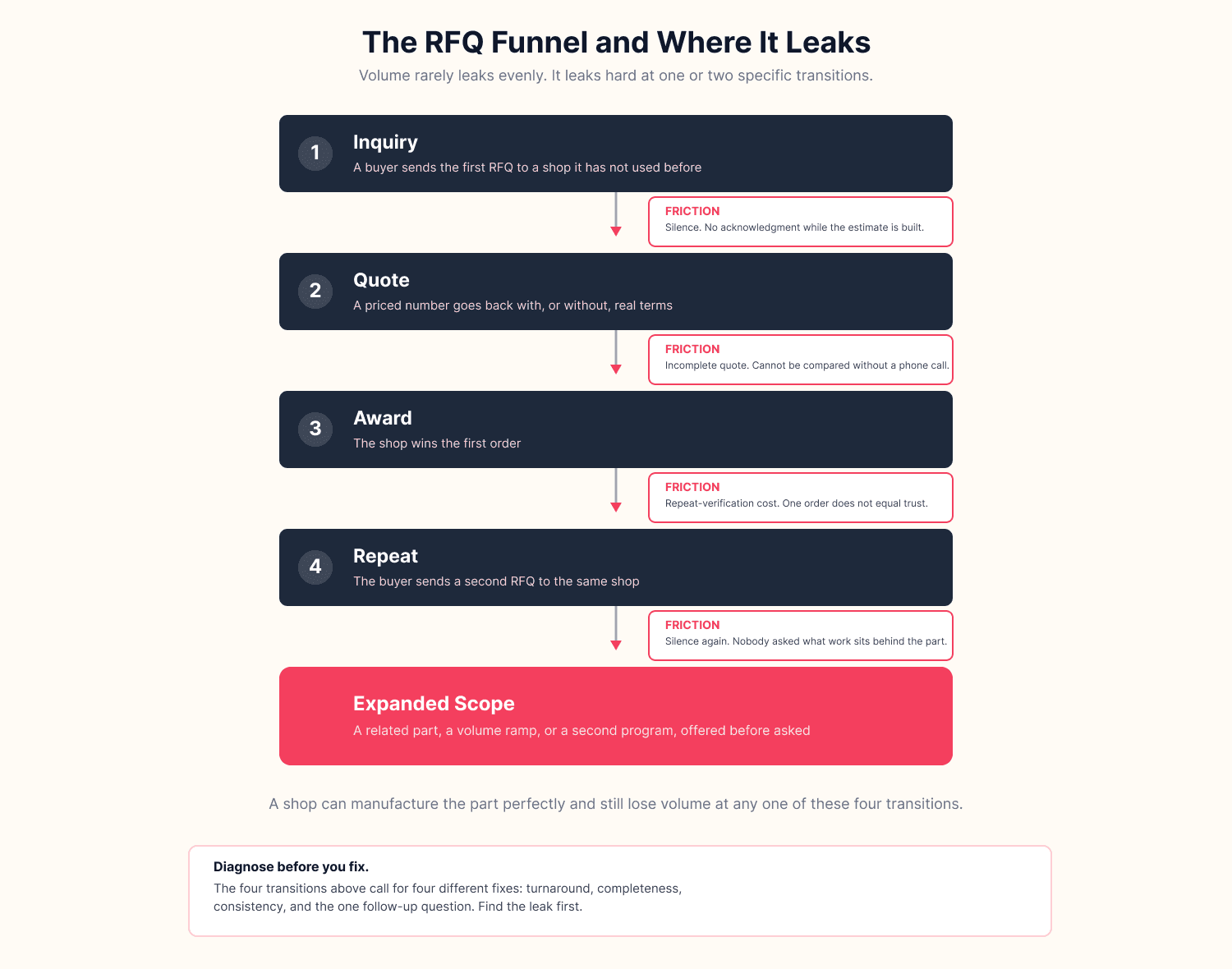
Inquiry, quote, award, repeat, and expanded scope look like a simple pipeline. Volume rarely leaks evenly across all five stages. It usually leaks hard at one or two points, and the fix differs at each.
- Inquiry to quote. The leak is silence. An RFQ sits unacknowledged while the shop works on the estimate, and the buyer's attention moves to whoever answered first.
- Quote to award. The leak is an incomplete quote that cannot be compared against a competitor's without a phone call the buyer would rather not make.
- Award to repeat. The leak is the repeat-verification cost described above. One successful order does not automatically make a shop a known quantity. Consistency across several does.
- Repeat to expanded scope. The leak is silence again, in a different form. Nobody asked whether there was more work behind the part that was actually sent.
A shop can manufacture the part perfectly and still lose volume at any of these transitions. Diagnosing which one is leaking, rather than fixing the whole funnel at once, is the fastest route to the highest-leverage change.
See Also
Frequently asked questions
What does RFQ generation mean for a manufacturing job shop?
The ongoing flow of new quote requests a shop receives, both first-time inquiries and repeat requests from buyers already using it. Most advice covers only getting found for the first time. The bigger, less discussed lever is repeat generation, the RFQs earned from buyers a shop already has a relationship with, covered in the levers above.
How do suppliers get more RFQs from buyers they have already worked with?
Mostly by removing the friction that keeps a known-good relationship from growing. The specific culprits, and the fix for each, are covered in the four action levers above.
Why did my RFQ volume from one buyer stop after just one order?
Usually not dissatisfaction. A buyer who never sends a second RFQ is often defaulting back to a supplier it already trusts at low effort, because re-qualifying even a good new one carries its own cost. The fix is consistency and a direct follow-up question, not a lower price.
How can a job shop increase RFQs without spending more on marketing?
By treating the RFQs already arriving as the growth channel itself. Faster acknowledgment, a more complete quote, consistent follow-through, and one specific follow-up question do more for volume than another dollar spent finding new contacts, which only solves the first-contact half of the problem.
How fast should a manufacturer respond to an RFQ?
Fast enough that the buyer knows it was received and when to expect the full quote, ideally within about a day, even if the priced quote itself takes longer to prepare properly. Acknowledgment speed and quote speed are different levers, and both matter, as covered above.
What should a complete manufacturing quote include?
More than a unit price. A complete quote states the basis the price and lead time actually rest on, not just the numbers themselves, so a buyer can compare it against a second shop's quote without a clarifying call. The full element-by-element comparison is in the table above.
Why do buyers keep sending RFQs to the same few suppliers?
Every added supplier a buyer actively uses adds an ongoing cost of managing and re-verifying that relationship, not just an initial one. Consolidating repeat business with a smaller, known set of suppliers is standard procurement practice for controlling that cost, not a judgment on any one shop's quality.
Should I follow up after sending a quote?
Yes, but not with a generic check-in. Asking a specific question, such as whether anything in the quote needs clarifying, keeps the conversation open without reading as pressure the way "any update?" does.
Ready for fewer, better conversations?
Augmino connects verified Indian manufacturers with buyers who mean business.
Apply to Join