Sourcing Forgings from India: A Buyer's Guide to Specification, Process, and Qualification


Sourcing a forging from an Indian supplier comes down to three decisions. Make them before the first quote is issued. The exact material grade. The forging process suited to the part's volume and shape. The traceability records that prove the batch you receive matches the batch that was tested. Get those three right, and qualification is mostly confirmation. Get one wrong, and a part that passes inspection on the bench can still fail in service.
You specify a forging. You don't just order one. A forging is only as good as the metallurgy behind it. Unlike a casting, a forged part gets its strength from how the metal was shaped, not just what it's made of. That difference is where most sourcing mistakes start.
When forging isn't the right process
Not every part that needs strength should be forged. Forging earns its cost premium on parts that see cyclic load, impact, or fatigue risk, where the grain-flow advantage actually matters in service. It doesn't earn that premium on a part that just needs to look strong on a datasheet, where a cheaper process does the job just as well.
A few signals point away from forging. The part sees no meaningful cyclic load, impact, or fatigue risk, so grain flow doesn't change its service life. The geometry has complex internal features that forging can't produce economically, where casting is the better fit. The order volume is too low to justify tooling lead time, and CNC machining from bar stock or a welded fabrication would meet the requirement just as well.
If two or more of these describe your part, it's worth pricing a simpler process before committing to a forging RFQ.
Why forging is specified differently from casting
A casting has no directional grain structure. The metal cools from a liquid into the mold's shape. Its strength is roughly the same in every direction, but lower overall. That's because shrinkage, porosity, and trapped gas are all normal risks when metal solidifies. A forging works differently. The metal is shaped while still solid, so the grain flow bends to follow the part's shape instead of getting cut across during machining. That unbroken grain flow is why a forging has higher fatigue resistance, more toughness, and a better strength-to-weight ratio than an equivalent cast or machined part. This comes from the Forging Industry Association's own comparison of manufacturing processes.
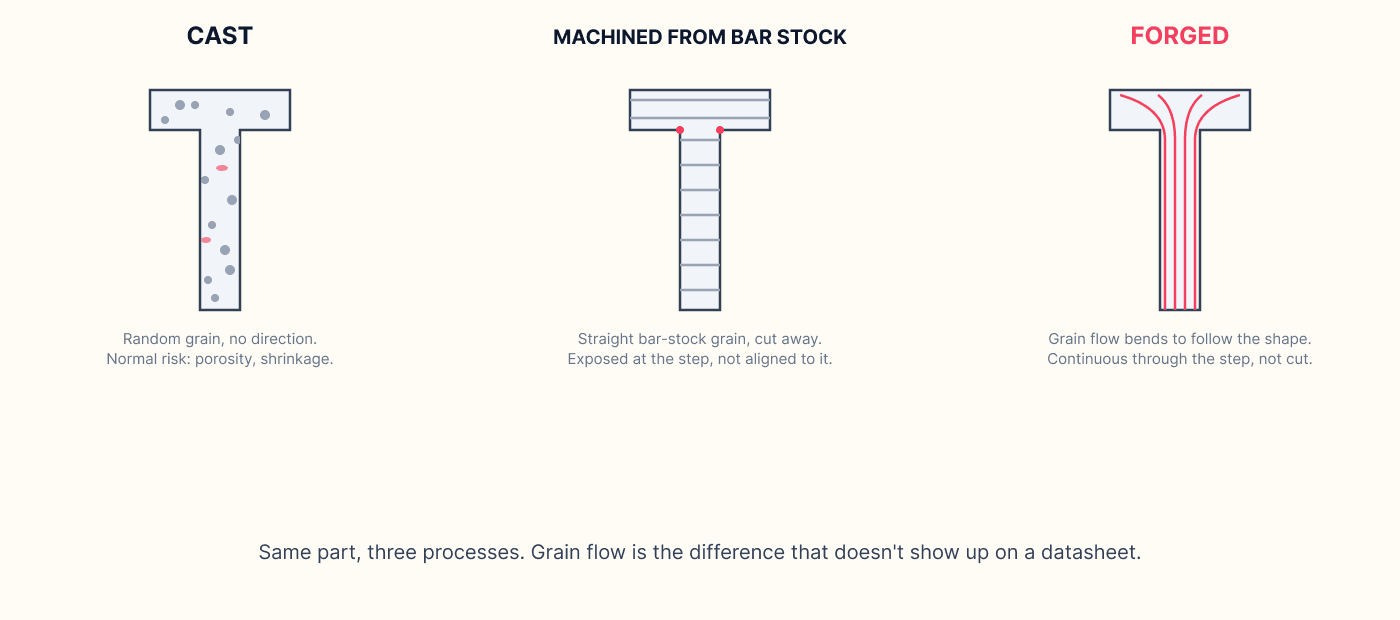
Here's why this matters to a buyer. A forging's real advantage only shows up if you specify the grain flow, the grade, and the heat treatment correctly. Order a forging the way you'd order a casting, on shape and price alone, and you lose the whole reason to choose forging in the first place.
Specify the grade, not just "steel"
The most common gap in a forging enquiry is a drawing that just says "alloy steel" or "steel forging," without naming the grade. Dozens of alloy steels could technically qualify. Their strength, hardenability, and temperature performance are all meaningfully different.
Worked example: a hydraulic valve body needs a forging that will be machined, pressure-tested, and run at moderate temperature under cyclic load. A buyer who specifies only "alloy steel" leaves the grade choice to whichever bar stock the supplier has on hand. A buyer who specifies 42CrMo4 gets a chromium-molybdenum steel with a known, repeatable response to heat treatment, and a track record in exactly this kind of application.
42CrMo4 is the European designation under EN 10083 (DIN material number 1.7225). It's functionally the same as AISI/SAE 4140 in the US system, and JIS SCM440 in Japan. European and Asian steel suppliers' own technical documents confirm this cross-reference. The grade names differ by standard body. The alloy makeup and mechanical response are widely treated as equivalent for most applications, though a buyer should still confirm which standard a supplier is certifying against. A supplier who can't tell you which standard's grade they're quoting against hasn't actually confirmed the grade. Neither has a supplier who treats "4140" and "some equivalent alloy steel" as the same thing, without naming the actual standard.
The fix is one line added to every forging RFQ. Name the grade and the standard it's specified against, not just the alloy family. "42CrMo4 per EN 10083" is a specification. "Alloy steel" is a guess you're leaving the supplier to make for you.
Choose the forging process on purpose
Forgings are made two main ways, plus a third specialized process for ring-shaped parts. The choice changes tolerance, tooling cost, and lead time enough that it belongs in the RFQ. Don't leave it to the supplier's default.
Closed-die (impression-die) forging shapes the metal inside a cavity cut into two die halves. This produces a near-net shape with tighter tolerances, and a more consistent, repeatable form. The tooling is expensive and takes time to cut. It only pays off at volume.
Open-die forging shapes the metal between flat or simply shaped dies, with no cavity. It relies on the operator's control of the workpiece. Tooling is minimal, and it can adapt quickly. That makes it the right call for large parts, low volumes, or a first prototype run. But it leaves more stock for machining, and wider dimensional variation, than closed-die work.
Worked example: a buyer who needs 50,000 units a year of a mid-size automotive bracket should specify closed-die forging. The die cost spreads across the whole run. The same buyer might also need 20 large pressure-vessel flanges a year, in a size no standard die covers. For that part, they should specify open-die forging, and budget the extra machining stock into the cost. Ask a closed-die shop to quote a 20-piece run of an odd-sized part, or ask an open-die shop to hold automotive tolerances at volume, and you'll get a quote that looks fine. The part won't be.
| Closed-die (impression-die) | Open-die | |
|---|---|---|
| Typical volume | Medium to high (thousands+) | Low (prototype to hundreds) |
| Tolerance | Tighter, near-net shape | Wider, more machining stock needed |
| Tooling cost | High (die design + cutting) | Low to none |
| Lead time to first part | Longer (die lead time) | Shorter |
| Best fit | Repeatable production parts | Large, custom, or low-volume parts |
A third process, ring rolling, applies specifically to rings, flanges, bearing races, and gear blanks. A preformed ring of heated metal is rolled between two rollers until it reaches the target diameter and wall thickness, producing a seamless ring with grain flow running in the hoop direction, exactly where a ring-shaped part needs its strength. If your part is a ring or flange, ask specifically whether the supplier ring-rolls it or classifies it as open-die. The two aren't the same process, and open-die tooling won't give a ring-shaped part the hoop-direction grain properties that ring rolling does.
Request the mechanical test reports that actually apply
A forging's mechanical properties aren't visible on the part. You confirm them by testing a sample from the same heat and lot, against named standards. The result goes on a certificate the buyer can check.
Three tests matter for most industrial forgings.
| Test | Measures | Standard | Matters most when |
|---|---|---|---|
| Tensile | Yield strength, ultimate tensile strength, elongation | ASTM A370 / E8 | Every industrial forging |
| Impact (Charpy V-notch) | Toughness under sudden load | ASTM E23 | Shock or cold-temperature service |
| Hardness (Rockwell or Brinell) | Fast strength proxy, heat-treatment consistency check | ASTM E18 / E10 | Confirming the heat-treatment batch held |
ASTM A788 sets the general requirements steel forgings are supplied against.
A buyer doesn't need to become a metallurgist to use this. The test is simple. Ask for the actual test report tied to the heat number of the parts you're receiving. Don't accept a generic material datasheet for the grade. A datasheet describes what the grade can do. A heat-specific test report describes what this batch actually did.
Heat-treatment traceability is the qualification backbone
Heat-treatment traceability is a supplier's ability to connect a finished forging back to the specific heat of raw material and the specific heat-treatment batch that produced it. Two forgings of the same grade can behave completely differently in service if their heat treatment differed, and traceability is how a buyer rules that out.
A traceable forging supplier can connect a finished part back to three things. The heat, or melt, number of the raw material. The heat-treatment batch it went through, including time, temperature, and quench method. And the specific mechanical and hardness test results for that heat and batch. This is what lets a buyer trust batch three the same way they trusted batch one, without re-testing every shipment.
This is also where most forging-specific defects get caught, before they leave the shop. Laps and seams are the most common surface defects. They form when metal folds over itself during forging instead of fusing together. Usually the cause is die geometry, the wrong billet size, or forging at too low a temperature. These flaws are often invisible to the eye. Magnetic particle inspection (MPI) catches them on ferrous forgings. On non-ferrous or austenitic stainless parts, where MPI doesn't work, dye penetrant inspection is the equivalent surface check. Neither method sees what's happening inside the part. For internal discontinuities on larger or thicker forgings, such as shafts, rings, and pressure parts, ultrasonic testing (UT) is the standard method, and it complements MPI rather than replacing it. A supplier who can't describe their MPI, dye penetrant, or UT practice, and can't tie an inspection result to a specific heat number, is asking you to trust the process instead of verifying it.
| Method | Catches | Material scope |
|---|---|---|
| Magnetic particle (MPI) | Surface-breaking flaws (laps, seams) | Ferrous only |
| Dye penetrant | Surface-breaking flaws | Any material, including non-ferrous and austenitic stainless |
| Ultrasonic (UT) | Internal discontinuities | Any material; standard for larger or thicker sections |
Is your forging enquiry actually ready to send?
Before the RFQ goes out, check for these signs the specification isn't complete yet. An underspecified enquiry doesn't just risk a wrong part. It produces quotes from different suppliers that you can't compare, because each supplier filled the gaps differently.
- The drawing names an alloy family ("steel," "alloy steel") but not a specific grade and standard.
- No forging process is specified, and the part's volume or size hasn't been shared with the supplier to let them recommend one.
- The application's load, temperature, or fatigue conditions aren't described, only the geometry.
- There's no stated requirement for heat-specific test reports versus a generic datasheet.
- Nobody has asked which NDT methods (MPI, dye penetrant, or UT, as applicable) are included or priced as separate line items.
- The tolerance on critical dimensions doesn't state whether it's pre- or post-machining.
If more than one or two of these are true, the enquiry is asking suppliers to make specification decisions for you. The quotes that come back won't be comparing the same part.
Red flags at the qualification stage
A few supplier responses are worth treating as a stop, not a caution. A quoted grade with no named standard, like "equivalent to 4140" with no EN, DIN, or JIS reference. A test report that names the grade and property values but not the heat number. It may not match the batch being shipped. No mention of NDT or MPI when the part carries any fatigue or safety load. Vague language about "our own quality process," instead of a named test standard. A quoted press capacity or maximum forging size that doesn't obviously fit the part, with no capacity numbers volunteered when asked. No clear answer on whether post-forging machining happens in-house or gets subcontracted out. Any of these is a sign the supplier is selling a grade and a promise, not a traceable part.
Sourcing this category from India
India's forging base is broad and automotive-heavy. Estimates of the market's overall size vary widely across research firms, but automotive consistently comes out as the dominant end use, alongside a growing aerospace and general engineering base.
The Association of Indian Forging Industry, established in 1965, represents member firms across major forging hubs including Pune, Rajkot, Ludhiana, and Chennai, among others. Capability varies as widely as the base itself. The specification and qualification steps above are what actually separate a supplier who can hold a grade to standard from one who's guessing.
Sourcing a forging well is mostly a specification discipline. Name the grade against a standard. Choose the process for the actual volume and shape. Ask for heat-specific test data instead of a datasheet. Confirm traceability before the first order, not after a failure. None of this requires you to become a metallurgist. It just requires asking for these four things, in writing, before the quote is issued.
Related reading
Download
Augmino Forging RFQ Qualification Toolkit
XLSX · 12.7 KB
A Excel toolkit for sourcing forgings from India a fill-in RFQ specification checklist covering grade/standard cross-reference, process selection (closed-die, open-die, ring rolling), heat-treatment condition, and NDT method, plus a side-by-side supplier qualification and red-flag scorecard for comparing candidate forging suppliers before you commit to a first order.
Frequently asked questions
What is the difference between a forging and a casting for load-bearing components?
A forging is shaped while the metal is solid, which aligns its internal grain structure to the part's geometry and gives it higher fatigue resistance and toughness than a casting of the same grade. A casting solidifies from molten metal with no directional grain structure, carrying more risk of porosity and inclusions.
Is 42CrMo4 the same as AISI 4140?
Yes. 42CrMo4 is the European designation under EN 10083 (DIN 1.7225). 4140 is the equivalent AISI/SAE designation. Both refer to the same chromium-molybdenum alloy. Most engineers treat them as interchangeable. Still, a buyer should confirm which standard a supplier is certifying against.
What is the difference between open-die and closed-die forging?
Closed-die forging shapes metal inside a cavity for tighter tolerances and repeatable near-net shapes, suited to medium-to-high volume production. Open-die forging shapes metal between simple dies with no cavity, suited to large, custom, or low-volume parts, at the cost of wider tolerances and more machining stock.
What mechanical test reports should I request from a forging supplier?
Ask for three things, all tied to the specific heat number of the parts being shipped, not a generic grade datasheet. Tensile testing, per ASTM A370/E8. Impact, or Charpy, testing per ASTM E23, if the application sees shock or low-temperature load. Hardness testing per ASTM E18 or E10.
What is heat-treatment traceability and why does it matter?
It's the ability to connect a finished forging back to its raw-material heat number, its specific heat-treatment batch parameters, and the mechanical test results for that batch. It lets a buyer trust a later shipment without re-testing every batch themselves.
What are the most common forging defects to check for?
Laps and seams are the most common. That's metal folding over itself without fusing. Underfill and flow-line disruption also happen often. Laps especially are often invisible to the eye. Magnetic particle inspection catches them. This should be a named part of a supplier's quality process for any load-bearing forging.
How do I know if a forging supplier's quality system is reliable?
Check three things. Do they name the standard behind every grade and test they cite, like EN, ASTM, or JIS? Do their test reports tie to a specific heat number, rather than a generic datasheet? Can they describe their NDT practice specifically, instead of just saying "quality checks"?
Should I specify normalized, quenched-and-tempered, or annealed condition?
Yes, state it explicitly rather than leaving it to the supplier's default. The condition changes hardness, ductility, and machinability, and a datasheet for the grade alone doesn't tell you which condition the supplier plans to deliver. Tie the required condition to the mechanical properties your application actually needs.
Ready for fewer, better conversations?
Augmino connects verified Indian manufacturers with buyers who mean business.
Apply to Join