Supplier Offboarding in Manufacturing: A Buyer's Checklist for Contracts Tooling and Capacity


Supplier offboarding is the structured process a manufacturing buyer runs when ending a relationship with an active supplier. It covers contract and financial closeout, recovery of any buyer-owned tooling or data and verification that a replacement source can actually produce the part. The last step is a decision on how the exited supplier gets classified for future reference. Done well, offboarding closes the relationship cleanly and keeps a capable supplier reachable later. Done informally, it leaves tooling stranded at a facility that owes you nothing and a replacement supplier that was never tested before you needed them.
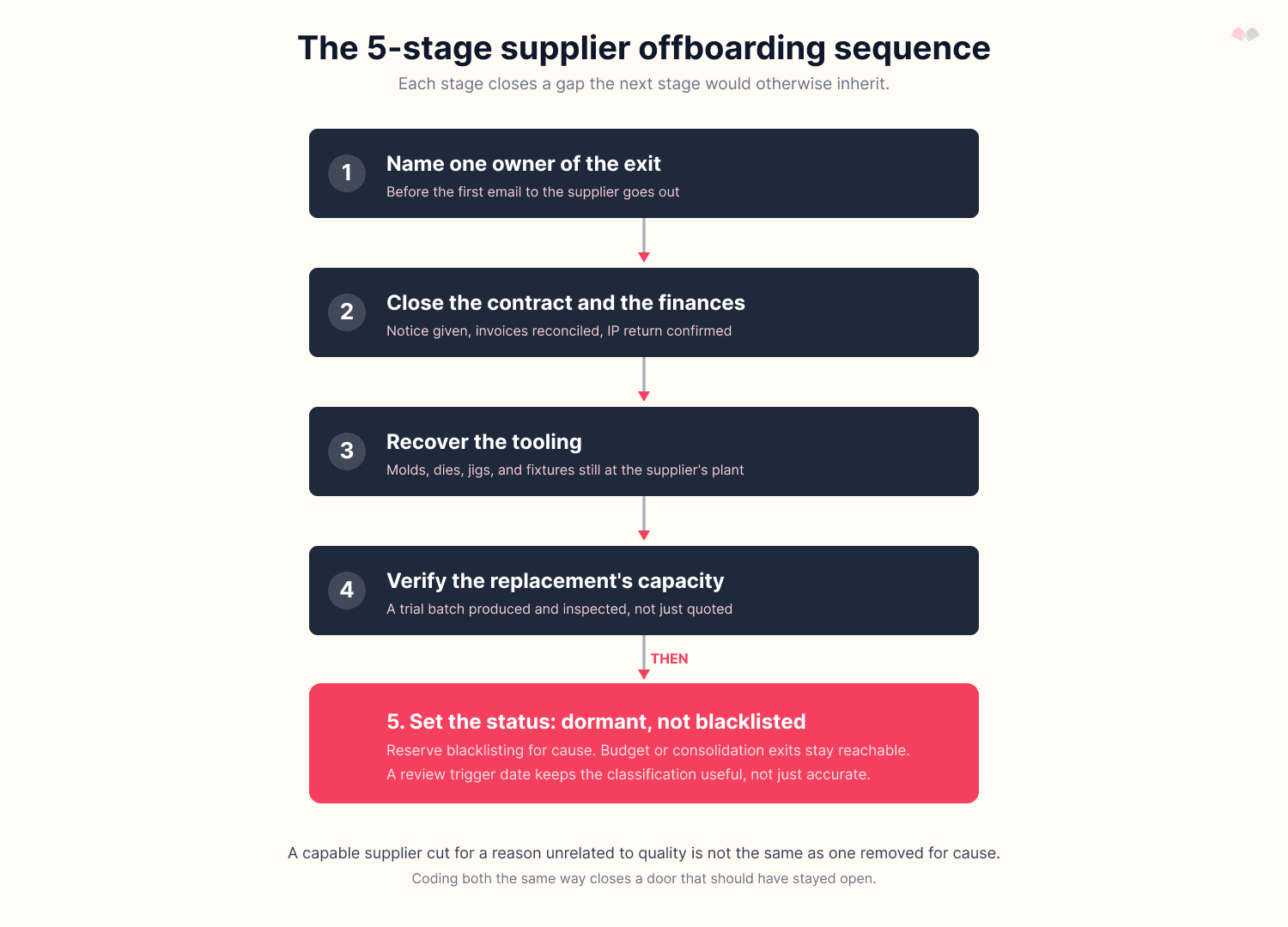
Here is the five-stage sequence at a glance. Each stage is covered in detail below.
| Stage | What it covers |
|---|---|
| 1. Name the owner | One person accountable for the whole exit, start to finish |
| 2. Close the contract | Termination notice, invoice reconciliation, IP and data return |
| 3. Recover the tooling | Buyer-owned dies, molds, fixtures, and gauges pulled back |
| 4. Verify the replacement | A trial batch produced and inspected, not just quoted |
| 5. Set the status | Exited supplier marked dormant, suspended, or disqualified |
This sequence assumes a planned exit, with time to work through each stage in order. A supplier bankruptcy or a sudden shutdown compresses the same five stages into days instead of weeks. Tooling recovery and replacement qualification happen under real time pressure, but the sequence itself does not change.
Why manufacturing supplier offboarding is not the same as vendor offboarding
Most offboarding checklists in circulation were written for software and services vendors. Revoke a login, retrieve a laptop, close an invoice, done. A manufacturing relationship carries something a SaaS subscription never does. Physical assets that belong to the buyer but live inside someone else's factory.
A stamping die, an injection mold, a CNC fixture, or an inspection jig is often paid for by the buyer to make one specific part. It does not travel with a cancelled purchase order. It sits on a shelf or a press bed until someone recovers it. Generic offboarding guidance rarely covers this, because most vendors it was written for never had a physical footprint at all.
The other manufacturing-specific piece is capacity. A software vendor's replacement is a like-for-like subscription swap. A manufacturing replacement has to actually make the part, at tolerance and volume, and a name on an approved vendor list is not proof of that yet.
Signs you are not ready to offboard this supplier yet
Before starting the exit, check these signals. If more than one is true, the offboarding will create a problem instead of closing one.
- Nobody has been named as the single owner of the exit.
- You cannot say, without asking someone else first, which molds, dies, jigs, or fixtures sit at this supplier's facility right now.
- The planned replacement has quoted the part but never actually produced a comparable one.
- Outstanding invoices, a warranty claim, or an open non-conformance dispute is still unresolved.
- The real reason for the exit has not been written down anywhere a future buyer could read it.
- Nobody has confirmed whether the original contract even contains a tooling-ownership clause.
- This supplier is the only qualified source for a safety-critical part, and no second source has been qualified yet.
- A major customer program is about to launch, and disrupting the supply base now adds more risk than the exit saves.
Step 1: Name one owner of the exit before anything else moves
Supplier offboarding touches procurement, engineering, quality, and finance, sometimes legal too. When no single person owns it, each function assumes another is handling its piece. The final invoice gets reconciled. The tooling recovery does not, because finance assumed engineering was tracking it and engineering assumed procurement had already asked for it back.
Name one owner the moment the exit decision is made, before the first email to the supplier goes out. That person does not execute every task personally. They confirm each task has a name and a date attached, and can say at any point exactly what is still open. Usually that is the category manager who already holds the relationship, not a generalist function that has never spoken to this supplier's plant.
Step 2: Close the contract and the finances first
The financial and legal closeout is the part most offboarding checklists already get right, so it is worth stating plainly.
Confirm the contract's termination or notice clause and give notice in writing, on the timeline the contract specifies. Notice periods vary by category. Standard materials commonly carry 30 to 60 days. A supplier change on a specialized or tooled part can need three to six months, because that is how long qualifying a replacement realistically takes. Reconcile every outstanding invoice and any warranty obligation that survives the contract's end. Confirm what happens to shared drawings, specifications, and any data the supplier holds for you, and revoke system access if it had any.
This step is not manufacturing-specific, but it gets marked done prematurely more often than it should, because the invoice is the visible part and the IP return is not.
Step 3: Recover the tooling the step generic checklists skip
This is the mechanic that separates a manufacturing offboarding from every other kind. A buyer who pays for dedicated tooling often owns it outright once payment clears, depending on what the tooling agreement actually says. That is generally true whether it is a stamping die, an injection mold, a CNC fixture, or an inspection jig, and it stays true even though the tooling keeps sitting inside the supplier's facility. Owning the tooling on paper is not the same as having it in your hands. Offboarding is when that difference matters.
A worked example. A buyer sources a stamped bracket built on a dedicated progressive die, paid for three years ago as a tooling line item. The exit is over category consolidation, unrelated to quality and nobody has looked at the die since it was approved. Where exactly it lives, whether it is marked as buyer-owned, and whether the supplier has any basis to hold onto it, real or invented, all surface at once.
A documented case from an international-manufacturing legal advisory shows what happens when nobody can answer those questions. Without a clear tooling agreement, a company once paid $200,000 to recover molds it had purchased just eight months earlier for $80,000. The supplier had withheld five molds across three product lines and would not say which mold matched which part until payment was made (Harris Sliwoski LLP, "THE Guide to Molds and Tooling inInternational Manufacturing," 25 May 2025). The stoppage cost roughly $800,000 more in lost revenue. The tooling itself was never disputed. Only the location, the marking, and the leverage were.
Three things prevent this. A tooling register that logs every buyer-owned asset, covering location, proof of ownership, remaining tool life, last production date, and who holds the CAD file and machine program tied to it. Reviewed quarterly, not reconstructed from memory at exit time. Physical marking that stamps the tooling with the buyer's name and a unique identifier. A recovery clause in the original contract giving the buyer the right to reclaim tooling within a fixed number of days.
Inspection gauges carry one more wrinkle. If a buyer-owned gauge moves to a new supplier, its calibration history needs to move with it. A gauge with no calibration record cannot be trusted at the new supplier's line, no matter how well it worked at the old one.
For a buyer sourcing from an Indian supplier, a cross-border tooling transfer carries one more layer most international-manufacturing guidance skips. Moving a mold or die out of the country adds export documentation, customs clearance, and import duty at the buyer's end, on top of the domestic recovery steps above. If a dispute over the tooling ends up in front of an Indian court instead of getting resolved directly, the process and the timeline look different from what a buyer's home jurisdiction would predict. None of this makes recovery impossible. It makes the register and the recovery clause worth having in place before the exit starts, not after.
Procurement software increasingly uses AI to flag a supplier's financial risk, summarize a contract or draft a termination notice. None of it recovers a die sitting on a press bed in another country. That step is still a register, a phone call and a truck, whatever automation handles the paperwork around it.
Once those exist, the step is simple. Pull the register entry, verify the tooling matches it, confirm no lien exists, and schedule recovery or transfer. It only turns into a crisis when improvised at the moment leverage has already shifted to whoever holds the goods.
Step 4: Verify the replacement supplier's capacity is real not just a name on a list
An approved vendor list entry means a supplier passed qualification at some point. It does not mean that supplier can absorb this part, at this volume, today. Shifting volume to a name already on the list without confirming actual production treats a paper qualification as equivalent to a working one.
A worked example. A buyer runs three CNC machining suppliers for a family of turned parts and exits one over cost, not quality. The plan is to shift volume to a second, already-approved supplier who has quoted similar parts but never machined this specific part number, at this tolerance. Before marking the exit complete, the buyer runs a trial batch through the replacement and inspects it. The trial surfaces a tolerance the replacement's equipment cannot hold consistently at volume, something no paper qualification would have shown.
Capacity is only half the picture. Machine offsets, cycle-time settings, and the inspection method used to check the part do not transfer automatically with the part number. Neither does the paperwork behind them, the control plan, work instruction, and inspection plan a mature supplier builds up over time. A replacement rediscovering any of this from scratch can lose real weeks, even with the right machine sitting idle.
In a regulated industry like automotive or aerospace, this step is bigger than a trial batch. Moving a part to a new supplier typically needs a full PPAP submission and a fresh audit of the replacement against IATF 16949 or AS9100, not just an inspected sample.
This is the same concentration-risk discipline behind supply base rationalization generally. A shorter supplier list only helps if the suppliers who remain can carry the volume. A trial batch, produced and inspected rather than just quoted, belongs inside the offboarding process, before the old capacity is gone. Verifying a replacement here is close to a mirror of qualifying a brand new supplier from scratch, see our guide to the first 90 days with a new supplier for the fuller qualification sequence this trial batch is compressing.
Step 5: Classify the exited supplier's status dormant not blacklisted
The last decision in an offboarding is easy to skip because the relationship already feels closed. It still needs a name. Approved vendor list management typically uses status categories beyond simple active or inactive, including something closer to conditional, suspended, and disapproved for suppliers removed for cause. Disqualification or blacklisting is meant for a serious non-conformance or regulatory violation, a door meant to stay closed.
A supplier exited for budget or category consolidation is a different case. Coding them the same way as one removed for cause erases that difference for whoever reads the record next year. A capable supplier who lost volume when two categories merged into one vendor was not disqualified. They were deprioritized. Marking them dormant instead keeps an accurate record of why the relationship ended, and leaves the door open if the category reopens later.
Re-qualifying a supplier from scratch takes real time, and one available today may not be available eighteen months later when a buyer realizes the cut was a mistake. A review trigger date on the dormant classification, not an open-ended one, makes it useful instead of just accurate.
The offboarding sequence mapped
The five steps run in this order for a reason. Each one closes a gap the next would otherwise inherit. An owner in place before tasks get assumed by nobody. The contract closed before the tooling clause is relied on. The tooling recovered before a transfer is promised. The replacement verified before the status is set.
| Stage | What it prevents |
|---|---|
| 1. Name the owner | Tasks silently assumed to be someone else's job |
| 2. Close the contract | An invoice or warranty gap surfacing after the relationship is over |
| 3. Recover the tooling | Buyer-owned assets stranded or held as leverage |
| 4. Verify the replacement | A capacity gap discovered only after the old supplier is gone |
| 5. Set the status | A capable supplier permanently written off for a reason unrelated to quality |
A one-page offboarding checklist
The table below is a compressed view. The downloadable version, Augmino-Supplier-Offboarding-Checklist.csv, adds a responsible role and an evidence column for every line.
| Stage | Sample task | Owner |
|---|---|---|
| Name the owner | Assign a single named owner with sign-off authority | Procurement lead |
| Close the contract | Give termination notice per the contract timeline and reconcile invoices | Procurement / Finance |
| Recover the tooling | Pull the tooling register entry, verify marking and location, confirm no lien | Engineering / Quality |
| Verify the replacement | Confirm a trial batch was produced and inspected, not just quoted | Quality / Engineering |
| Set the status | Document the exit reason and classify as dormant, suspended, or disqualified | Procurement lead |
What a clean offboarding leaves behind
An offboarding that runs through all five stages leaves a closed contract with nothing outstanding, every buyer-owned asset accounted for, and a record that tells the next buyer why the relationship ended, not just that it did.
The suppliers most likely to fall through the cracks are rarely the ones cut for poor quality. Those exits get documented carefully, because someone wants a record of the problem. The ones who disappear quietly are the capable suppliers, cut for a reason that had nothing to do with their work. Those are the relationships worth closing out properly, because they are the ones a buyer is most likely to need again.
The supply base rationalization guide covers scoring which suppliers survive a reduction, and the first 90 days onboarding guide covers what replaces them. Offboarding is the step in between that closes one relationship cleanly enough that reopening it later is still possible.
See Also
Download
Augmino Supplier Offboarding Checklist
CSV · 3.3 KB
A 5-stage checklist (name the owner, close the contract, recover the tooling, verify the replacement, set the status) with a task, responsible role, and evidence column for each line, built for a buyer running a manufacturing supplier exit end to end.
Frequently asked questions
What is supplier offboarding in manufacturing?
The structured process of ending an active supplier relationship, covering the contract, any buyer-owned assets, and how the exited supplier gets recorded. The sections above walk through each stage.
Who should own the supplier offboarding process?
A single named owner, usually the category manager already holding the relationship, assigned the moment the exit decision is made. The naming-an-owner section covers why.
What happens to buyer-owned tooling when a supplier relationship ends?
Tooling the buyer paid for, such as a mold, die, or fixture, is typically owned by the buyer despite sitting at the supplier's facility. Recovering it depends on a register and a contract clause.
How do you recover molds, dies, or fixtures from an exited supplier?
Pull the register entry, verify it physically matches, and confirm no lien exists before scheduling transport. Without a register beforehand, recovery becomes a negotiation, as the worked example above shows.
Should you mark an exited supplier as blacklisted or dormant?
Only a supplier removed for a serious quality or compliance failure belongs on a blacklist. A capable supplier cut for budget or consolidation should be marked dormant instead.
How do you verify a replacement supplier's capacity before completing an exit?
Confirm the replacement has produced a trial batch of the part and had it inspected, not just quoted the job. The capacity section above covers why an approved vendor list entry alone is not enough.
What should a manufacturing supplier offboarding checklist include?
At minimum, an exit owner, contract and financial closeout, tooling and IP recovery, replacement capacity verification, and status classification.
How much notice should a manufacturing supplier get before contract termination?
Standard materials commonly need 30 to 60 days. A specialized or tooled part can need three to six months to let a replacement get qualified.
Can I offboard a supplier if they still hold buyer-owned tooling?
Not cleanly. Recover or formally transfer the tooling first, unless the contract explicitly says otherwise. Closing the contract before the tooling question is settled is exactly the sequencing mistake the tooling-recovery section above exists to prevent.
Ready for fewer, better conversations?
Augmino connects verified Indian manufacturers with buyers who mean business.
Apply to Join