What Suppliers Wish Buyers Would Specify Before Quoting


A drawing lands in a supplier's inbox. Steel bracket, five holes, one bend. The material callout says "steel." Nothing else. Somewhere in the shop, someone has to decide what that means before a price can go out. Mild steel or a specific grade. A tensile spec or none. The buyer who sent the drawing already has an answer in their head. The supplier does not have access to it.
This is the ordinary condition of quoting, not the exception. A buyer sends what feels like enough information to get a price. A supplier receives something that is enough to start guessing. The two are not the same document, even though they are the same email.
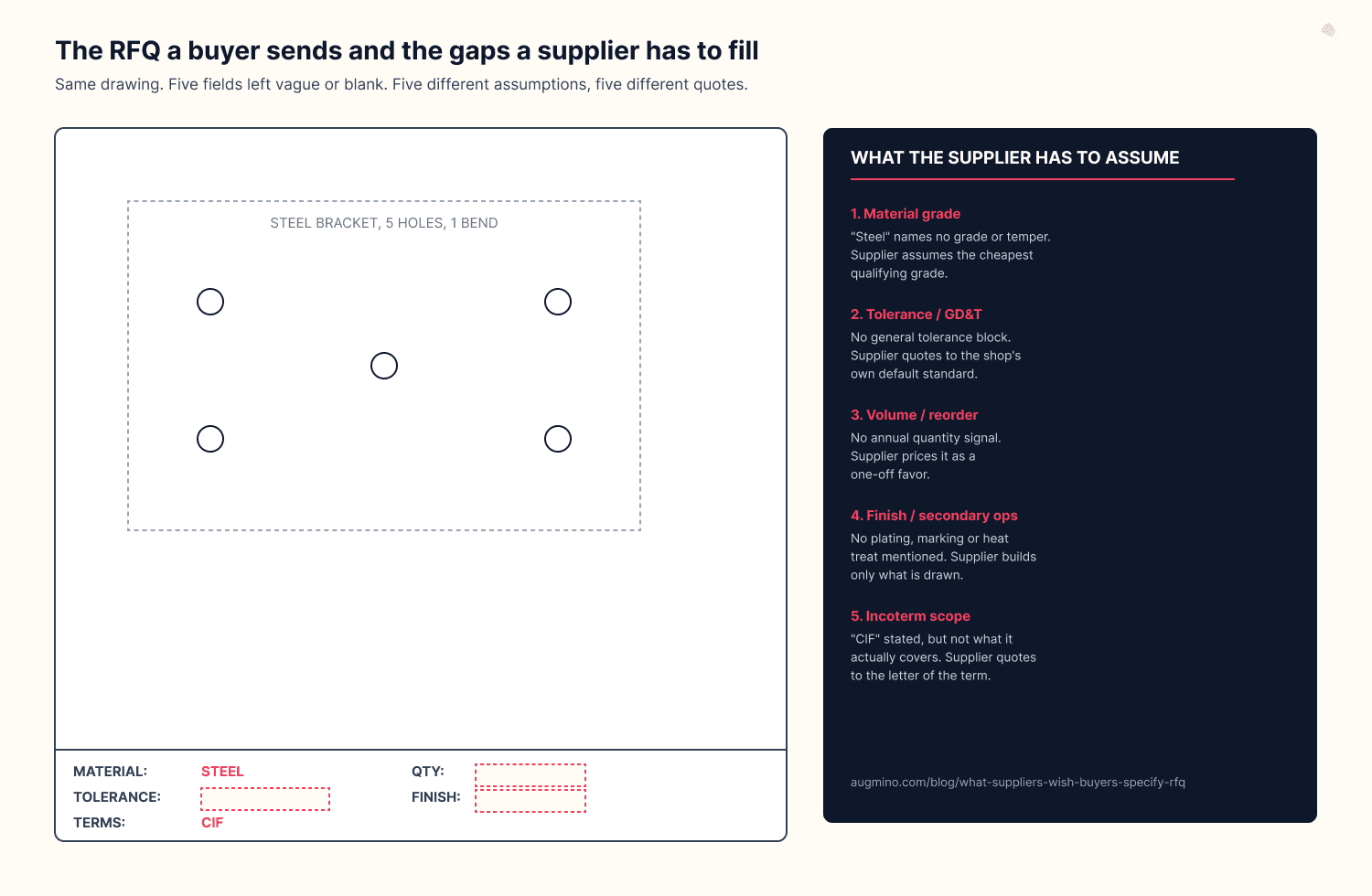
What each gap actually costs
| RFQ field | What's often left unstated | What a supplier has to assume | What goes wrong if the assumption is wrong |
|---|---|---|---|
| Tolerance / GD&T | No general tolerance block, no reference standard | The shop's own default tolerance applies | Parts pass the supplier's own inspection and fail the buyer's |
| Material grade | Material named, grade and cert unspecified | The most common or cheapest qualifying grade | Wrong grade quoted or a mill cert requirement discovered after the fact |
| Volume / reorder | No annual quantity or reorder signal given | This is a one-off, priced accordingly | A quote priced as a favor gets treated as the standing price on reorder |
| Finish / secondary ops | Heat treat, plating or marking not mentioned | Only what's drawn gets built | Added operations after acceptance look like a price increase, not a scope change |
| Incoterms / payment | Term stated, scope of risk/cost not explained | The term covers only what it technically covers | Buyer expects coverage the Incoterm never provided |
None of these gaps are the buyer trying to hide anything. Most of them are information that lives in the buyer's head, assumed obvious, because it's obvious to them. It isn't visible to a supplier who has never worked with that buyer before. The free RFQ Assumption Register below has these same five fields laid out as a one-page worksheet, for filling in before the next RFQ goes out.
The gap doesn't disappear. It gets filled in differently by everyone who reads it
An incomplete RFQ does not produce a range of similarly-cautious quotes. It produces quotes built on different silent assumptions. Each supplier resolves the missing information on their own, in whatever direction their own experience points them. One assumes the cheaper grade and prices low. Another assumes the safer grade and prices high. A third asks, loses two days waiting for a reply and quotes last. None of these suppliers did anything wrong. The RFQ simply didn't tell them what the buyer already knew.
The result on the buyer's side looks like three comparable quotes for the same part. It is not that. It is three quotes for three different parts that happen to share a drawing number.
The five gaps, in more detail
Each row in the table above is a pattern seen often enough, across enough different sources, to be worth explaining on its own.
Tolerance and GD&T defaults. Job-shop practitioners on forums like Practical Machinist raise this constantly. A drawing with no stated general tolerance, no "unless otherwise specified" block, forces a supplier to guess at a standard rather than quote to one. A part machined to a shop's own default tolerance can be well within spec and still get rejected on incoming inspection. The buyer was working from a tighter number that was never written down.
Material grade and certification. "Aluminum" and "steel" are not specifications, they are categories. Manufacturing content sites like YISHANG Fabrication and AMN Engineering both document the same pattern from the supplier side. A bare material name leaves open which grade, which temper, whether a mill certificate is required and whether substitution is allowed. Different suppliers resolve that gap differently. The quotes stop being about the same material.
Annual volume or reorder expectations. A quote for a one-off prototype and a quote for a part that will reorder quarterly are not the same pricing decision. Tooling amortizes differently, process choice differs and margin expectations differ. Guides from sources like Criterion Precision and general RFQ checklists make the same point from opposite directions. Without a volume signal, a supplier has to guess whether they're pricing a favor or a relationship. The two numbers are not close.
Surface finish and secondary operations. A quote that never mentions heat treatment, passivation, plating or marking will still get built without them, because a supplier prices what's on the drawing. If those operations get added after the quote is accepted, the price moves. It looks to the buyer like the supplier is padding a number that was never complete to begin with.
Payment terms and Incoterms, on export orders. This one is specific to cross-border RFQs. Buyer-side guidance from sources like USA Customs Clearance and freight-forwarder content aimed at Indian exporters both flag the same recurring confusion. Buyers conflate Incoterms with payment terms, assuming a term like CIF covers more of the risk or cost than it actually does. A supplier quoting to the letter of an Incoterm and a buyer assuming it covers something broader are working from two different contracts without realizing it.
What actually closes the gap
The fix isn't a longer RFQ template. It's naming the five things above, specifically, even briefly. A tolerance line that says "general tolerance per ISO 2768-m unless noted" closes the first gap in one sentence. A material line that says "6061-T6, mill cert required" closes the second. A volume line that says "prototype only, no reorder expected this year" or "expect quarterly reorders of similar quantity" closes the third. A finish line that lists every operation, even "none," closes the fourth. And for export orders, naming the Incoterm alongside one sentence on who pays freight and insurance closes the fifth.
None of this requires new software or a new process. It requires deciding, once, what's already true about the order, then writing that down before the drawing goes out. The RFQ Assumption Register turns this into a five-line worksheet instead of a mental checklist. Every blank field gets filled in anyway. The only question is whether the buyer writes the answer once, or five suppliers each write a different one.
See Also
- India-UK CETA - Duty Free Eligibility
- How to Get More RFQs as a Manufacturing Job Shop
- CBAM for Indian Exporters: What the EU Carbon Border Tax Costs
- The Identity Problem: Serious Industrial Sourcing Concerns
- The Noise Problem: Free Listings Shift Costs to Serious Suppliers & Buyers
- The Pay-to-Rank Problem
Download
Augmino RFQ Assumption Register
PDF · 3.3 KB
A one-page pre-send worksheet with the same five RFQ fields as the table below, a blank column to fill in the buyer's own answer before sending and what a supplier will assume if that cell is left blank. No scoring, fill-in only, for a buyer to run through before an RFQ goes out.
Frequently asked questions
Why do manufacturers ask so many questions before quoting?
Because the drawing alone usually leaves out information the supplier needs to price accurately. Most often that means tolerance defaults, material grade and expected volume. A question at RFQ stage is a supplier trying to quote the right part not stalling.
What's the most common missing detail in an RFQ?
Material grade specificity and general tolerance defaults are the two most frequently cited gaps across supplier-side sourcing content, ahead of volume and finish details.
Does an incomplete RFQ always produce a bad quote?
Not necessarily a bad one. It produces a quote built on an assumption the buyer never confirmed, which may or may not match what the buyer actually needed. The risk shows up later, at inspection or reorder, not at the quote itself.
How much detail is enough in an RFQ?
Enough that a supplier who has never worked with the buyer before doesn't have to guess at tolerance, material grade, expected volume, required finish or (for export orders) what the payment terms actually cover.
Ready for fewer, better conversations?
Augmino connects verified Indian manufacturers with buyers who mean business.
Apply to Join