AS9100 Certification for Indian Precision Shops: Cost, Timeline and What It Actually Unlocks


A precision shop in Coimbatore gets a call from a Tier-1 aerospace buyer's engineer, who liked what he saw on a plant visit two months earlier. He says he'll pass the shop's name along internally. Nothing comes of it. No RFQ arrives, no rejection email, no explanation.
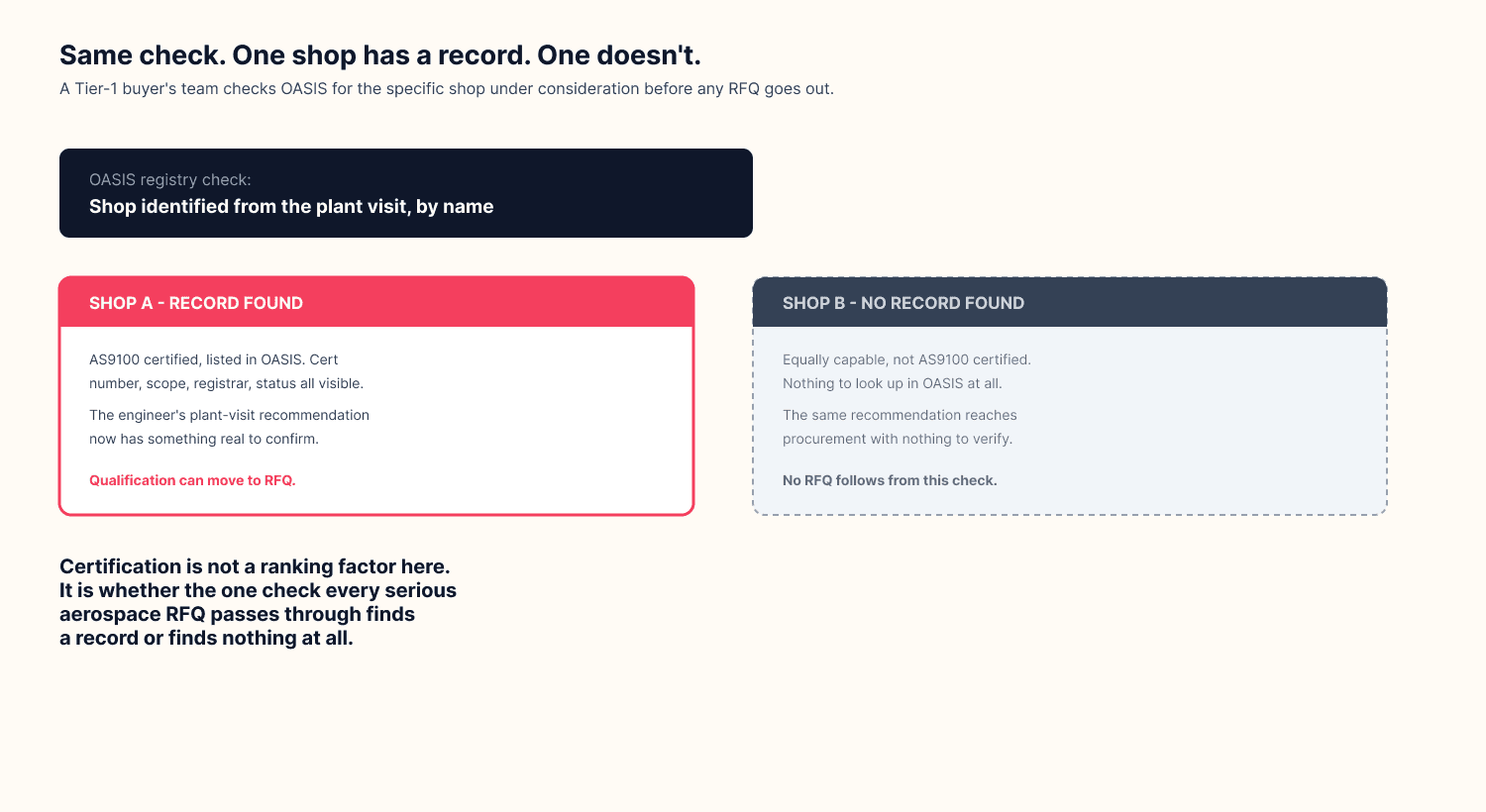
The shop assumes it lost on price or the buyer went with someone they already knew. Neither is true. Before any aerospace RFQ goes out, the buyer's procurement team checks a certification registry for the specific shop the engineer recommended and there is no record. The engineer's recommendation had nothing to verify against.
That registry is real. It has a name and getting listed in it is the actual thing AS9100 certification buys a shop. The cost and the paperwork are the visible part. The registry check is the part that decides whether an RFQ ever reaches the shop at all.
What AS9100 Actually Is and Why ISO 9001 Isn't Enough
AS9100 is a quality management standard. It builds on ISO 9001 and adds a layer of aerospace-specific requirements on top. Configuration management, risk management tied to safety and reliability, first article inspection, counterfeit parts prevention and traceability that goes beyond what ISO 9001 alone asks for.
A shop that already holds ISO 9001 is not starting from zero. Most of the general quality management infrastructure carries over directly, document control, corrective action, management review. AS9100 adds the aerospace-specific layer on top of that foundation. It does not replace any of it. For the ISO 9001 groundwork itself, our ISO 9001 guide for Indian manufacturers covers the cost and process this piece assumes as a starting point.
The distinction matters for a shop deciding whether to pursue it. ISO 9001 requires a business to run a documented system for consistent quality. AS9100 requires that system to also meet the specific expectations of an industry where a missed nonconformance can ground an aircraft.
AS9100 and NADCAP solve different problems and shops sometimes confuse the two. AS9100 certifies the quality management system as a whole. NADCAP, run by the same organization behind OASIS, accredits specific special processes, heat treatment, plating, non-destructive testing and welding among them, when a buyer's contract calls for one of those specifically. A shop can hold AS9100 without needing NADCAP at all or need both, depending on which processes are actually on its floor.
What AS9100 Costs
ndia-specific AS9100 cost figures do not exist in verifiable form. The ranges below are global instead, a planning baseline to check a real quote against, not a number to budget from directly.
| Cost category | Typical range |
|---|---|
| Gap analysis (optional, assesses current-state readiness) | Several thousand dollars |
| Registrar audit fees (Stage 1 + Stage 2) | $3,000-$10,000, plus auditor travel |
| Implementation (documentation, training, internal audit setup) | $8,000-$20,000 for a shop with limited existing QMS documentation |
| Total for a small-to-mid shop, first certification | $10,000-$50,000, narrowing to roughly $20,000-$45,000 for a small aerospace-focused shop |
| Three-year certification cycle, registrar fees only, 10-50 employee shop | $10,000-$20,000 |
These ranges come from KSQA, QMS Collective and AS9100 Store, all global-market figures. Several major registrars operate India entities directly, Bureau Veritas, DNV, SGS, Intertek, NQA and TÜV Nord among them, but none publish an India-specific fee schedule. Request quotes from two or three of those registrars' India offices before setting a real budget.
Certification listings offering AS9100 registration for a few thousand rupees are not accredited registrars and paying one gets a shop a worthless piece of paper, not a real certificate. Verify accreditation before paying for anything.
A few state MSME schemes reimburse part of certification cost, though none we found names AS9100 specifically. Tamil Nadu's Q-Cert scheme reimburses certification and consultancy costs up to Rs 10 lakh for international quality certifications and Karnataka's MSME certification-reimbursement scheme covers 75% of costs up to Rs 1.5-2 lakh for national and international certifications respectively. Both list examples like ISO 9001 and BIS marks in their published material rather than naming AS9100 directly, so eligibility is not guaranteed. Confirm AS9100-specific coverage with the state MSME office directly before counting on either scheme in a certification budget.
The Certification Timeline, Stage by Stage
| Stage | Typical duration |
|---|---|
| Gap analysis to Stage 1 readiness | Varies by starting point |
| Stage 1 to Stage 2 audit | 1-2 months |
| Stage 2 audit itself | 2-5 auditor-days, depending on shop size |
| Nonconformance closure (if any are raised) | Must close within 6 months of the closing meeting or a repeat Stage 2 is required |
| Full process, shop new to formal QMS | 9-12 months, start to certificate |
| Full process, shop already ISO 9001-certified | Roughly 6 months |
| Certificate validity | 3 years |
| Surveillance audits | Annual, 1-3 days each |
The single biggest lever on timeline is whether the shop already holds ISO 9001. A shop starting from a documented ISO 9001 system is adding an aerospace-specific layer to something that already exists. A shop starting from no formal QMS at all is building two things at once, which is why that path runs closer to a year.
What AS9100 Actually Unlocks: The OASIS Database
No aviation authority legally requires AS9100 certification. It is a contractual requirement instead. Major OEMs, Boeing, Airbus, Lockheed Martin, Northrop Grumman among them, flow it down through the aerospace supply chain to their direct suppliers and Tier-1s. A sub-tier supplier further down the chain sometimes clears qualification with ISO 9001 alone. It depends on what that specific customer's flow-down requires. There is no single rule that applies to every aerospace supply relationship.
What is universal is OASIS, the Online Aerospace Supplier Information System. It is run by the International Aerospace Quality Group and PRI, the two standards bodies behind AS9100 itself. Any organization certified to AS9100, AS9110 or AS9120 must be listed in OASIS. OEMs and Tier-1 buyers use that registry as a standard step in verifying and qualifying suppliers, often a specific shop already identified through a referral, a plant visit or an existing relationship, before an RFQ ever gets sent.
A shop without AS9100 does not come up with a lower-ranked or incomplete record when a buyer checks OASIS for it. There is no record to find at all. The Coimbatore shop in this piece's opening did not lose an RFQ on price or relationship. The engineer's recommendation reached procurement and procurement had nothing to confirm it against.
Being listed is not automatically enough either. An OASIS record carries a defined scope, the specific standard and, through the certificate behind it, the process categories the certification actually covers, alongside the certificate itself. A buyer checking the registry is also checking whether that scope matches what they need. A shop holding a valid, current AS9100 certificate can still come up short at this step if its certified scope does not cover the specific work being quoted. Confirming scope with the registrar before Stage 1 is worth doing deliberately, not assuming it will sort itself out later.
AS9100 clears this one gate. It does not replace the rest of the evaluation. Process capability, pricing, delivery performance and technical fit are all judged separately, after a shop clears the certification check, not instead of it, the kind of scrutiny covered in our guide to what serious buyers actually check before they get in touch. A shop still earns the RFQ on manufacturing strength. Certification is what keeps the plant visit that already went well from going nowhere afterward.
Signs a Shop Isn't Ready to Start the Process Yet
AS9100 is a real commitment of time and money. Starting before the shop is ready usually means a longer, more expensive path than starting from firmer ground. A shop is not ready yet if most of the following are true:
- No formal document control system exists, quality records live in individual people's files or memory rather than a shared, controlled system
- Internal audits have never been conducted, even informally
- There is no single person who owns quality system responsibility day to day
- Nonconformances get fixed quietly rather than logged, tracked and root-caused
- The shop has no ISO 9001 certification and no plan to pursue one first or alongside AS9100
- Leadership has not budgeted realistic time for staff involvement, not just registrar fees
None of these are disqualifying on their own. They are signs that a gap analysis, even an informal one, should come before committing to a Stage 1 audit date.
Is AS9100 the Right Investment Right Now?
Readiness is one question. Whether it is worth pursuing yet is a separate one. AS9100 makes sense once a shop is actually chasing direct OEM or Tier-1 aerospace work. It usually does not make sense to start yet if most of the following are true:
- Aerospace is a small share of the shop's target revenue or purely aspirational with no live RFQs or customer requests behind it
- No aerospace customer or prospect has asked for AS9100 directly
- The shop's real constraint right now is machining capability or general quality discipline, not certification
- There is no specific OEM or Tier-1 relationship the certification is meant to unlock
In that case, building process capability and a disciplined ISO 9001 system first is usually the better return on the same budget. AS9100 is faster and cheaper to add later, once there is a specific aerospace relationship it needs to unlock, than it is to carry as a certificate with no aerospace work behind it.
Documents a Shop Already Has If It's Close to Ready
A shop that has been running a real quality system, even informally, usually already has most of this in some form:
- A quality manual, even an informal one
- A process map of how a job actually moves through the shop
- Records from at least one internal audit
- Management review minutes, even from an informal meeting
- Calibration records for gauges and measuring equipment
- Training records showing who is qualified for what
- A nonconformance log
- Corrective action records tied to that log
If most of these already exist, the gap analysis is likely to be short. If none of them do, that is not disqualifying, it just means the gap analysis has more to find.
The AS9100 Certification Process, Step by Step
A shop ready to begin usually follows the same sequence, no matter which registrar it picks. Document the current quality system as it actually is, gaps included, before selecting a registrar. Run or commission a gap analysis against the AS9100 requirements specifically, not just ISO 9001. Build out the documentation and internal audit practice the gap analysis identifies as missing. Select an accredited registrar, request quotes from more than one and confirm their accreditation body directly rather than taking a sales rep's word for it. Schedule Stage 1, close whatever it identifies, then schedule Stage 2.
The shops that move fastest through this sequence are usually the ones that already run ISO 9001 with real discipline, not just a certificate on the wall. The documentation habit is the actual prerequisite. The certificate is what gets issued once that habit is demonstrated to an auditor.
Picking between registrars comes down to a short list of questions worth asking every one of them before signing anything.
| Question to ask the registrar | Why it matters |
|---|---|
| Is your AS9100 accreditation currently valid and in scope for our process category? | The certificate only counts if the registrar's own accreditation covers it |
| Are auditor travel and lodging charges included in the quoted fee? | A common cost that shows up later if not asked upfront |
| How many auditor-days will Stage 1 and Stage 2 each take? | Needed to schedule production around the audit realistically |
| What is the earliest available Stage 1 date? | Registrar backlogs vary and can add months on their own |
| What is the annual surveillance audit fee, separate from the initial certification fee? | This recurs every year of the three-year cycle, not a one-time cost |
The Takeaway
AS9100 is a real cost and a real time commitment. For a shop targeting direct OEM or Tier-1 aerospace work, it is also the difference between being evaluated and having no record for a buyer to check at all. The certificate itself documents a quality system. The OASIS listing that comes with it is what gives a buyer's team something real to confirm before an RFQ goes out.
See Also
Download
Augmino AS9100 Readiness Checklist Cost Timeline Planner
XLSX · 7.6 KB
A planner listing the documentation a shop needs before Stage 1, a stage-by-stage timeline row the shop can date against its own target, a cost-category breakdown
Frequently asked questions
How much does AS9100 certification cost?
Global sources put a first-time certification for a small-to-mid shop in the $10,000-$50,000 range, with a small aerospace-focused shop typically landing around $20,000-$45,000. India-specific pricing needs a direct quote from a registrar's India office.
How long does AS9100 certification take?
Roughly 9-12 months for a shop with no prior formal quality system, closer to 6 months for a shop already certified to ISO 9001. The Stage 2 audit itself typically runs 2-5 auditor-days.
Do I need ISO 9001 before I can get AS9100?
Not strictly. But a shop with an existing, disciplined ISO 9001 system moves through AS9100 certification faster. Most of the general quality management infrastructure carries over directly.
What does AS9100 actually let a shop do that ISO 9001 alone doesn't?
It gets the shop listed in OASIS, the registry aerospace OEMs and Tier-1 buyers check to verify and qualify a supplier before sending an RFQ. Certification requirements also flow down contractually from specific OEMs. Which tier of the supply chain a shop is targeting affects whether AS9100 is actually required for that relationship.
Ready for fewer, better conversations?
Augmino connects verified Indian manufacturers with buyers who mean business.
Apply to Join