What A Critical Supplier Letter Means And How To Respond


A precision job shop outside Coimbatore missed three delivery dates in one quarter. Two shipments were a few days late. The third arrived on time, but the buyer's incoming inspector found a bore diameter out of tolerance on roughly one part in twenty.
A week later, a letter came from the buyer's supplier quality team. It said the shop was now a critical supplier. It asked for a written corrective action plan within two weeks. It said the buyer would keep inspecting every shipment closely until performance recovered.
The shop owner read that as a sign his business was about to lose the account. It usually is not. A critical supplier letter is a real document with a real process behind it, most common in automotive and aerospace supply chains where quality rules are strict. Getting one does not mean a supplier is dishonest or incapable. It means a buyer's quality system caught a real problem and is now asking for a formal answer instead of an informal one. Plenty of good shops have received one and kept the account. What decides the outcome is not the letter itself. It is what the supplier sends back.
What the letter actually signals
Different buyers use different names for this. Some call it a critical supplier letter. Some send a Supplier Corrective Action Request (SCAR). Some call it a controlled shipping notice. The names differ, but the shape underneath is usually the same.
The letter marks a shift from routine quality monitoring to formal oversight. Under quality systems like IATF 16949 in automotive and AS9100 in aerospace, buyers are expected to track supplier performance and step in with documented action once a pattern of problems shows up, not just a single bad day. A critical supplier letter is that step-in moment made official and put in writing.
It usually means one of three things happened. A defect reached the buyer's own line or customer instead of getting caught earlier, sometimes called a quality escape. A problem repeated after the supplier already said it was fixed. Or a pattern of missed deliveries built up over more than one shipment. A single late truck rarely triggers this on its own. A pattern does.
What actually triggers critical status
The letter is a response to a pattern, not a one-time slip. The most common triggers are:
- A quality escape. A defective part got past the supplier's own inspection and reached the buyer, sometimes reaching the buyer's own customer.
- A repeat non-conformance. The same defect type shows up again after a prior fix was supposedly closed out.
- A delivery pattern, not one late shipment. Multiple missed dates in a defined window, the kind that shows up as a downward trend on a buyer scorecard rather than a single exception.
- A safety-relevant finding. In aerospace particularly, a defect tied to a safety-of-flight or critical-safety characteristic gets escalated faster and more formally than an ordinary cosmetic issue, because the tolerance for it is close to zero.
None of these describe a supplier that is inherently bad at making parts. They describe a supplier whose problem became visible to the buyer instead of staying invisible, which is a different thing.
Signs a shop is heading toward this before the letter ever arrives
A critical supplier letter rarely comes out of nowhere. These signs usually show up first, often for months:
- Delivery has slipped more than once in a quarter. Nobody proactively told the buyer before the date passed.
- More than one non-conformance report is open with the same buyer at the same time.
- The quality manager first hears about a problem from a customer phone call, not from the shop's own internal tracking.
- Past corrective actions were closed out on paper without anyone checking, weeks later, whether the fix actually held on a later job.
- A buyer scorecard or performance rating has been trending down for two review periods in a row. Nobody inside the shop raised it as a real issue.
- Nobody in the shop currently owns writing a formal corrective action response, so if a request came in tomorrow, there is no process ready to answer it.
Two or more of these being true is a warning sign worth acting on before any letter shows up, not after.
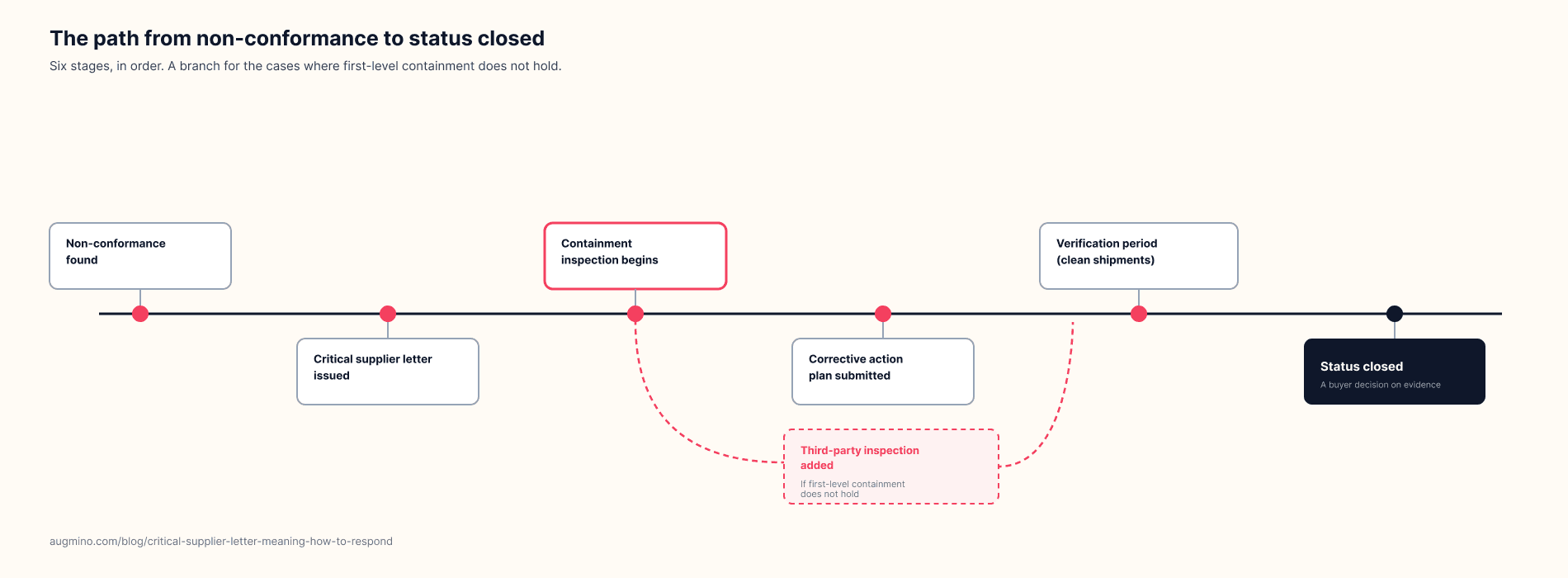
What a credible response actually looks like
Buyers in automotive and aerospace usually expect a structured response, most often built on the 8D format (eight disciplines). This is the same structure Ford, GM and several other automotive OEMs require as the standard corrective-action document. Aerospace suppliers use a similar structure as well. Some buyers use a shorter version of the same idea under a different name. The steps are almost always the same underneath.
| Step | What it means in plain terms | Example from the Coimbatore shop |
|---|---|---|
| Contain the problem | Stop suspect parts from shipping right now, before the cause is even known | 100% inspection of the bore diameter on every part before shipment, starting immediately |
| Describe the problem clearly | State exactly what went wrong, in terms the buyer can check for themselves | "Bore diameter measured 0.04mm over the drawing tolerance on 5 of 100 parts in lot 214" |
| Find the real root cause | Go past the first guess to the actual reason it happened | Worn boring bar insert was not replaced on schedule. The wear log had not been updated in three weeks |
| Fix the cause, not just the part | Correct what caused it, not only the parts already affected | Insert replacement interval shortened and added to a checklist, not left to memory |
| Verify the fix over real production | Confirm the fix holds across more than one job, not a single lucky run | Three following production runs measured 100%, zero out-of-tolerance parts |
| Prevent recurrence elsewhere | Apply the lesson to any other job that uses the same tooling or process | Same interval check added to two other machines running similar bores |
| Report back on the buyer's timeline | Send the written response back inside the window the letter asked for | Response submitted on day 12 of a 14-day window, with supporting inspection data attached |
A response that misses the containment step or that jumps straight to "we fixed it" without showing the root cause reads as incomplete even if the underlying fix was real. Buyers reading these responses professionally can tell the difference between a shop that understood its own process and one that is guessing.
What a defensive response looks like next to a credible one
| Defensive response | Credible response |
|---|---|
| Argues the letter's tone was unfair or overly harsh | Accepts the finding and responds to the substance, whether or not the tone felt fair |
| Blames the buyer's inspector or measurement method without evidence | Provides its own measured data and, if there is a real disagreement, requests a joint measurement instead of a verbal dispute |
| Says the problem was "a one-off" with no supporting data | Shows containment data proving the rate of the problem, not just an assurance |
| Goes quiet for days while working on a fix internally | Sends a short interim update inside 48 hours, even if the full response is still days away |
| Treats the request as an accusation to push back on | Treats the request as a specific, answerable question and answers it point by point |
The difference is not tone alone. A credible response can still push back on a specific factual error, as long as it brings its own evidence rather than disputing the letter's wording.
What not to do
Getting defensive is the single most common mistake. It is also understandable. A letter naming your shop "critical" feels personal even when it is describing a process, not a person. But disputing the letter's tone instead of addressing what it actually found rarely helps. It also uses up time that should go into containment and root cause work.
Going silent is the second common mistake. Buyers read silence as either avoidance or incompetence, neither of which is usually true, but the letter's clock does not pause while a shop works quietly in the background. A short interim note, even a one-line update saying containment is in place and full analysis is underway, keeps the relationship functional while the real work continues.
How a supplier gets removed from critical status
Buyers close out critical status the same way they open it, on evidence, not on a promise. The general shape across industries is a sustained run of clean performance, verified by the buyer, followed by a formal notice ending the status. What counts as "clean" varies. Some buyers set a defined number of consecutive shipments with no defects. Others set a time window, commonly measured in weeks, of on-time delivery and zero non-conformances. Heavier containment programs, sometimes called controlled shipping, add a second layer where an outside, buyer-approved inspector checks every shipment before the supplier's own inspection is trusted again. Moving off that heavier layer usually requires an even longer clean run than the standard exit.
The exact thresholds are set by the buyer, not by any single universal rule, so a supplier should ask directly what specific criteria will close the status rather than guessing. What stays constant is the logic behind it. The fix has to hold across real production, not just one measured sample, before the buyer is willing to put it in writing that the status is over.
Where this leaves you
A critical supplier letter is a real and recoverable part of a serious quality relationship, not a verdict on the shop that received it. What decides whether the account survives is not the letter and usually not even the original defect. It is whether the response shows the buyer a shop that found its own root cause, fixed it and proved the fix held.
For the quality management system that makes a fast, credible response like this possible before a letter ever arrives, see the ISO 9001 guide for Indian manufacturers. For the qualification paperwork this kind of oversight sits alongside in automotive supply chains, see the PPAP guide for precision turned parts.
See Also
Frequently asked questions
What is a critical supplier letter?
It is a formal notice from a buyer's quality team designating a supplier for closer oversight after a real performance problem, usually a repeated defect, a quality escape or a delivery pattern. See "What the letter actually signals" above for what usually sits behind it.
Why did I get a critical supplier letter if my delivery was actually on time?
Critical status is rarely triggered by one shipment. It usually reflects a pattern across more than one order or a single serious quality escape rather than a delivery issue. The triggers section above breaks down the most common causes.
What is the difference between a critical supplier letter and a SCAR?
A Supplier Corrective Action Request (SCAR) is one specific document format some buyers use to request this kind of formal response. A critical supplier letter is a broader designation that a SCAR often accompanies. The terminology section above explains how the naming varies by buyer.
What is an 8D report and do I have to use that exact format?
An 8D report is an eight-step corrective action format built around containment, root cause and prevention, required by name by several major automotive OEMs. Whether your specific buyer requires the exact 8D structure or a shorter version of the same logic is covered in the response-format section above.
What is controlled shipping and does every critical supplier get put on it?
Controlled shipping is a containment program where a supplier's shipments get inspected 100% before release, sometimes by an outside party the buyer approves. Not every critical-status case escalates to it. The exit-criteria section above explains when it applies and how a supplier moves off it.
How long does a supplier normally stay on critical status?
There is no single fixed period. Buyers typically require a sustained run of clean, verified performance, measured either in consecutive shipments or a time window, before formally closing the status. See "How a supplier gets removed from critical status" above.
Can a supplier dispute a critical supplier letter?
A supplier can raise a specific factual disagreement, such as a measurement method, if it brings its own supporting data. Disputing the letter's tone instead of its substance is the most common mistake suppliers make, covered in the "what not to do" section above.
Ready for fewer, better conversations?
Augmino connects verified Indian manufacturers with buyers who mean business.
Apply to Join