Sourcing Injection Molded Components from India: Material, Cycle Economics and Quality Verification


Three quotes come back for the same molded bracket. The prices are within 12 percent of each other. On paper, that looks like an easy comparison.
It usually isn't and the reason has nothing to do with the mold itself. Who owns the tool that produces this part is a real question and a separate one. This is about what's happening to the part, not the tool. It starts before any tool is even cut. The material spec, the cost math and the checks that tell you whether what came off the line is what you actually asked for.
Before You Compare Quotes: A Readiness Check
A molded-parts RFQ is not actually comparable across suppliers if any of the following are true. Most buyers find at least two.
- The material callout names a resin family ("PA66," "ABS") with no filler percentage.
- No one has confirmed whether the quoted price assumes any regrind content, or what the maximum allowable percentage is.
- The quote doesn't say which gate type the mold uses or where the gate sits on the part.
- No one has asked for a certificate of analysis per resin lot, only a generic "material certified" line.
- Cycle time is quoted as a single number with no note on what happens to price as volume changes.
- Quality criteria for sink marks, warpage or weld lines exist only as "good cosmetic finish" in the spec, with no measurable definition.
- The buyer has never seen the actual first-article part, only a sample from a similar tool or a prior run.
None of these make a supplier dishonest. They make three quotes into three different bets, priced as if they were the same one.
Material Selection: The Missing Number in "PA66-GF"
Two suppliers can both quote "PA66-GF," glass-fiber-reinforced nylon and mean materially different parts. Glass fiber raises tensile strength, stiffness and heat-deflection temperature over the unfilled resin. It also does the opposite of what a buyer usually wants in two other places. It reduces impact toughness and it restricts how well the material flows into thin-walled sections of the mold.
| Unfilled resin | Glass-filled resin | |
|---|---|---|
| Tensile strength / stiffness | Lower | Higher |
| Heat-deflection temperature | Lower | Higher |
| Impact toughness | Higher | Lower |
| Flow into thin-wall sections | Better | More restricted |
| Wear on mold steel over the tool's life | Lower | Higher, abrasive |
The line that's usually missing is the fill percentage. "PA66-GF" alone could mean 15 percent glass or 40 percent. Those two parts behave differently enough that a quote naming only the resin family isn't comparable to another quote for the same part. Ask for the fill percentage in writing, on the quote itself, not in a follow-up email after the order is placed.
A second hidden assumption sits next to fill percentage: whether the price assumes any regrind. Molders commonly blend reprocessed material, sprues, runners and rejected parts ground back down, into virgin resin, often in the 10-30 percent range, and a blend within that range doesn't necessarily compromise mechanical properties. The risk isn't regrind itself. It's a quote priced assuming regrind on a part that was supposed to be virgin-only, or a cosmetic part where regrind shows up as inconsistent gloss or color. State virgin-only or a maximum regrind percentage on the quote itself, the same way you'd state fill percentage.
The glass-fill question also touches the mold, not just the part. A higher fill percentage wears mold steel faster over the tool's working life, since the glass fiber is abrasive. That's a reason to ask a toolmaker about steel grade for a high-fill-percentage part, covered in more depth in the buyer's guide to qualifying a tool or mold maker.
One more assumption worth naming before tooling starts: resin-specific shrinkage. A mold is cut to account for the shrinkage rate of the specific resin grade named at the time. If that grade changes later, a cheaper compound, a different supplier's equivalent, a substitution made for availability, its shrinkage rate can differ enough to move final part dimensions. Confirm any resin substitution against the mold's original shrinkage allowance before a production run starts, not after parts arrive out of tolerance.
Cycle Economics: What Actually Moves the Price at Volume
The tooling cost on a molded part amortizes down as volume goes up. The arithmetic is simple enough to do on the quote itself. A $50,000 mold spread over 100,000 parts adds 50 cents to each one. The same mold spread over a million parts adds 5 cents. Ask what volume a quoted piece price assumes the tooling cost is amortized over, because a price that looks aggressive at 100,000 units can quietly assume a million.
Once tooling cost fades into the background at real production volume, cycle time becomes one of the largest remaining levers on per-part cost. It drives how many parts a machine can produce per hour. It also drives how many machine-hours a job actually consumes. A part that molds in 20 seconds and one that molds in 40 seconds are not close in cost even if every other input is identical. There's no reliable industry-wide percentage to attach to exactly how much of a part's cost cycle time represents. It varies too much by part geometry, machine size and material to state as a clean number. Any guide that gives you one is rounding from somewhere unverifiable. What's consistent is the direction. At volume, cycle time is worth negotiating on directly, not just accepting as a fixed property of the part.
Quality Checks Specific to a Molded Part
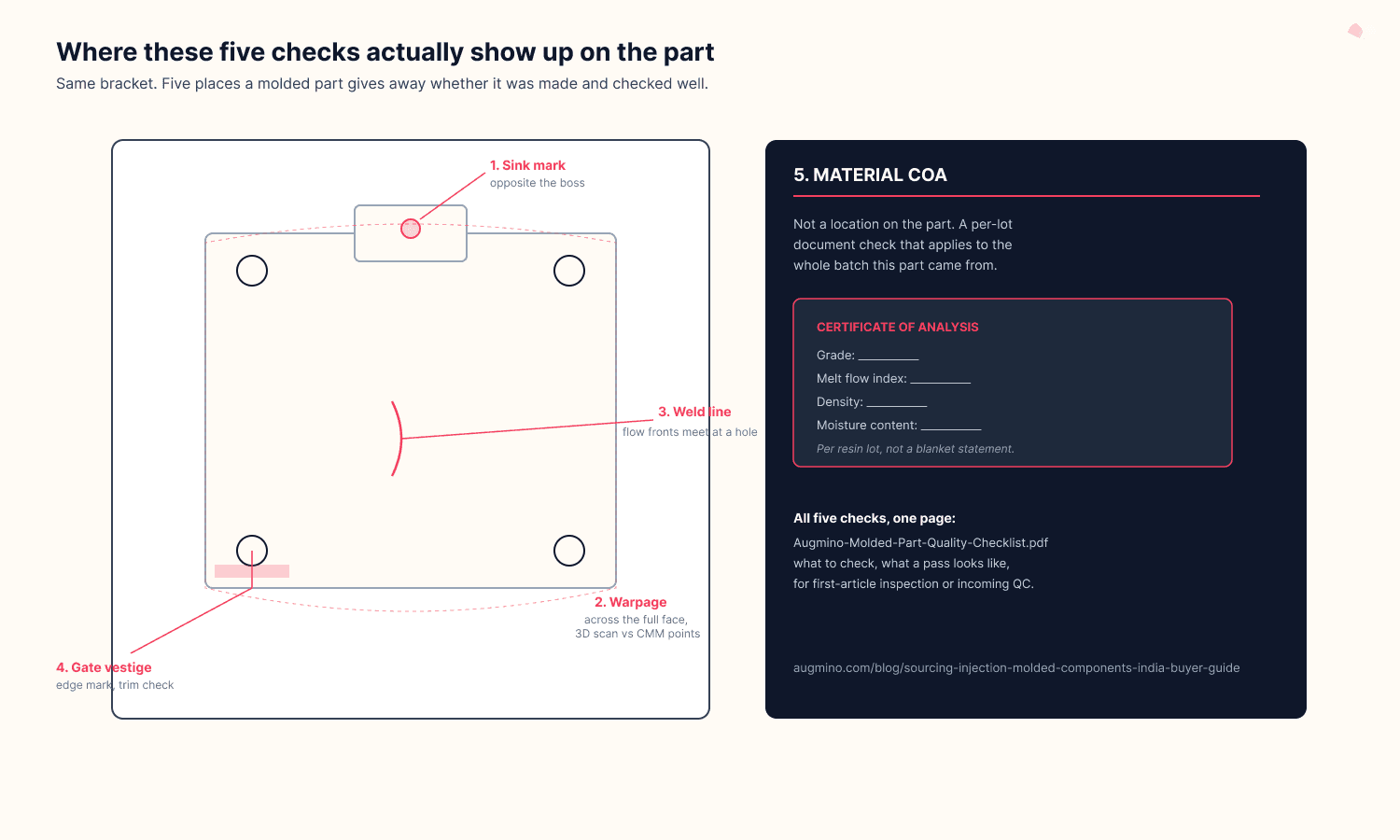
A molded part fails in a small number of recognizable ways. Each one has a specific verification method.
Sink marks. A shallow depression on the surface, usually opposite a rib or boss, caused by the thicker section cooling and shrinking more slowly than the surrounding wall. Checked visually and by surface profile measurement against the part's cosmetic-zone spec.
Warpage. The part cools unevenly and distorts from its intended shape, often from uneven wall thickness or a poorly placed gate. A coordinate measuring machine (CMM) checks warpage at specific datum points, but it's a point-based measurement. For a full picture of a part that's bowing or twisting across a broad surface, a 3D scan captures the whole shape, not just a handful of points.
Weld lines. Two flow fronts of molten material meet inside the mold and don't fully fuse, leaving a visible line and often a weaker spot at that seam. Where a weld line falls on the part matters. So does whether it lands somewhere structurally load-bearing. Both are real design and mold-flow questions worth asking a supplier about before tooling starts.
Gate vestige and location. Every gate leaves some mark on the part where the material entered the mold and how much depends on the gate type.
| Gate type | Typical vestige left behind | Common use |
|---|---|---|
| Edge gate | 0.5-2mm, usually requires manual trimming | Standard, non-cosmetic surfaces |
| Submarine (tunnel) gate | Self-shears to a light witness mark, roughly 0.1-1.5mm depending on tunnel design and resin | Cosmetic parts, where a trim mark would be visible |
If the part has a cosmetic face, ask where the gate sits and which type is planned. A gate placed on a visible surface with no plan to hide or minimize the vestige is a decision that should have been made with you, not around you.
Material certification. Ask for a certificate of analysis (COA) per resin lot, showing grade, melt flow index, density and moisture content, not a one-time "material certified" statement covering every batch indefinitely. Lot-level traceability matters more as order volume grows. It's the only record connecting a specific batch of finished parts back to the specific resin lot it came from, if a quality question surfaces later.
The Molded Part Quality Checklist
The five checks above are easier to run consistently from a one-page reference than from memory. That matters most at first-article inspection, when several things are being verified at once. The free download, Augmino-Molded-Part-Quality-Checklist.pdf, lays out all five with what to check and what a pass looks like, ready to print and keep on the inspection bench.
The Takeaway
A molded part's quote hides more assumptions than its price suggests. Four things decide whether two quotes are actually pricing the same part. The fill percentage behind a resin name. The gate type and where it sits. The volume a piece price is amortized over. Whether material traceability goes to the lot or just the order. Ask for each one in writing before comparing bids, not after choosing a supplier. The tooling question, covered in depth here, still needs its own answer. This is the other half.
Related reading
Download
Augmino Molded Part Quality Checklist
PDF · 3.8 KB
A 1-page checklist covering the five verification points in this guide, each with what to check and what a pass looks like, for use at first-article inspection or incoming QC
Ready for fewer, better conversations?
Augmino connects verified Indian manufacturers with buyers who mean business.
Apply to Join