Sourcing High-Mix, Low-Volume CNC Parts From India: A Buyer's Guide


A buyer qualifies a CNC shop in Rajkot for a prototype. Twelve parts, one design, three weeks. The parts come back within tolerance, the shop is responsive, the buyer moves the relationship into production.
Production, in this case, is not one part run in volume. It is forty different part numbers, each ordered in batches of twenty to fifty units. The schedule is monthly and rolling and it keeps changing which part comes next.
Six months in, changeovers are running long. A few part numbers are drifting out of spec between batches. The buyer is asking why the shop that nailed the prototype cannot seem to hold the same standard now.
The shop did not get worse. It was qualified for a different job. A prototype tests whether a supplier can make one part well, once. An ongoing high-mix, low-volume production relationship tests something else. It tests whether a supplier can hold quality and pace across many different parts, switching between them constantly, without treating each change as a fresh setup problem.
Why this is not the same decision as a prototype RFQ
If you are sourcing a single prototype run, a different guide covers that process. See our guide to managing prototype RFQs. That guide assumes you are comparing quotes for a one-time build.
This guide starts after that point. It is for a buyer who already has a qualified supplier or is evaluating one, for an ongoing high-mix, low-volume production relationship, sometimes shortened to HMLV. The part count is high. The volume per part is low. The mix keeps changing. That is a structurally different demand on a supplier than either a single prototype or a dedicated high-volume production line. It needs its own vetting questions.
What actually changes across the three stages
| Prototype | Ongoing HMLV production | High-volume production | |
|---|---|---|---|
| Vetting weight | Can this shop make one part correctly, once | Can this shop hold quality and pace switching between many parts on a rolling schedule | Can this shop sustain one part at scale, with formal audits and often a second source |
| Tooling approach | Minimal, sometimes throwaway fixturing built just for the sample | Flexible, quick-change fixturing that reconfigures across part families without a new engineering cycle each time | Dedicated, part-specific tooling, justified because the volume amortizes the cost |
| Quality system expectations | Looser, hand-checked, one-off inspection is normal | The same formal system used at any volume, applied consistently, not relaxed because a batch is small | The same system, at higher throughput, usually with statistical process control layered on |
The middle column is the one most buyers do not vet for directly. It does not look like a separate stage from the outside. A shop that is good at prototypes and a shop that is good at high-mix, low-volume production can look identical on a first factory visit. The difference shows up in how the shop is organized to switch between jobs, not in how well it does any single job.
What to ask about tooling
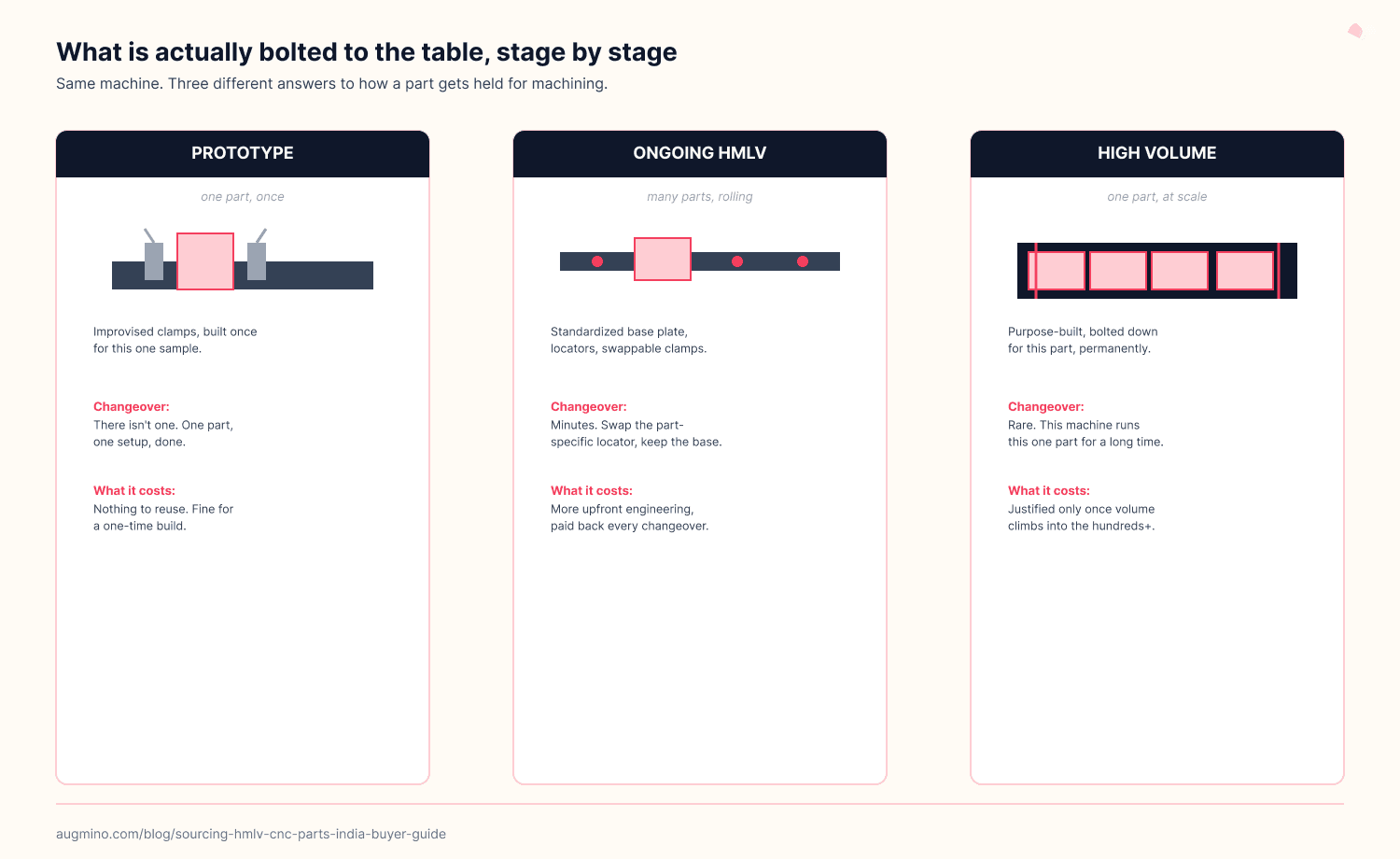
Picture a shop still running dedicated, job-specific fixtures for every part number in a forty-SKU rotation. That alone tells you something about its cost structure and its flexibility, before a single part is even made. Building a new fixture for every part in a low-volume, high-mix rotation adds engineering time and downtime to every single changeover. That is exactly the wrong cost to carry when the volume per part is small.
The shops that handle this well tend to invest in flexible, quick-change workholding instead. Think standardized base plates, zero-point clamping and locators that reconfigure across part families rather than requiring new tooling each time. The underlying discipline has a name, SMED (single-minute exchange of die), a decades-old changeover-reduction method that treats setup steps as things to be measured and shortened, not accepted as fixed. A shop that talks about changeovers in SMED-adjacent terms, what can be prepared before the machine stops versus what actually has to happen while it's stopped, is describing a system. A shop that has never heard the term is probably still treating changeover as downtime to be tolerated. The same discipline usually shows up in how a shop handles programming, not just fixturing. A shop that reuses CAM programs, fixture setups and inspection routines across similar part families is running a system, not starting from scratch on every job. Ask a supplier directly how they hold parts across their current mix, and whether job sequencing is planned to group similar setups together or left to whichever part is next on the list. Some shops now use scheduling software built for exactly this, sequencing jobs specifically to minimize changeover between similar setups, worth asking about directly rather than assuming it's handled by whoever runs the floor that day. A shop that has invested in quick-change tooling will usually describe changeovers as something they measure and actively work to shorten. A shop that has not will usually describe changeovers in terms of how long the machinist needs to set up the next job. It treats that time as an unavoidable cost, not something to engineer down.
Dedicated tooling is not wrong. It becomes worthwhile once a single part's volume climbs into the hundreds or beyond, where the fixed cost of building it amortizes across enough units to make sense. Watch for a mismatch in either direction. A shop applying high-volume tooling logic to a low-volume, high-mix book of work is one version. A shop still running prototype-style improvised fixturing on parts it has already been producing for months is the reverse.
Process flexibility matters here too, not just fixturing. A forty-part-number mix rarely stays within one machining process. Ask whether the shop can hold turning, milling and mill-turn work on its own floor, or whether a mixed rotation means routing some part numbers out to a different vendor. Every hand-off between shops adds its own lead time, its own quality handoff and its own chance for a part to sit in transit instead of on a machine, on top of whatever changeover discipline the primary shop already has.
What changes and what does not in the quality system
The instinct on a small batch is to relax the quality system a little. The stakes on twenty units feel lower than on two thousand. This is the wrong instinct for an ongoing HMLV relationship and it is worth checking for directly.
A first article inspection only tells you what you need to know when it's built on the actual production tooling and process, not a one-off setup used just for that first check. Suppose a supplier's first article for a new part number is built differently from how the remaining units will actually be run. If so, the inspection is not telling you what you think it is telling you. This is not just good practice, aerospace's AS9102 standard codifies it directly, including a requirement to re-verify a first article when a part comes back into production after a defined gap, the same question worth asking any HMLV supplier regardless of industry.
Documentation and traceability requirements do not need to reset for every new part number either. A supplier working under a formal quality system, such as AS9100D, is expected to carry material certification, lot traceability and process documentation across every part in its book. That holds at whatever volume that part is ordered in. This is about the quality-system discipline, not the inspection method used on any single batch, which can reasonably shift from full inspection toward sampling and statistical process control as a part's own volume grows. What should not shift is whether the documentation and traceability exist at all. The discipline that keeps a 2,000-unit run traceable is the same discipline a 20-unit batch needs, applied at a smaller scale, not a lighter one.
Keeping your prototype and ongoing production work with the same registered facility can avoid a second cost buyers often do not anticipate. Split that work across suppliers instead and you often pay the cost of requalifying a new supplier's quality system from scratch, every time a part moves from prototype to production, though how much of that cost is unavoidable depends on the industry and the certifications involved. If the shop that built your prototype already holds the right quality system for production work, that continuity is worth protecting.
The real question to ask a supplier before committing to ongoing HMLV work
Not "can you make this part." Ask instead how they run a week with six different part numbers. Ask what order they run them in and what changes between each one, and ask what happens when an urgent job needs to jump that order. A supplier with a real answer has actually built for this kind of work. That answer names four things. How they hold tooling. How they track which revision of which drawing is running. How a first article gets re-verified when a part comes back into rotation after a gap. And how a rush job gets inserted without quietly bumping every other part number's promised date. A supplier who answers with a version of "we just switch the fixture and go" has not.
Related reading
Download
Augmino HMLV Production Stage Decision Matrix
XLSX · 6.0 KB
A reference comparing what to check at each of 3 production stages across supplier vetting weight, tooling approach and quality-system expectations, for a buyer deciding whether their current supplier is actually built for the stage they are now asking them to run.
Frequently asked questions
What does high-mix low-volume (HMLV) manufacturing mean?
It describes a production pattern where a supplier makes many different part numbers, each in relatively small quantities. The schedule keeps changing which part comes next. It is distinct from a single prototype run and from a dedicated high-volume production line. It puts different demands on a supplier's tooling and scheduling discipline than either.
Is a prototype-qualified CNC supplier automatically ready for ongoing HMLV production?
Not automatically. A prototype tests whether a supplier can make one part correctly, once. Ongoing HMLV work tests something else. It tests whether the same supplier can hold quality and pace switching between many parts on a recurring schedule. That depends on how the shop is tooled and organized, not just on the skill shown in the prototype.
Should a supplier use dedicated tooling for a high-mix, low-volume order?
Usually not, until an individual part's volume grows large enough to justify the fixed cost of building tooling specific to it. Flexible, quick-change workholding that reconfigures across part families is generally the better fit while the mix stays high and the volume per part stays low.
Does a small batch need a lighter quality system than a large one?
No. The documentation, traceability and inspection discipline a formal quality system requires should apply at whatever volume a part is ordered in. A supplier that relaxes its process for small batches is introducing exactly the inconsistency a quality system exists to prevent.
Ready for fewer, better conversations?
Augmino connects verified Indian manufacturers with buyers who mean business.
Apply to Join